Imagine receiving a message that says, “That’s against TOS” or “Read the TOS before signing up.” If you are unfamiliar with internet slang and online terminology, the abbreviation TOS can be confusing.
Some people think it is a casual texting phrase, while others assume it is related to gaming or social media rules.
In reality, TOS has a very specific meaning that appears across text messages, online communities, apps, websites, gaming platforms, and business discussions.
Understanding it can help you avoid misunderstandings, follow platform rules, and communicate more confidently online.
This guide explains TOS meaning in text in simple language. You will learn its primary definition, secondary meanings, how people use it in different situations, what tone it conveys, and when you should or should not use it.
You will also see real conversation examples, related abbreviations, and practical usage tips so that you can recognize TOS instantly whenever it appears in a message, post, or online discussion.
Quick Definition of “TOS”
Quick Answer
Most common
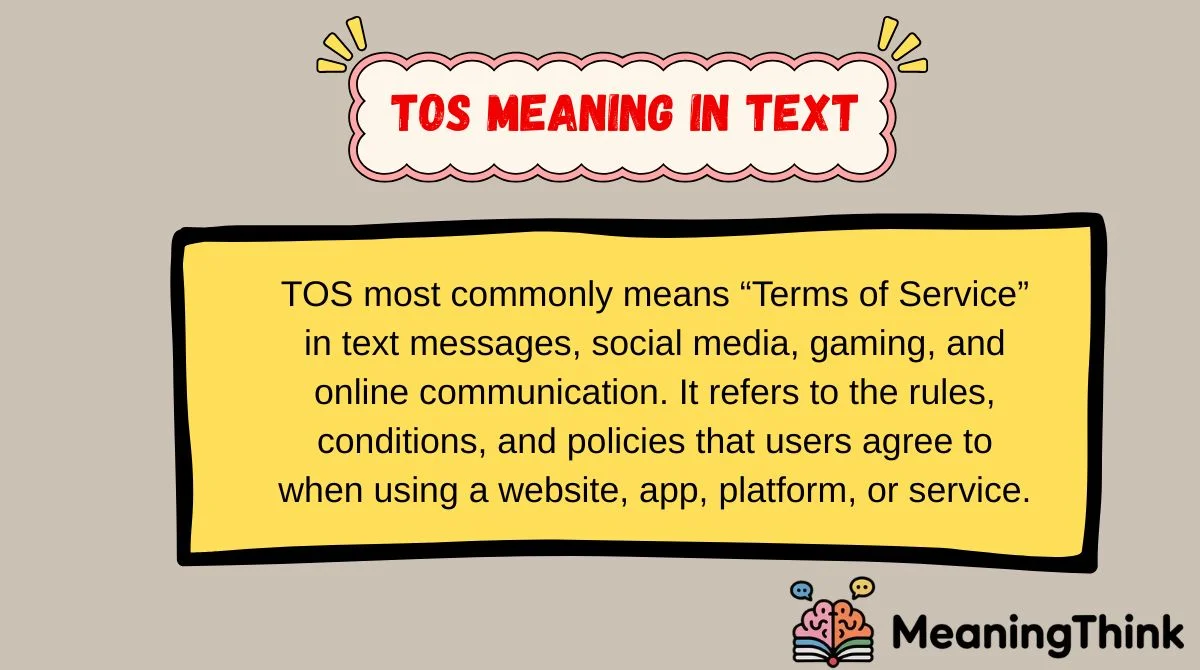
TOS most commonly means “Terms of Service” in text messages, social media, gaming, and online communication. It refers to the rules, conditions, and policies that users agree to when using a website, app, platform, or service.
Less commonly, TOS can have other meanings depending on the context, such as “Terms of Sale” in business settings or “The Original Series” in certain entertainment discussions. However, “Terms of Service” is by far the most widely used meaning online.
Detailed Meaning Breakdown
Primary Meaning: Terms of Service
When someone writes TOS, they are usually referring to the legal and behavioral rules that govern a platform or service.
Examples include:
- Social media rules
- Gaming platform policies
- App usage agreements
- Website account regulations
- Community guidelines
Example
Primary usage
“Your account could be banned for violating the TOS.”
Here, TOS clearly means the platform’s official rules.
Secondary Meaning: Terms of Sale
In business, e-commerce, or contract discussions, TOS may refer to Terms of Sale.
Example
Business context
“Please review the TOS before placing the order.”
In this context, it refers to payment, shipping, refunds, and purchasing conditions.
Rare Meaning: The Original Series
Fans of television franchises sometimes use TOS to mean The Original Series.
Example
Entertainment
“I still prefer TOS over the newer versions.”
This meaning is much less common in general texting.
What “TOS” Means in Different Situations
Everyday Texting
In casual conversations, people usually use TOS when talking about online accounts, apps, or rules.
Example
Texting
“Don’t use that bot. It breaks the TOS.”
Meaning: The bot violates the platform’s rules.
Social Media Platforms
On platforms like Instagram, TikTok, X, and Reddit, TOS often appears in discussions about bans, content removal, or account restrictions.
Example
Social media
“That post was removed because it violated TOS.”
Meaning: The content broke the platform’s official rules.
Dating & Relationships
In dating conversations, TOS is uncommon but may appear when discussing dating apps.
Example
Dating apps
“Fake profiles are against the app’s TOS.”
Meaning: The app does not allow fake accounts.
Professional Communication
In workplace emails or business chats, TOS may refer to legal agreements or service conditions.
Example
Professional
“Please sign the TOS before activating the account.”
Meaning: Review and accept the Terms of Service agreement.
Cultural or Regional Differences
TOS is largely an international internet abbreviation. Users in North America, Europe, Asia, and many other regions recognize it as Terms of Service because major online platforms use similar terminology.
Psychological & Tone Analysis
Why People Use It
People use TOS because it is short and widely understood in online communities. Instead of typing “Terms of Service” repeatedly, they use the abbreviation.
What It Signals Socially
Using TOS often signals that the speaker:
- Is familiar with internet culture
- Understands platform rules
- Is discussing policy or moderation
- May be warning others about potential consequences
Emotional Layer Behind It
The emotional tone is usually neutral. However, depending on context, it can carry:
| Tone | Example |
|---|---|
| Warning | “That’s against TOS.” |
| Frustration | “My account was banned for TOS issues.” |
| Advice | “Check the TOS first.” |
| Authority | “The platform enforces its TOS strictly.” |
15 Real Conversation Examples (Explained)
1. “That hack is against TOS.”
Warning
Explanation: The hack violates platform rules.
2. “Did you read the TOS?”
Question
Explanation: Asking whether someone reviewed the service agreement.
3. “Your account could be suspended for breaking TOS.”
Risk
Explanation: Warning about possible penalties.
4. “The seller updated their TOS.”
Business
Explanation: Refers to new terms or conditions.
5. “This bot is TOS-compliant.”
Approval
Explanation: The bot follows the platform’s rules.
6. “I got banned for a TOS violation.”
Penalty
Explanation: The user broke the rules.
7. “Make sure the giveaway follows TOS.”
Reminder
Explanation: Ensure the giveaway meets platform requirements.
8. “TOS says automated messaging isn’t allowed.”
Policy
Explanation: Quoting a specific rule.
9. “The new update changed the TOS.”
Update
Explanation: The service agreement was modified.
10. “Streaming that content may violate TOS.”
Caution
Explanation: It may break platform policies.
11. “The app removed my post under TOS.”
Moderation
Explanation: The post was removed for rule violations.
12. “Please accept the TOS to continue.”
Requirement
Explanation: Acceptance is required before using the service.
13. “That exploit isn’t allowed under TOS.”
Restriction
Explanation: The exploit breaks the rules.
14. “Read the TOS before buying.”
Purchase
Explanation: Review the terms related to the purchase.
15. “TOS changed after the merger.”
Corporate
Explanation: The company revised its service terms.
When “TOS” Can Be Misunderstood
Context Confusion
Someone discussing business contracts may mean Terms of Sale, while a gamer means Terms of Service.
Generational Gap
Younger internet users usually recognize TOS immediately. Older users may not know the abbreviation and may ask for clarification.
Platform Differences
| Platform | Likely Meaning |
|---|---|
| Gaming forums | Terms of Service |
| Social media | Terms of Service |
| E-commerce | Terms of Sale |
| Entertainment fandoms | The Original Series |
Always check the surrounding conversation.
Similar Words, Symbols, or Abbreviations
| Term | Meaning |
|---|---|
| TOS | Terms of Service |
| EULA | End User License Agreement |
| CG | Community Guidelines |
| AUP | Acceptable Use Policy |
| ToS | Alternative capitalization of TOS |
| T&C | Terms and Conditions |
| TOSV | Terms of Service Violation |
| Ban | Account restriction or removal |
| Strike | Official warning from a platform |
| Compliance | Following rules and policies |
When Not to Use “TOS”
Professional Risks
In formal legal documents, write Terms of Service in full the first time. Some readers may not recognize the abbreviation.
Cultural Risks
In international communication with non-technical audiences, the abbreviation may be unfamiliar.
Tone Risks
Avoid sounding accusatory.
Too harsh:
“You clearly violated TOS.”
Better:
“That might conflict with the platform’s TOS.”
Expert Tips for Using “TOS” Correctly
Best Practices
Use confidently
- Use it when discussing online rulesThis is the most common and universally understood context.
- Spell it out in formal documentsWrite “Terms of Service” first, then use TOS afterward.
- Check the audienceNot everyone is familiar with internet abbreviations.
- Avoid using it as a threatKeep the tone informative rather than confrontational.
- Provide context when necessaryExample: “The app’s TOS prohibits automation.”
- Be precise in business discussionsClarify whether you mean Terms of Service or Terms of Sale.
- Use standard capitalizationTOS or ToS are both acceptable, but stay consistent.
- Read the actual terms before referencing themMany people mention TOS without knowing the specific rule.
FAQs
What does TOS mean in text?
TOS usually means “Terms of Service.” It refers to the rules and conditions users agree to when using a website, app, game, or online platform.
What does TOS mean on social media?
On social media, TOS refers to the platform’s official rules, policies, and community standards.
What is a TOS violation?
A TOS violation occurs when a user breaks a platform’s rules, such as spamming, using unauthorized bots, posting prohibited content, or engaging in abusive behavior.
Is TOS the same as Terms and Conditions?
They are similar but not always identical. Terms and Conditions (T&C) is a broader phrase, while Terms of Service (TOS) specifically governs the use of a service or platform.
What does TOS mean in gaming?
In gaming, TOS almost always means Terms of Service, which includes rules about cheating, exploits, account sharing, and player conduct.
Can TOS mean something other than Terms of Service?
Yes. In business contexts it may mean Terms of Sale, and in entertainment discussions it can mean The Original Series. However, these meanings are less common.
Should I use TOS in professional emails?
It is better to write Terms of Service in full the first time you mention it, especially when communicating with clients or legal teams.
Why do people say “against TOS”?
People say “against TOS” to indicate that an action violates a platform’s official rules and could lead to warnings, content removal, or account suspension.
Final Summary
The abbreviation TOS most commonly stands for Terms of Service, the rules and conditions that govern the use of websites, apps, games, and online platforms.
It is widely used in texting, social media discussions, gaming communities, and professional online communication.
When you see phrases such as “against TOS,” “TOS violation,” or “read the TOS,” the speaker is almost always referring to platform rules. Less common meanings include Terms of Sale and The Original Series, so context is important.
To use TOS confidently:
- Assume it means Terms of Service unless the context suggests otherwise.
- Spell it out in formal or legal communication.
- Use it neutrally when discussing policies and rules.
- Clarify the meaning in business discussions where Terms of Sale could also apply.
Understanding TOS meaning in text helps you navigate online conversations, avoid confusion, and communicate more effectively across social media, gaming platforms, and professional digital environments.