You are texting a friend, and they reply with mkay. Suddenly, you pause. Are they agreeing? Are they annoyed? Are they ending the conversation? This tiny four-letter reply can create surprising confusion.
In modern texting, short responses often carry emotional meaning beyond the dictionary definition. Mkay is one of those expressions. Depending on the context, it can sound friendly, casual, impatient, sarcastic, or simply neutral.
Many people know okay or ok, but mkay feels slightly different. It adds a conversational tone that changes how the message is received. Younger users frequently use it in chats, social media comments, gaming conversations, and casual online discussions.
This guide explains exactly what mkay meaning in text is, how people use it, what emotional signals it can send, and when you should avoid using it. By the end, you will be able to interpret mkay correctly and use it confidently in your own messages.
Quick Definition of “Mkay”
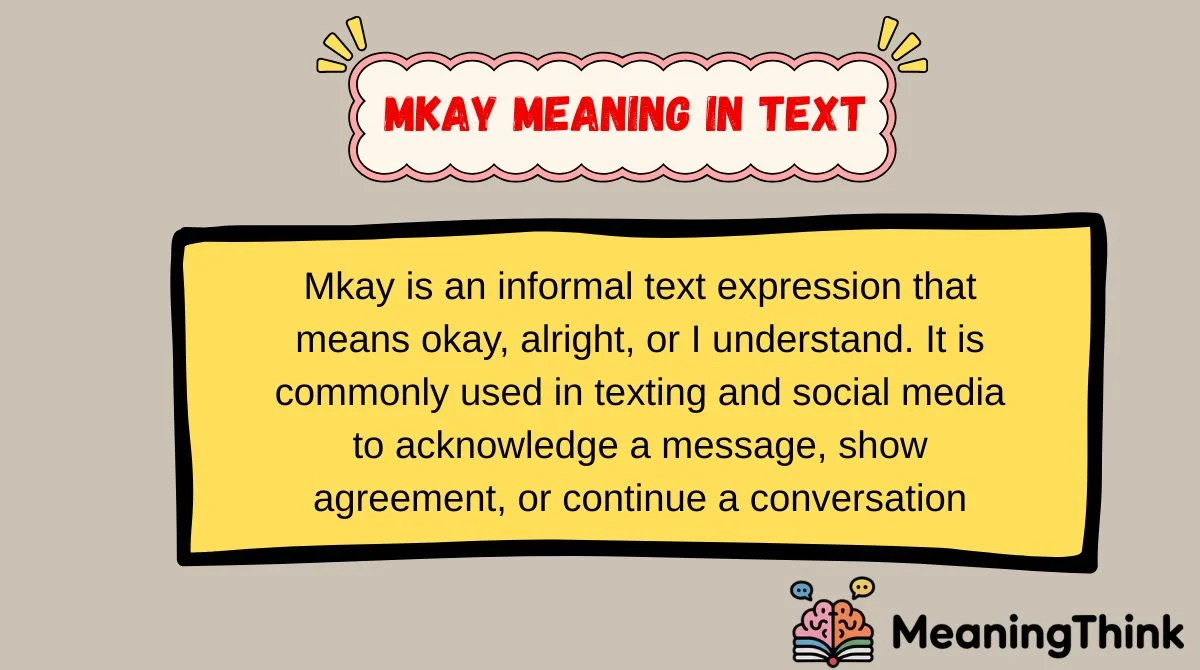
Mkay is an informal text expression that means okay, alright, or I understand. It is commonly used in texting and social media to acknowledge a message, show agreement, or continue a conversation. Depending on the context and punctuation, it can also sound playful, reluctant, sarcastic, or mildly dismissive.
Detailed Meaning Breakdown
Primary meaning
The primary meaning of mkay is simply okay.
Example
Neutral
Person A: “Can you send the file tonight?”
Person B: “Mkay.”
Meaning: “Yes, that’s fine.”
In this form, it is a casual acknowledgment with no strong emotional message.
Secondary meanings
1. Reluctant agreement
A: “Let’s leave at 6 a.m.”
B: “Mkay…”
Meaning: “I’ll do it, but I’m not excited about it.”
2. Conversation filler
A: “First we’ll meet, then we’ll drive to the venue.”
B: “Mkay, got it.”
Meaning: “I’m following what you’re saying.”
3. Playful acknowledgment
A: “You owe me coffee.”
B: “Mkaaay 😂”
Meaning: Lighthearted acceptance.
Rare meanings
Rarely, mkay can be used sarcastically.
A: “I’m definitely going to become a millionaire by tomorrow.”
B: “Mkay…”
Meaning: “I don’t really believe that.”
This interpretation usually depends on the surrounding conversation and punctuation.
What “Mkay” Means in Different Situations
Everyday Texting
In regular text conversations, mkay usually means okay.
“I’ll call you after dinner.”
“Mkay.”
The tone is informal and relaxed.
Social Media Platforms
On platforms like Instagram, TikTok, X, and Snapchat, mkay is often used in comments and replies.
“Another gym selfie?”
“Mkay 😏”
Here it may carry humor, teasing, or mild sarcasm.
Dating & Relationships
In romantic conversations, the tone becomes more important.
“I miss you.”
“Mkay ❤️”
Warm and playful.
“We need to talk.”
“Mkay.”
Could sound cautious, uncertain, or emotionally distant.
Professional Communication
Using mkay in work emails or formal business messages is generally not recommended.
Less professional: “Mkay, I’ll review it.”
Better: “Okay, I’ll review it.”
Many professionals may interpret mkay as too casual.
Cultural or Regional Differences
Mkay is most common in English-speaking online culture. Some non-native English speakers may not recognize it immediately and could mistake it for a typo. In international communication, okay is usually clearer.
Psychological & Tone Analysis
People choose mkay instead of okay for several reasons.
Why people use it
- To sound more casual.
- To make the conversation feel conversational.
- To soften a response.
- To avoid sounding overly formal.
- To add personality to a message.
What it signals socially
| Form | Likely Signal |
|---|---|
| mkay | Casual agreement |
| mkay! | Friendly enthusiasm |
| mkay 🙂 | Warm acknowledgment |
| mkay… | Hesitation or reluctance |
| MKAY | Emphasis, annoyance, or joking exaggeration |
Emotional layer behind it
Unlike ok, which can feel abrupt, mkay often sounds slightly softer and more human. However, if used without additional context, it can also feel dismissive because of its brevity.
15 Real Conversation Examples (Explained)
1
“I’ll be there at 8.”
Reply: “Mkay.”
Explanation: Simple acknowledgment.
2
“Can you bring snacks?”
Reply: “Mkay 👍”
Explanation: Friendly agreement.
3
“We have a surprise test tomorrow.”
Reply: “Mkay…”
Explanation: Reluctant acceptance.
4
“I’m deleting social media.”
Reply: “Mkay 😅”
Explanation: Mild amusement.
5
“Don’t forget the meeting.”
Reply: “Mkay, thanks.”
Explanation: Polite acknowledgment.
6
“I’m the best gamer here.”
Reply: “Mkay 😂”
Explanation: Playful disbelief.
7
“Let’s reschedule.”
Reply: “Mkay.”
Explanation: Neutral agreement.
8
“I bought another pair of shoes.”
Reply: “Mkaaay 😏”
Explanation: Teasing response.
9
“Please finish the report today.”
Reply: “Okay, I will.”
Explanation: Better than “mkay” in a professional setting.
10
“I miss hanging out with you.”
Reply: “Mkay ❤️”
Explanation: Affectionate acknowledgment.
11
“You should sleep earlier.”
Reply: “Mkay mom 😂”
Explanation: Playful compliance.
12
“I’m moving to another city.”
Reply: “Mkay… wow.”
Explanation: Processing surprising news.
13
“Watch this video.”
Reply: “Mkay, sending feedback in a minute.”
Explanation: Acknowledgment plus action.
14
“I’m definitely going to win the lottery.”
Reply: “Mkay 😆”
Explanation: Friendly skepticism.
15
“See you tomorrow!”
Reply: “Mkay, night!”
Explanation: Casual conversation ending.
When “Mkay” Can Be Misunderstood
Context confusion
“Mkay.” can mean:
- Yes
- Fine
- I guess
- Whatever
- I’m listening
Without additional words or emojis, the reader must guess the tone.
Generational gap
| Age Group | Likely Interpretation |
|---|---|
| Teens & young adults | Casual and normal |
| Middle-aged users | Informal but understandable |
| Older users | Possibly unfamiliar or odd |
Platform differences
| Platform | Common Tone |
|---|---|
| Snapchat | Playful |
| TikTok | Humorous |
| Casual | |
| Discord | Conversational |
| Potentially unprofessional |
Similar Words, Symbols, or Abbreviations
| Term | Meaning |
|---|---|
| ok | Basic acknowledgment |
| okay | Standard agreement |
| k | Very short acknowledgment |
| kk | Friendly acknowledgment |
| alr | Alright |
| aight | Informal “alright” |
| gotcha | I understand |
| bet | Agreed / sounds good |
| 👍 | Agreement or approval |
| 👌 | Everything is fine |
When Not to Use “Mkay”
Professional risks
Avoid it in:
- Job applications
- Client emails
- Formal reports
- Business proposals
- Official workplace communication
Cultural risks
International colleagues or customers may not understand mkay. Use okay instead for clarity.
Tone risks
Avoid mkay when discussing:
- Serious problems
- Medical issues
- Financial matters
- Conflicts
- Emotional conversations
Example
“My surgery is tomorrow.”
“Mkay.”
This could sound cold or insensitive.
Expert Tips for Using “Mkay” Correctly
- Use it with friends, not formal contacts.
- Add emojis if you want a warmer tone.
- Avoid using it as the only reply in serious discussions.
- Use “mkay!” when you want to sound upbeat.
- Use “mkay…” only if you intentionally want to show hesitation.
- Remember that punctuation changes the meaning.
- Choose “okay” instead when clarity matters.
- Match the other person’s communication style.
FAQs
What does mkay mean in a text message?
Mkay usually means okay, alright, or I understand. It is an informal acknowledgment used in casual conversations.
Is mkay rude?
Not necessarily. It is often friendly and casual. However, if used without context or during a serious conversation, it can seem dismissive or uninterested.
What is the difference between ok and mkay?
Ok is a straightforward acknowledgment. Mkay adds a more conversational, relaxed, or playful tone.
What does mkay mean from a girl?
It usually means okay, but the tone depends on context. It could be friendly, teasing, hesitant, or affectionate depending on the message and punctuation.
What does mkay mean from a guy?
In most cases, it simply means okay or got it. Tone clues such as emojis, capitalization, and punctuation help determine whether it is playful, neutral, or sarcastic.
Can mkay be sarcastic?
Yes. Mkay… or MKAY can sometimes express disbelief, annoyance, or sarcasm.
Is mkay professional?
Generally no. Use okay, certainly, or understood in professional communication.
Why do people say mkay instead of okay?
People often use mkay to sound more relaxed, conversational, playful, or expressive than a plain okay.
Final Summary
Mkay meaning in text is usually a casual version of okay. It can show agreement, understanding, acknowledgment, or a relaxed conversational tone.
The exact meaning depends heavily on punctuation, emojis, and the surrounding context.
Use mkay when chatting with friends, commenting on social media, or having informal conversations. Be more careful in professional settings or serious discussions, where a simple okay or understood is clearer and more appropriate.
The smartest approach is to read the emotional context, not just the word itself. A cheerful “Mkay! 😊” feels very different from a hesitant “Mkay…”. Once you recognize those tone signals, interpreting and using mkay becomes easy and natural.