If you’ve ever received a message that simply said “FU”, you may have paused before replying.
In one conversation, it could be a playful joke between close friends. In another, it might be an insult. This is why the abbreviation often causes confusion.
Texting language changes quickly. People shorten words, create new slang, and use abbreviations that depend heavily on context.
FU is one of those terms that can carry very different meanings depending on who sent it, where it was used, and the tone of the conversation.
In most cases, FU is understood as a shortened form of a vulgar insult.
However, online communities, gaming groups, and younger users sometimes use it jokingly, sarcastically, or with a completely different meaning. Because of these variations, understanding context is essential.
This guide explains exactly what FU means in text messages, social media posts, dating conversations, and professional settings. You’ll also see real examples, learn when the term can be misunderstood, and discover the safest way to interpret it in modern digital communication.
Quick Definition of “FU”
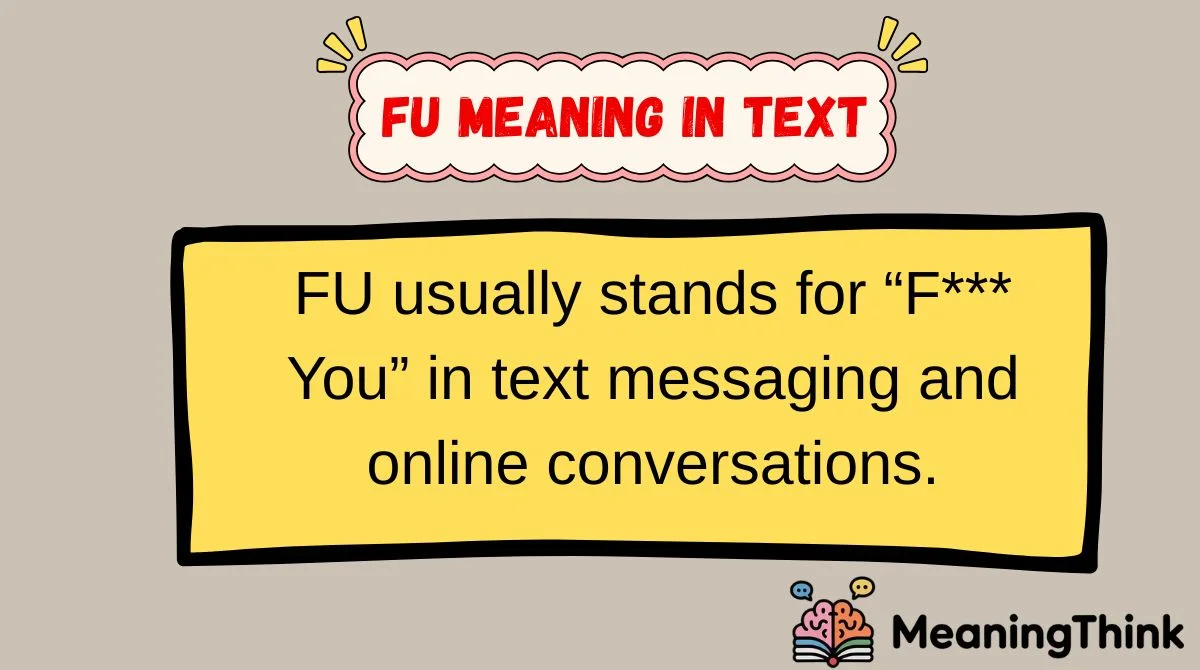
FU usually stands for “F*** You” in text messaging and online conversations.
It is commonly used as an insult, expression of anger, or sarcastic joke. In some online communities, it may be used playfully between friends or have alternative niche meanings, but the offensive interpretation is the most widely recognized.
Detailed Meaning Breakdown
Primary Meaning: “F*** You”
Most common
This is the meaning most people will assume when they see FU.
Example: “You took my spot again? FU.”
In this context, the sender is expressing anger, frustration, or hostility. The abbreviation softens the spelling slightly, but the message is still considered rude or offensive.
Secondary Meaning: Playful or Sarcastic Banter
Friends only
Close friends sometimes use FU jokingly.
Example: “You beat me at the game again? FU 😂”
Here, the emoji changes the tone. The sender is not seriously angry; they are teasing a friend.
Alternative Community Meanings
Rare
In some niche groups, FU may stand for:
- Follow Up
- Friendly Update
- Fan Unit
- Fuel Unit
These meanings are uncommon in casual texting. Unless the conversation is clearly about business, technology, gaming, or another specialized topic, people generally interpret FU as the offensive phrase.
Rare Meanings
Context needed
In workplace notes or project discussions, someone might write:
“Please send an FU on the client request.”
In that situation, FU means follow-up, not the vulgar expression.
What “FU” Means in Different Situations
Everyday Texting
Among friends, FU often appears during teasing, arguments, or competitive situations.
Example
Everyday
Friend A: “I ate the last slice of pizza.”
Friend B: “FU 😭”
Meaning: Friend B is annoyed, but the crying emoji suggests a humorous reaction rather than genuine hostility.
Social Media Platforms
On platforms like TikTok, Instagram, X, Reddit, or Discord, FU can be:
- A reaction to a post
- A joke between followers
- A comment expressing disagreement
- A meme-based response
Tone is often harder to judge because facial expressions and voice are absent.
Dating & Relationships
In romantic conversations, context becomes especially important.
Example
Dating
Partner A: “I forgot our movie night.”
Partner B: “FU.”
Possible meanings:
- Genuine anger
- Playful exaggeration
- Sarcastic disappointment
The relationship history determines which interpretation is correct.
Professional Communication
In business settings, FU should generally not be used because many readers will assume the offensive meaning.
Instead of writing:
“Sending an FU tomorrow.”
Write:
“Sending a follow-up tomorrow.”
This avoids confusion and maintains professionalism.
Cultural or Regional Differences
English-speaking internet users around the world usually recognize FU as the vulgar phrase. In some regions, younger users may treat it more casually, but older generations often view it as highly disrespectful.
Psychological & Tone Analysis
Why People Use It
People choose FU because it is:
- Short
- Emotionally strong
- Easy to type
- Widely understood
What It Signals Socially
Depending on context, it may signal:
| Usage | Social Signal |
|---|---|
| With anger | Hostility |
| With emojis | Playfulness |
| With friends | Familiarity |
| In public comments | Strong disagreement |
| In work messages | Poor professionalism |
Emotional Layer
The abbreviation often carries stronger emotion than a neutral phrase such as “I’m upset.” Even when shortened, it communicates intensity.
15 Real Conversation Examples (Explained)
1
“You deleted my save file? FU.”
Angry
Explanation: Genuine frustration.
2
“FU 😂 you won again.”
Joking
Explanation: Friendly teasing.
3
“FU for spoiling the ending.”
Annoyed
Explanation: Mild to moderate annoyance.
4
“Can you send an FU on the proposal?”
Workplace
Explanation: Means follow-up.
5
“FU 😜”
Flirty
Explanation: Playful sarcasm.
6
“Seriously? FU.”
Hostile
Explanation: Likely intended as an insult.
7
“FU, I’m stealing your fries.”
Playful
Explanation: Lighthearted banter.
8
“FU. Don’t text me again.”
Severe
Explanation: Strong rejection.
9
“Need an FU after the meeting.”
Business
Explanation: Follow-up request.
10
“FU bro 🤣”
Friends
Explanation: Friendly joking.
11
“FU for making me laugh in class.”
Playful
Explanation: Not offensive.
12
“FU, that was my parking spot.”
Annoyed
Explanation: Real irritation.
13
“FU ❤️”
Sarcastic
Explanation: Contradictory emoji suggests humor.
14
“Client requested an FU email.”
Professional
Explanation: Follow-up email.
15
“FU 🙄”
Sarcastic
Explanation: Eye-roll emoji indicates sarcastic annoyance.
When “FU” Can Be Misunderstood
Context Confusion
Without emojis or additional words, the meaning is unclear.
Example: “FU”
Is it a joke? An insult? A follow-up request? Context is missing.
Generational Gap
Younger users may interpret it as casual banter, while older users often see it as highly offensive.
Platform Differences
| Platform | Common Interpretation |
|---|---|
| Discord | Joking or gaming banter |
| Instagram DMs | Depends on relationship |
| Inappropriate | |
| Work email | Confusing or unprofessional |
| Often blunt or sarcastic |
Similar Words, Symbols, or Abbreviations
| Term | Meaning |
|---|---|
| WTF | Expression of surprise or frustration |
| IDK | I don’t know |
| SMH | Shaking my head |
| LMAO | Laughing very hard |
| BRB | Be right back |
| GTFO | Get out (often rude) |
| STFU | Stronger offensive command |
| ILY | I love you |
| JK | Just kidding |
| TBH | To be honest |
When Not to Use “FU”
Avoid using “FU” in these situations
High risk
Professional Risks
- Emails to clients
- Messages to managers
- Job applications
- Formal workplace chats
Cultural Risks
Some cultures view any version of the phrase as extremely disrespectful, even if abbreviated.
Tone Risks
Because text lacks vocal tone, a joke can easily be interpreted as aggression.
Expert Tips for Using “FU” Correctly
- Know your audience. Close friends may understand the joke; strangers may not.
- Use emojis carefully. Emojis can soften the tone but do not guarantee the message will be understood as playful.
- Avoid it in professional settings. Write out “follow-up” instead.
- Consider the relationship. What works with a best friend may damage a new relationship.
- If angry, pause before sending. Abbreviations can escalate conflict quickly.
- When in doubt, choose clearer wording. “I’m frustrated” is less likely to be misunderstood.
- Read the conversation history. Previous messages often reveal whether the tone is serious or playful.
- Remember that screenshots last forever. Casual slang can be shared beyond the original conversation.
FAQs
Does FU always mean “F*** You”?
No. While that is the most common meaning, it can also mean follow-up or other niche terms in specific professional or technical contexts.
Is FU offensive?
Usually yes. Most people consider it a rude or offensive expression unless it is clearly being used jokingly between friends.
What does FU mean from a girl?
The meaning depends on the context, relationship, emojis used, and the rest of the conversation. It could be playful teasing, sarcasm, or genuine anger.
What does FU mean on TikTok?
On TikTok, it is often used as a humorous reaction, sarcastic comment, or expression of frustration.
Can FU mean follow-up?
Yes. In business communication, some people use FU as shorthand for follow-up. However, writing the full phrase is safer.
Is FU the same as STFU?
No. STFU is generally considered stronger and more aggressive than FU.
Should I reply if someone texts FU?
First determine the tone. If it appears playful, a lighthearted response may be appropriate. If it seems hostile, it may be better to ask for clarification or avoid escalating the conversation.
Can FU get someone in trouble at work?
Yes. Because many people interpret it as an offensive insult, using it in workplace communication can appear unprofessional and may lead to complaints or disciplinary issues.
Final Summary
FU is a short abbreviation with a surprisingly wide range of meanings, but the most common interpretation is “F*** You.”
In casual texting, friends may use it jokingly with emojis or sarcasm. In arguments, it often expresses real anger. In business settings, it may occasionally mean follow-up, but that usage is far less common.
The key to understanding FU is context. Look at the relationship between the people, the platform, the surrounding messages, and any emojis included. A laughing emoji can completely change the tone, while a short standalone “FU” may sound much harsher.
For safe and effective communication, avoid using FU in professional environments and with people who may not understand your intended tone. When clarity matters, write out your message directly instead of relying on ambiguous slang.
Understanding abbreviations like FU helps you read online conversations more accurately, avoid misunderstandings, and communicate with greater confidence in today’s fast-moving digital world.