You’re chatting with a friend when they suddenly reply with “TMM.” You pause for a second and wonder, What does TMM mean? Is it a typo? A slang term? Or does it have a hidden meaning that everyone else seems to understand?
Text abbreviations have become a normal part of online communication. From Snapchat and Instagram to WhatsApp, TikTok, Discord, and Messenger, people often shorten words to save time or add personality to their messages.
The challenge is that many abbreviations have more than one meaning, and TMM is one of them.
Understanding TMM meaning in text depends on the conversation, the relationship between the people chatting, and sometimes even the platform they’re using. The same three letters can express affection in one conversation and simply refer to “tomorrow” in another.
This guide explains everything you need to know about TMM meaning in text, including its primary definition, alternative meanings, where it’s commonly used, the tone it conveys, and real-life conversation examples so you can recognize and use it confidently.
Quick Definition of “TMM”
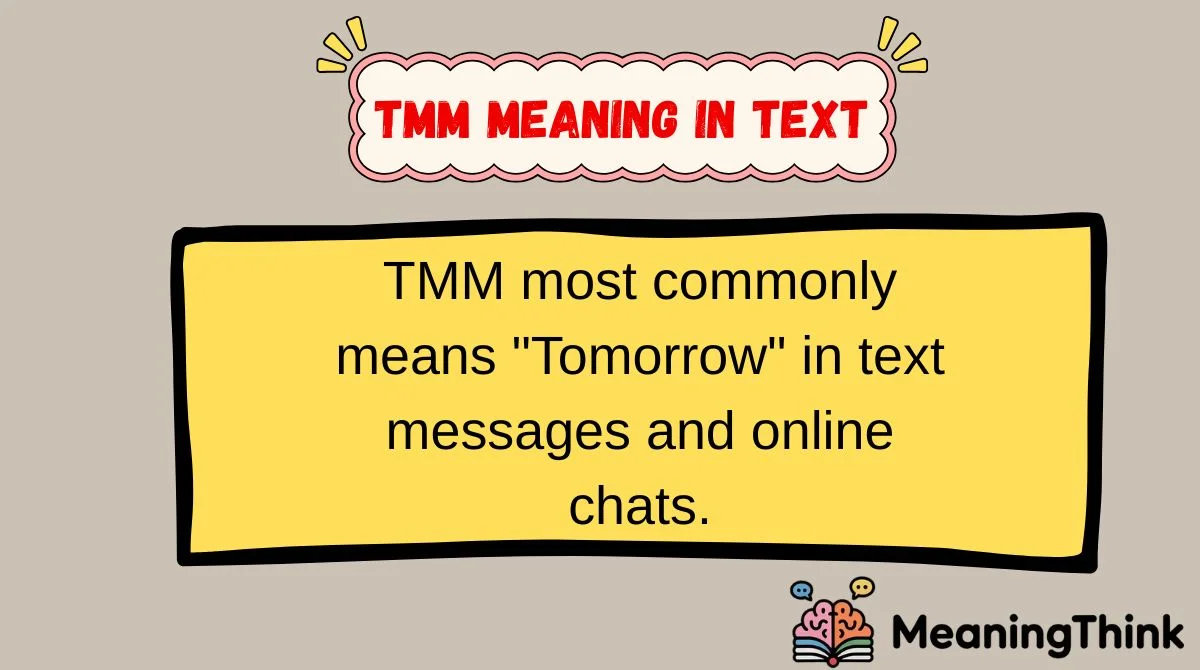
TMM most commonly means “Tomorrow” in text messages and online chats. People use it as a quick shorthand when discussing future plans or postponing something until the next day.
Depending on the conversation, TMM can also represent other phrases, personal nicknames, gaming terms, business abbreviations, or community-specific meanings. However, when used in everyday texting and social media, “tomorrow” is by far the most common interpretation.
Detailed Meaning Breakdown
Primary Meaning: Tomorrow
The most widely accepted meaning of TMM is “tomorrow.”
Instead of typing the full word, people shorten it to TMM to make conversations faster, especially when chatting on mobile devices.
Examples
- I’ll send it TMM.
- Let’s meet TMM.
- Talk to you TMM.
- My package arrives TMM.
- I’ll call you TMM morning.
The meaning is usually obvious because it’s connected to future plans.
Why Do People Use TMM Instead of “Tomorrow”?
People choose abbreviations because they:
- Type faster
- Keep conversations casual
- Match internet slang
- Save time
- Follow texting habits used by friends
Modern texting often values speed over perfect spelling, making abbreviations like TMM common.
Secondary Meanings of TMM
Although “tomorrow” is the most common meaning, TMM may stand for different phrases depending on context.
Some possible secondary meanings include:
Too Much Money
Occasionally used jokingly.
Example:
I spent TMM this weekend.
Meaning:
The speaker spent too much money.
Tell Me More
Some users shorten Tell Me More as TMM.
Example:
That sounds interesting. TMM!
Meaning:
The speaker wants additional details.
Personal Initials
Many people use TMM as initials.
Example:
Designed by TMM.
Here, it doesn’t represent slang at all.
Business or Organization Name
Some companies and organizations use TMM as an abbreviation.
For example:
- Company names
- Internal departments
- Project titles
- Software systems
In these cases, the meaning depends entirely on the workplace or industry.
Rare Meanings
Rare meanings are uncommon in regular texting but may appear in specialized communities.
Examples include:
- Gaming abbreviations
- Academic programs
- Medical terminology
- Engineering projects
- Brand abbreviations
Unless the conversation relates to one of these topics, it’s usually safest to interpret TMM as tomorrow.
What “TMM” Means in Different Situations
Everyday Texting
This is where TMM appears most often.
Friends use it when discussing plans for the next day.
Examples:
- See you TMM.
- I’ll finish it TMM.
- Let’s eat together TMM.
- I’ll text you TMM evening.
- We can play TMM.
The tone is relaxed and friendly.
Social Media Platforms
On social media, TMM usually refers to tomorrow when people announce future content.
Examples include:
- New video TMM.
- Giveaway starts TMM.
- Live stream TMM.
- Results drop TMM.
- Big surprise TMM.
Common platforms include:
- TikTok
- Snapchat
- X
- Threads
Followers immediately understand that something is happening the next day.
Dating & Relationships
People often use TMM while making plans with someone they like.
Examples:
- Can’t wait to see you TMM ❤️
- Goodnight. Talk TMM.
- Miss you already. See you TMM.
- Dinner TMM?
- Our date is TMM.
The abbreviation keeps the message short while maintaining a warm, casual tone.
Professional Communication
Using TMM in professional settings requires caution.
While coworkers who know each other well might understand it, writing tomorrow in full is generally more appropriate in formal emails, reports, or client communication.
Informal Team Chat
- I’ll finish the report TMM.
Acceptable in casual workplace messaging.
Formal Email
Instead of:
I’ll send it TMM.
Write:
I’ll send it tomorrow.
Using complete words appears more professional and reduces the chance of confusion.
Cultural or Regional Differences
The popularity of TMM varies across countries and online communities.
In many regions, people prefer:
- Tmr
- Tmrw
- Tom
- Tomorrow
Meanwhile, some friend groups regularly use TMM as their preferred shorthand.
This is why context matters more than the abbreviation itself.
You may rarely see TMM in one community but encounter it daily in another.
Psychological & Tone Analysis
Abbreviations are about more than saving time. They also communicate a certain social style.
Understanding why people choose TMM helps you understand the tone behind the message.
It Creates a Casual Atmosphere
Typing “TMM” instead of “tomorrow” makes the conversation feel relaxed.
It suggests the speaker isn’t aiming for perfect grammar. They’re simply chatting naturally.
It Signals Digital Familiarity
People who regularly use abbreviations often spend significant time communicating online.
Using TMM shows they’re comfortable with internet language and texting culture.
It Makes Conversations Faster
Short messages encourage quick back-and-forth replies.
Instead of writing:
I’ll call you tomorrow after work.
Someone might type:
Call u TMM.
The meaning stays the same while reducing typing effort.
It Reflects Informal Relationships
You’re much more likely to see TMM between:
- Friends
- Siblings
- Couples
- Classmates
- Gaming teammates
People usually avoid it with strangers or formal contacts.
It Can Express Excitement
When someone says:
Can’t wait TMM!
The abbreviation keeps the message energetic and spontaneous.
It feels more conversational than writing the full word.
It Depends Entirely on Context
Unlike abbreviations with only one definition, TMM relies heavily on surrounding words.
For example:
Meeting TMM.
Clearly means tomorrow.
But:
TMM designed the logo.
Now it probably refers to initials or an organization.
Reading the complete conversation is always the best way to identify the correct meaning.
15 Real Conversation Examples (Explained)
1. Friend Planning
Alex: Want to grab coffee?
Emma: Sure, TMM works better.
Explanation: TMM means tomorrow, indicating the meeting should happen the next day.
2. Homework
Teacher: When will you submit it?
Student: I’ll upload it TMM.
Explanation: The student promises to submit the assignment tomorrow.
3. Family Chat
Mom: Are you visiting?
Son: Yes, TMM afternoon.
Explanation: The visit is planned for tomorrow afternoon.
4. Dating
Chris: Can’t wait to see you.
Mia: Same! See you TMM ❤️
Explanation: TMM confirms they have plans for the next day while adding an affectionate tone.
5. Gaming
Player 1: Another match tonight?
Player 2: Busy today. TMM?
Explanation: The player suggests playing tomorrow instead.
6. Work Chat
Manager: Status update?
Employee: Final version TMM morning.
Explanation: The employee expects the work to be completed tomorrow morning.
7. Group Project
Sara: Ready to practice?
John: Let’s do it TMM.
Explanation: The practice session has been postponed until tomorrow.
8. Shopping
Friend: Did your package arrive?
You: Nope, delivery is TMM.
Explanation: The expected delivery date is tomorrow.
9. Social Media
Follower: When’s the new vlog?
Creator: Uploading TMM!
Explanation: The creator announces that the new video will be published tomorrow.
10. Fitness
Coach: Gym today?
Athlete: Recovery day. Back TMM.
Explanation: The athlete plans to return to training the following day.
11. Travel
Friend: Are you leaving today?
Traveler: Flight is TMM morning.
Explanation: The departure is scheduled for tomorrow morning.
12. Study Session
Classmate: Library tonight?
You: Can’t today. TMM after class?
Explanation: You suggest meeting tomorrow after classes end.
13. Birthday Planning
Friend: Did you buy the gift?
You: Not yet. I’ll get it TMM.
Explanation: You plan to purchase the gift tomorrow.
14. Weekend Plans
Sibling: Movie tonight?
You: Let’s go TMM instead.
Explanation: You’re rescheduling the outing for the next day.
15. Casual Check-In
Friend: Want to talk?
You: I’m exhausted. Can we chat TMM?
Explanation: You’re politely asking to continue the conversation tomorrow, showing that TMM is a quick and friendly shorthand for “tomorrow.”
When “TMM” Can Be Misunderstood
Like many internet abbreviations, TMM doesn’t always have a single meaning. While most people use it to mean “tomorrow,” others may interpret it differently based on the conversation, platform, or personal experience. Understanding these situations helps you avoid confusion.
Context Confusion
The biggest reason TMM is misunderstood is that it can represent different phrases.
For example:
Message: “I’ll finish it TMM.”
Most readers will understand this as tomorrow.
However, if the conversation is about a company, project, or initials, TMM could refer to something completely different.
Always read the surrounding messages before deciding what the abbreviation means.
Generational Gap
Younger internet users are generally more familiar with text abbreviations than older generations.
For example:
- Teenagers may instantly recognize TMM as “tomorrow.”
- Parents or grandparents might think it’s a typo.
- Professionals may ask for clarification if they don’t use texting slang regularly.
If you’re communicating with someone who may not know internet abbreviations, it’s better to write tomorrow in full.
Platform Differences
Different online platforms have different slang cultures.
For example:
- WhatsApp chats often use abbreviations like TMM.
- Snapchat conversations are usually short and informal, making abbreviations common.
- Instagram DMs frequently include shorthand.
- Workplace apps such as Slack or Microsoft Teams may use fewer slang abbreviations in formal discussions.
Knowing your audience is just as important as knowing the abbreviation.
Regional Differences
Not every country uses the same texting shortcuts.
Some people prefer:
- TMR
- TMRW
- Tom
- Tomorrow
Others may use TMM every day.
Regional texting habits can affect how easily someone understands the abbreviation.
Similar Abbreviations
Sometimes TMM gets confused with abbreviations that look similar.
For example:
- TM = Tomorrow or Trademark
- TMI = Too Much Information
- TTYL = Talk To You Later
- TBH = To Be Honest
Reading the complete sentence usually removes any confusion.
Similar Words, Symbols, or Abbreviations
Here are ten abbreviations related to TMM meaning in text that you’ll often encounter in digital conversations.
| Abbreviation | Meaning |
|---|---|
| TMR | Tomorrow |
| TMRW | Tomorrow |
| TM | Tomorrow (informal) or Trademark, depending on context |
| TTYL | Talk To You Later |
| BRB | Be Right Back |
| IMO | In My Opinion |
| TBH | To Be Honest |
| IDK | I Don’t Know |
| BTW | By The Way |
| ASAP | As Soon As Possible |
These abbreviations are widely used in texting, gaming, social media, and instant messaging.
When Not to Use “TMM”
Although TMM is useful in casual conversations, it isn’t suitable for every situation.
Formal Emails
Avoid using TMM in professional emails.
Instead of writing:
I’ll send the proposal TMM.
Write:
I’ll send the proposal tomorrow.
Using complete words creates a more professional impression.
Job Applications
When communicating with recruiters or hiring managers, avoid internet slang.
Professional communication should always be clear and polished.
Academic Writing
Assignments, essays, research papers, and reports should never include texting abbreviations like TMM unless you’re specifically discussing internet slang.
Business Documents
Contracts, presentations, proposals, and official documents should use standard language.
Writing tomorrow removes any possibility of confusion.
International Communication
If you’re chatting with someone from another country, they may not recognize TMM.
Using the complete word improves clarity.
Serious Conversations
Topics involving health, legal matters, finances, or emergencies should avoid abbreviations that could be misunderstood.
For example, instead of saying:
I’ll explain TMM.
Write:
I’ll explain everything tomorrow.
This sounds clearer and more reassuring.
Expert Tips for Using “TMM” Correctly
Follow these practical tips to use TMM naturally and confidently.
1. Let Context Do the Work
Use TMM only when the sentence clearly refers to the next day.
Example:
See you TMM.
The meaning is immediately obvious.
2. Know Your Audience
Use abbreviations with friends, classmates, family, or people who regularly text.
Avoid them with clients, teachers, or unfamiliar contacts.
3. Keep Professional Messages Formal
Emails and business communication should spell out tomorrow instead of using TMM.
Professional writing values clarity over speed.
4. Avoid Overusing Abbreviations
If every sentence contains internet slang, your message may become difficult to read.
Balance abbreviations with complete words.
5. Read Before Sending
Check whether your sentence could have another interpretation.
If there’s any chance of confusion, replace TMM with tomorrow.
6. Match the Conversation Style
If everyone else is using abbreviations, TMM fits naturally.
If the conversation is formal, use complete words.
7. Stay Updated
Internet slang changes quickly.
An abbreviation that’s common today may become less popular over time, so staying familiar with current texting trends helps you communicate naturally.
8. Prioritize Clarity
Saving a few keystrokes isn’t worth creating confusion.
Whenever clarity matters, write the full word.
Frequently Asked Questions
What does TMM mean in text messages?
In most text conversations, TMM means “tomorrow.” People use it as a quick way to discuss plans or events happening the next day.
Does TMM always mean tomorrow?
No. While tomorrow is the most common meaning, TMM can also represent personal initials, company names, or other phrases depending on the context.
Is TMM popular on Snapchat and Instagram?
Yes. Many users on Snapchat, Instagram, WhatsApp, TikTok, and other messaging platforms use TMM as shorthand for tomorrow in casual conversations.
Can I use TMM in professional emails?
It’s better not to. Writing tomorrow in full is more professional and avoids confusion with colleagues or clients.
Is TMM considered internet slang?
Yes. TMM is an informal texting abbreviation commonly used in online chats, social media, and instant messaging.
How can I tell what TMM means in a conversation?
Look at the surrounding words and the topic being discussed. If the message is about future plans, TMM almost always means tomorrow.
What is the difference between TMM and TMR?
Both abbreviations usually mean tomorrow. The choice depends on personal preference or the texting style of a particular group.
Should I use TMM with people who don’t know internet slang?
No. If you’re unsure whether the other person understands texting abbreviations, writing tomorrow is the safer and clearer option.
Final Summary
Understanding TMM meaning in text is easier once you consider the context. In most everyday conversations, TMM simply means “tomorrow.”
It’s a convenient abbreviation that helps people communicate quickly while keeping chats casual and friendly.
However, like many internet abbreviations, TMM can have alternative meanings in certain industries, organizations, or personal conversations.
That’s why reading the surrounding messages is essential before assuming its definition.
When texting friends, family, classmates, or teammates, using TMM is perfectly natural if everyone understands the abbreviation.
In contrast, professional emails, business documents, academic writing, and important conversations are better served by spelling out tomorrow to ensure complete clarity.
As digital communication continues to evolve, abbreviations like TMM remain a common part of online language. Learning what they mean—and when to use them—helps you communicate more confidently, avoid misunderstandings, and keep up with modern texting culture.