Imagine you’re texting a friend, and they suddenly reply with “erm…” before answering your question. You pause for a second. Are they confused? Are they annoyed? Are they trying to be polite? Or are they simply thinking?
Small words like “erm” often carry more meaning than people realize. Although it looks simple, this expression can completely change the tone of a conversation.
It’s common in text messages, social media comments, online gaming, group chats, and even professional conversations. However, its meaning depends heavily on the situation and the relationship between the people chatting.
If you’ve ever wondered what ERM means in text, you’re in the right place.
This complete guide explains its definition, emotional meaning, different contexts, real conversation examples, common misunderstandings, related slang, and expert tips so you can confidently understand and use erm in modern digital communication.
Quick Definition of “ERM Meaning in Text”
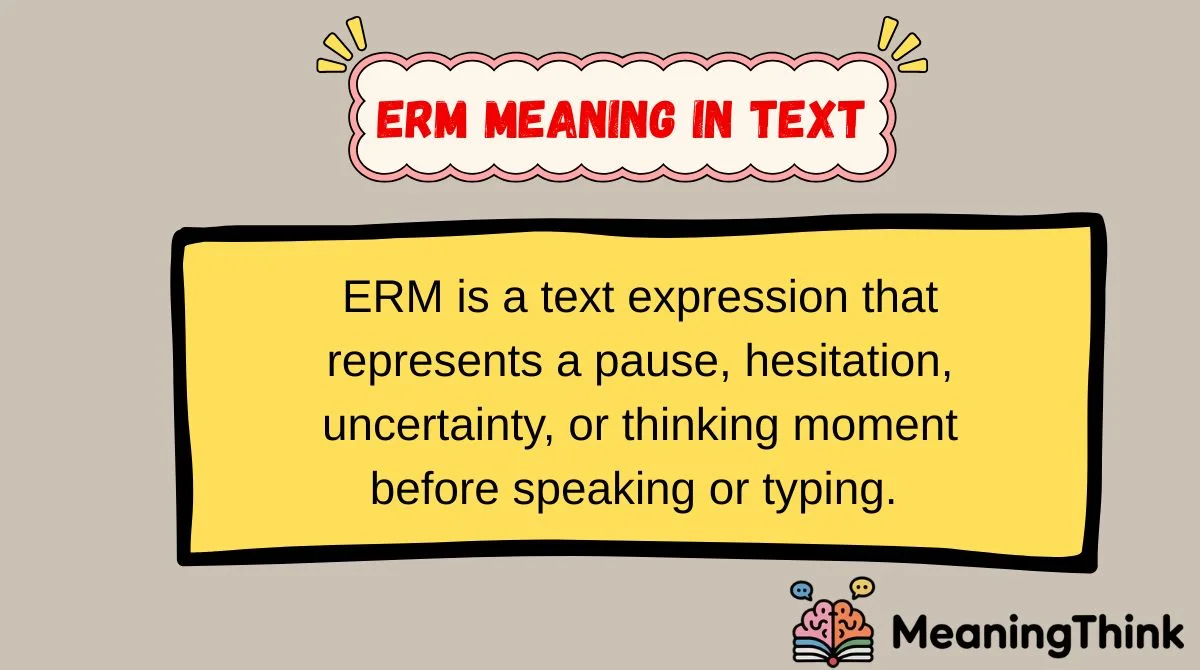
ERM is a text expression that represents a pause, hesitation, uncertainty, or thinking moment before speaking or typing. It is the written version of someone saying “um” or “uh” during a conversation.
Depending on context, erm may also express awkwardness, disbelief, sarcasm, mild disagreement, or an attempt to soften a response rather than sounding too direct.
Detailed Meaning Breakdown
Primary Meaning
The primary meaning of erm is hesitation.
People type erm when they need a brief moment to think before giving an answer. It shows that the speaker is choosing their words carefully or isn’t completely sure what to say.
For example:
“Erm…I’m not sure that’s a good idea.”
Here, the person is gently expressing doubt instead of rejecting the idea immediately.
Secondary Meanings
Besides hesitation, erm can communicate several other emotions.
Uncertainty
Sometimes people simply don’t know the answer.
Example:
“Erm…I think the meeting starts at 3.”
Awkwardness
People often use erm when a conversation becomes uncomfortable.
Example:
“Erm…that was a little embarrassing.”
Polite Disagreement
Rather than saying “No,” someone might begin with erm to sound kinder.
Example:
“Erm…I actually prefer the other option.”
Surprise
Sometimes erm shows unexpected confusion.
Example:
“Erm…what just happened?”
Sarcasm
Online, erm is frequently used sarcastically.
Example:
“Erm…who asked?”
In this case, the speaker isn’t hesitating—they’re being sarcastic or dismissive.
Rare Meanings
Although uncommon, ERM can also appear as an abbreviation in technical or business discussions.
Examples include:
- Enterprise Risk Management
- Electronic Resource Management
- Emergency Response Management
However, in everyday texting and social media, erm almost always means a hesitation sound rather than an acronym.
What “ERM” Means in Different Situations
Everyday Texting
In everyday chats, erm usually signals that someone is thinking before responding.
Examples include:
- deciding what to say
- avoiding sounding rude
- expressing uncertainty
- softening criticism
Example:
“Erm…I’ll let you know tomorrow.”
The reply sounds friendlier than simply saying “Later.”
Social Media Platforms
On platforms like Instagram, TikTok, Snapchat, X, Facebook, and Reddit, erm often appears before a funny or sarcastic comment.
Examples:
- “Erm…that’s definitely a choice.”
- “Erm…did anyone actually ask?”
- “Erm…okay then.”
Social media users frequently use it to add humor or exaggeration.
Dating & Relationships
In romantic conversations, erm often reveals nervousness.
Someone may type it because they feel shy, embarrassed, or unsure.
Examples:
“Erm…I actually like you.”
“Erm…can I ask you something?”
Here, the word makes the message feel more genuine and emotionally vulnerable.
Professional Communication
In work-related messages, erm should generally be avoided.
Professional communication values confidence and clarity.
Instead of writing:
“Erm…I think this might work.”
Write:
“I believe this solution could work.”
Using erm too often can make your message seem uncertain.
Cultural or Regional Differences
The word erm is especially common in British English.
People in the United Kingdom often say erm naturally during conversations.
In American English, um is generally more common.
Online, however, both spellings are widely understood across English-speaking countries.
Psychological & Tone Analysis
Why People Use It
People naturally pause while thinking.
Since texting removes facial expressions and vocal pauses, users type erm to recreate natural speech.
It makes digital conversations feel more human.
What It Signals Socially
Depending on context, erm can signal:
- politeness
- caution
- uncertainty
- awkwardness
- humor
- sarcasm
- careful thinking
Readers often interpret it as a softer opening than jumping straight into an opinion.
The Emotional Layer Behind It
Emotionally, erm often communicates:
- nervousness
- embarrassment
- hesitation
- surprise
- discomfort
- curiosity
It acts like a cushion before delivering information.
Instead of sounding harsh, the speaker appears more thoughtful.
15 Real Conversation Examples (Explained)
1.
Alex: Are you coming tonight?
Sam: Erm…probably.
Explanation: Sam isn’t completely sure.
2.
Emma: Do you like my haircut?
Lily: Erm…it’s different.
Explanation: Lily is trying to avoid hurting Emma’s feelings.
3.
Chris: Did you finish the project?
Ben: Erm…not yet.
Explanation: Ben hesitates because he knows the answer may disappoint Chris.
4.
Anna: Can I borrow your laptop?
Jake: Erm…I’d rather not.
Explanation: Jake politely refuses.
5.
Mark: What happened?
Sarah: Erm…it’s a long story.
Explanation: Sarah is deciding how much information to share.
6.
Friend: Is this true?
You: Erm…I don’t think so.
Explanation: You’re unsure.
7.
Teacher: Any questions?
Student: Erm…could you explain that again?
Explanation: The student asks politely.
8.
Friend: Did you eat my fries?
You: Erm…maybe.
Explanation: Playful hesitation.
9.
Date: Do you want another date?
You: Erm…absolutely!
Explanation: Builds suspense before giving a positive answer.
10.
Boss: Is the report finished?
Employee: Erm…almost.
Explanation: Shows slight uncertainty.
11.
Friend: Should I buy this?
You: Erm…I’d save my money.
Explanation: Gentle advice.
12.
Comment: This movie is terrible.
Reply: Erm…I loved it.
Explanation: Respectful disagreement.
13.
Sibling: Who broke the vase?
Brother: Erm…not me.
Explanation: Hesitation may suggest guilt.
14.
Friend: Want pizza?
You: Erm…always.
Explanation: Used humorously.
15.
Message: Did you tell everyone?
Reply: Erm…maybe one person.
Explanation: The speaker admits something cautiously.
When “ERM” Can Be Misunderstood
Context Confusion
Without tone of voice, readers may misunderstand erm.
Some think it means uncertainty.
Others read it as sarcasm.
Always consider the entire conversation.
Generational Gap
Younger internet users often use erm sarcastically.
Older users usually interpret it literally as hesitation.
This difference can change how messages are received.
Platform Differences
On TikTok or X, erm frequently introduces jokes or memes.
In private texting, it usually represents genuine hesitation.
In professional messaging apps, it may appear unconfident.
Similar Words, Symbols, or Abbreviations
| Term | Meaning |
|---|---|
| Um | Thinking pause |
| Uh | Brief hesitation |
| Hmm | Deep thinking |
| Hmm… | Considering something carefully |
| Well | Soft introduction before speaking |
| Like | Conversational filler |
| You know | Checks listener understanding |
| I guess | Mild uncertainty |
| Maybe | Lack of certainty |
| TBH | To be honest; introduces an honest opinion |
When Not to Use “ERM”
Professional Risks
Avoid erm in:
- business emails
- client messages
- resumes
- official reports
- legal communication
It can make you appear unsure.
Cultural Risks
Some cultures value direct communication.
Using too many hesitation words may seem indecisive.
Consider your audience.
Tone Risks
Avoid erm when:
- giving important instructions
- discussing emergencies
- making formal announcements
- providing customer support
- delivering serious news
Clear communication is more effective.
Expert Tips for Using “ERM” Correctly
- Use it naturally instead of forcing it into every sentence.
- Match your tone to the conversation.
- Avoid repeating erm multiple times in one message.
- Don’t use it in formal business writing.
- Use it to soften criticism when appropriate.
- Understand whether your audience may read it as sarcasm.
- Combine it with emojis only in casual conversations.
- Remember that context always determines the meaning.
Frequently Asked Questions
What does ERM mean in text messages?
It usually represents hesitation, uncertainty, or thinking before responding. It is the written equivalent of saying “um.”
Is ERM the same as UM?
Yes. Both represent thinking pauses, although erm is more common in British English while um is more common in American English.
Does ERM always mean someone is unsure?
No. It can also express sarcasm, awkwardness, surprise, or polite disagreement depending on the conversation.
Is ERM considered internet slang?
Yes. While it comes from spoken language, it has become a popular expression in texting, memes, and social media.
Can ERM be rude?
Not usually. However, when used sarcastically, it may sound dismissive or mocking.
Should I use ERM in professional emails?
No. Professional writing should be direct and confident without hesitation words.
Why do people type ERM instead of UM?
Many people simply prefer the spelling erm, especially those influenced by British English or internet culture.
Is ERM popular in 2026?
Yes. Erm remains a common expression across texting, online discussions, memes, gaming communities, and social media because it effectively conveys hesitation and conversational tone.
Final Summary
The phrase ERM meaning in text is simple on the surface but surprisingly expressive in everyday communication.
Most commonly, erm represents hesitation, uncertainty, or a brief thinking pause—the typed version of saying “um.” However, its meaning can shift depending on the context.
It may soften criticism, show nervousness, create suspense, or even introduce sarcasm in online conversations.
Understanding the situation, the relationship between the speakers, and the platform where the conversation takes place is the key to interpreting erm correctly.
In casual chats, it makes messages sound more natural and human. In formal or professional settings, however, it’s best replaced with clear and confident language.
When used thoughtfully, erm can improve the tone of your messages, make conversations feel more authentic, and help you communicate with greater emotional awareness.
Learning these small but meaningful expressions will make you a more confident reader and writer in today’s fast-moving digital world.