Have you ever opened a text message or social media comment and noticed someone writing “ONB”, only to wonder what it actually means? You’re not alone.
Internet slang changes quickly, and new abbreviations appear almost every day. While some are easy to understand, others depend heavily on context, making them confusing for anyone who is not familiar with online conversations.
The abbreviation ONB is one of those terms that can have different meanings depending on who is using it, where it appears, and what the conversation is about.
It may express honesty, emphasize a statement, or even refer to something completely different in another community.
This guide explains everything you need to know about the ONB meaning in text slang.
You’ll learn its primary definition, secondary meanings, how people use it on different platforms, what tone it conveys, common mistakes to avoid, real conversation examples, and practical tips for using it naturally. By the end, you’ll be able to understand and use ONB with confidence.
Quick Definition of “ONB”
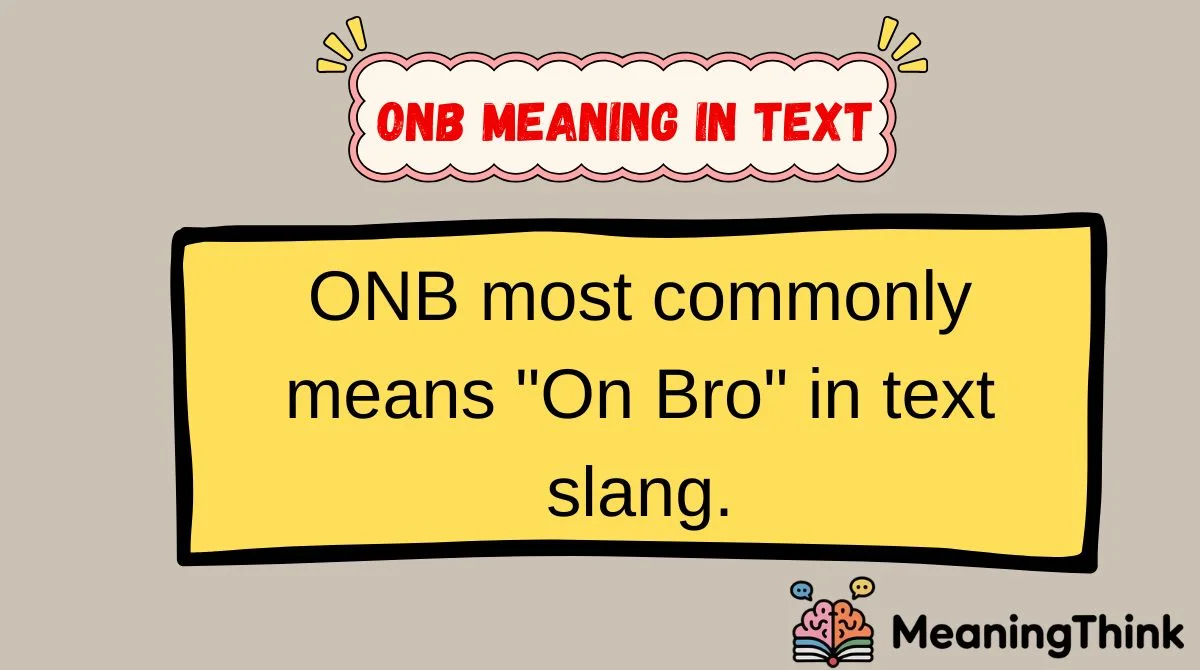
ONB most commonly means “On Bro” in text slang. It is used to show sincerity, emphasize that someone is telling the truth, or strongly stand behind a statement. Similar to saying “I swear” or “I’m being serious,” it adds emphasis to a message.
Depending on the conversation, ONB may also represent other phrases in specialized communities, organizations, or gaming groups, but “On Bro” is by far the most common meaning in modern texting and social media slang.
Detailed Meaning Breakdown
Primary Meaning: “On Bro”
The most widely accepted meaning of ONB is “On Bro.”
In online conversations, people use it as a verbal promise or statement of honesty. Instead of simply saying they’re serious, they write ONB to show they truly mean what they’re saying.
For example:
- ONB, I didn’t touch your phone.
- I’m coming tomorrow, ONB.
- ONB, that’s the best food I’ve ever had.
Here, ONB works like:
- I promise.
- I swear.
- Honestly.
- Believe me.
It doesn’t necessarily refer to an actual brother. Instead, “bro” is often used as a casual expression among friends.
Secondary Meanings
Although less common in casual texting, ONB can represent other phrases depending on the situation.
These include:
- Organization names
- Gaming clans
- Business abbreviations
- Internal workplace shorthand
- Personal initials
These meanings are uncommon unless the conversation clearly points toward them.
Rare Meanings
In certain online communities, ONB may have unique meanings known only within that group. These uses are rare and should not be assumed unless additional context makes the meaning obvious.
For everyday texting, social media, and messaging apps, interpreting ONB as “On Bro” is usually the correct choice.
What “ONB” Means in Different Situations
Everyday Texting
In personal messages, ONB is mainly used to prove sincerity.
Examples include:
- ONB, I forgot your birthday.
- ONB, I’ll pay you back tomorrow.
- ONB, I wasn’t joking.
The sender wants the receiver to trust their words.
Social Media Platforms
On platforms like TikTok, Instagram, Snapchat, Facebook, and X, ONB often appears in:
- Comments
- Captions
- Replies
- Live chats
Examples:
- ONB this song is amazing.
- ONB that was chaotic.
- ONB he deserves more followers.
Here, it strengthens the person’s opinion.
Dating & Relationships
People also use ONB while discussing relationships.
Examples:
- ONB I only like you.
- ONB I’m telling the truth.
- ONB I wasn’t talking to anyone else.
It serves as reassurance during emotional conversations.
Professional Communication
ONB is generally inappropriate in formal communication.
Avoid using it in:
- Business emails
- Job applications
- Client conversations
- Academic writing
- Official reports
Instead, choose professional phrases such as:
- I can confirm.
- Certainly.
- I assure you.
- To clarify.
Cultural or Regional Differences
ONB is more common among younger English speakers, especially in online communities influenced by American internet culture.
Some regions use it frequently in casual speech, while others rarely recognize it.
People unfamiliar with internet slang may misunderstand the abbreviation or think it refers to an organization instead of a slang phrase.
Psychological & Tone Analysis
Language is more than vocabulary—it also communicates emotion and social identity.
Why People Use It
People use ONB because it:
- Adds emphasis.
- Builds credibility.
- Shows confidence.
- Makes messages feel stronger.
- Signals honesty.
What It Signals Socially
Using ONB often suggests that the speaker:
- Wants to be believed.
- Feels confident.
- Is speaking casually.
- Belongs to online youth culture.
- Is comfortable using internet slang.
Emotional Layer Behind It
Depending on the message, ONB can express:
- Excitement
- Frustration
- Loyalty
- Confidence
- Surprise
- Seriousness
Although it’s only three letters, it carries emotional weight by making statements sound more genuine.
15 Real Conversation Examples (Explained)
1. “ONB I’m coming tomorrow.”
Explanation: The speaker promises they will arrive.
2. “ONB I never said that.”
Explanation: They strongly deny making the statement.
3. “That movie was incredible ONB.”
Explanation: They genuinely loved the movie.
4. “ONB she’s the nicest person here.”
Explanation: They sincerely believe the compliment.
5. “ONB I’m not joking.”
Explanation: They want others to take the message seriously.
6. “ONB I’ll help you move.”
Explanation: A sincere promise to assist.
7. “He really won? ONB?”
Explanation: The second speaker seeks confirmation.
8. “ONB this pizza is amazing.”
Explanation: A strong recommendation.
9. “ONB I forgot to reply.”
Explanation: An honest apology.
10. “I’m quitting, ONB.”
Explanation: The decision is serious.
11. “ONB that’s the funniest video today.”
Explanation: Strong personal opinion.
12. “ONB I studied all night.”
Explanation: The speaker wants to be believed.
13. “ONB I’ll text you later.”
Explanation: A genuine promise.
14. “ONB I didn’t know.”
Explanation: They emphasize honesty.
15. “ONB this game is addictive.”
Explanation: The speaker strongly recommends the game.
When “ONB” Can Be Misunderstood
Context Confusion
Since abbreviations often have multiple meanings, readers may interpret ONB differently if the conversation lacks context.
Generational Gap
Older adults may not recognize ONB as slang and could mistake it for an organization, company, or technical abbreviation.
Meanwhile, younger users are more likely to understand its slang meaning immediately.
Platform Differences
The meaning of ONB may vary depending on where it appears.
For example:
- Social media comments usually mean “On Bro.”
- Workplace chats may use a completely different meaning.
- Gaming communities sometimes create their own definitions.
Always consider the surrounding conversation before interpreting the abbreviation.
Similar Words, Symbols, or Abbreviations
Here are several slang terms related to ONB:
| Term | Meaning |
|---|---|
| FR | For real |
| NGL | Not gonna lie |
| ONG | On God |
| FRFR | For real, for real |
| ISTG | I swear to God |
| TBH | To be honest |
| IMO | In my opinion |
| ICL | I can’t lie |
| SMH | Shaking my head |
| LMK | Let me know |
These expressions all help add emotion, honesty, or emphasis in online conversations.
When Not to Use “ONB”
Although ONB works well in casual chats, there are situations where it should be avoided.
Professional Risks
Avoid using ONB in:
- Business meetings
- Workplace emails
- Client communication
- Legal documents
- Academic assignments
Professional writing should use complete, formal language.
Cultural Risks
Not everyone understands internet slang.
Using ONB with international audiences or older readers may create confusion.
Tone Risks
ONB may sound:
- Too informal
- Too casual
- Overly dramatic
- Immature in formal settings
Choose your wording based on your audience.
Expert Tips for Using “ONB” Correctly
- Understand the context before using it.
- Reserve it for casual conversations.
- Don’t use it in professional communication.
- Avoid overusing it in every message.
- Make sure your audience understands internet slang.
- Use it naturally instead of forcing it into conversations.
- If clarity matters, write the full sentence instead of relying on slang.
- Match your tone to the platform and the people you’re talking with.
FAQs
What does ONB mean in text slang?
ONB usually means “On Bro.” It emphasizes honesty, sincerity, or a serious statement.
Does ONB always mean “On Bro”?
No. While “On Bro” is the most common slang meaning, ONB can also represent organizations, businesses, or community-specific phrases depending on the context.
Is ONB the same as ONG?
No. ONB means “On Bro,” while ONG usually means “On God.” Both are used to emphasize truthfulness, but they use different expressions.
Can I use ONB at work?
Generally, no. Professional communication should avoid internet slang unless everyone involved understands and accepts that style.
Is ONB popular among younger people?
Yes. It is most commonly used by teenagers and young adults in texting, gaming, and social media conversations.
Can ONB be used in dating conversations?
Yes. People often use it to reassure a partner that they are being honest or serious.
Is ONB considered rude?
No. By itself, ONB is not rude. However, the overall sentence and tone determine whether a message sounds respectful or offensive.
How can I tell which meaning of ONB is correct?
Look at the surrounding conversation. In casual chats and social media, it almost always means “On Bro.” In professional or specialized settings, it may have another meaning.
Final Summary
ONB is a popular piece of modern internet slang that most commonly stands for “On Bro.” It helps people emphasize honesty, seriousness, and confidence in casual conversations.
Whether it appears in text messages, social media posts, gaming chats, or friendly discussions, it usually serves as a way of saying, “Believe me,” or “I’m telling the truth.”
Even though the abbreviation is simple, context remains important because ONB can occasionally represent other meanings in specific communities or organizations.
Before using it, consider your audience and the setting. It fits naturally in informal conversations but should be avoided in professional or academic communication.
Understanding slang like ONB helps you communicate more effectively, recognize online trends, and avoid misunderstandings.
By using it thoughtfully and only when appropriate, you can keep your messages clear, relatable, and easy for others to understand.