Have you ever received a message that simply said “uff” and wondered what it actually meant? Maybe a friend replied with “uff 😩,” someone commented “uff 🔥” on a photo, or your crush sent “uff” after reading your message.
At first glance, it looks like a random word, but its meaning can change depending on the conversation, emotion, and even the platform where it’s used.
Texting slang evolves quickly, and many expressions don’t follow traditional grammar rules. Instead, they reflect emotions, reactions, and personality.
That’s exactly why UFF has become so popular across messaging apps and social media. A single word can express exhaustion, surprise, admiration, relief, frustration, or excitement without requiring a full sentence.
This guide explains everything you need to know about the UFF meaning in text.
You’ll learn its primary definition, secondary meanings, emotional tone, regional differences, and how people use it in texting, social media, dating, and professional conversations. By the end, you’ll understand exactly what someone means when they type “uff” and when it’s appropriate to use it yourself.
Quick Definition of “UFF”
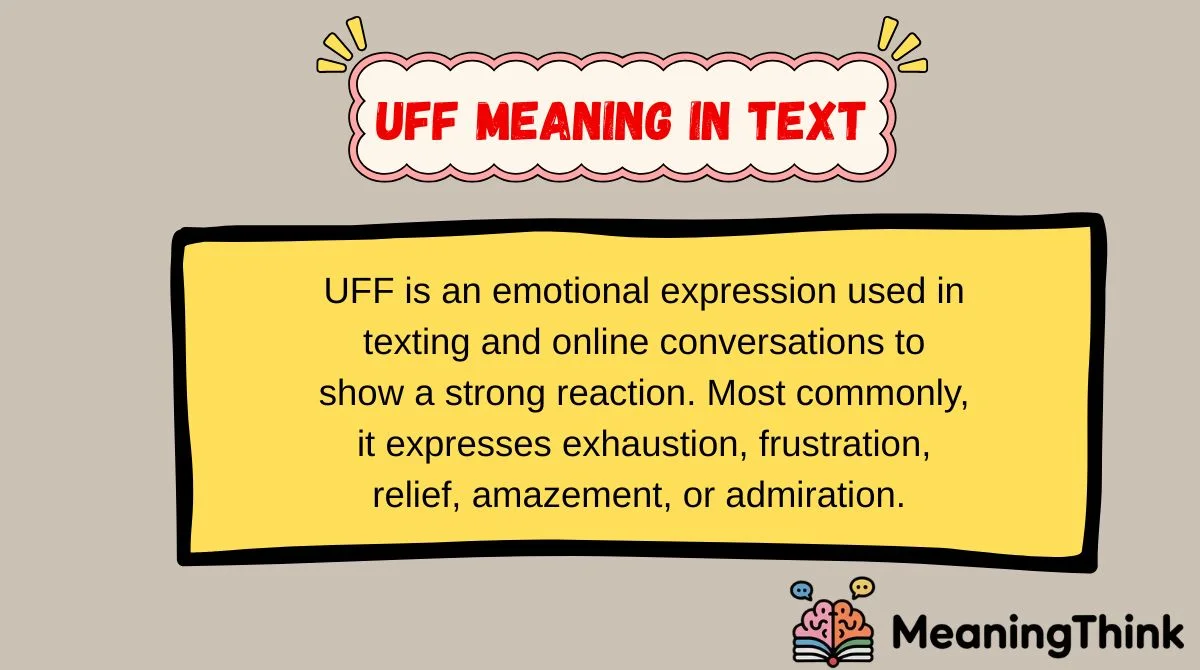
UFF is an emotional expression used in texting and online conversations to show a strong reaction. Most commonly, it expresses exhaustion, frustration, relief, amazement, or admiration. The exact meaning depends on the context and the emotion behind the conversation.
In some cultures and languages, particularly in South Asia and Latin America, “uff” is also used as an exclamation similar to “wow,” “phew,” “oh my,” or “that’s intense.” Because of this flexibility, it has become a common reaction across social media and messaging apps.
Detailed Meaning Breakdown
Primary Meaning
The most common meaning of UFF is an emotional sigh. Instead of writing a complete sentence, people type “uff” to instantly communicate how strongly they feel about something.
For example:
- “Uff, today was exhausting.”
- “Uff 😮 That goal was incredible.”
- “Uff, I finally finished my exams.”
Although these examples represent different emotions, they all share one thing: they express a strong emotional reaction.
Think of “uff” as the digital version of taking a deep breath after experiencing something difficult, exciting, or surprising.
Secondary Meanings
Depending on the conversation, UFF can have several additional meanings.
Relief
Someone may type “uff” after overcoming a stressful situation.
Example:
“I thought I missed the train. Uff, I made it.”
Here, the word communicates relief rather than frustration.
Frustration
When something goes wrong, “uff” can express annoyance.
Example:
“Uff, my internet stopped working again.”
Instead of complaining with a long message, the user summarizes their frustration with one expressive word.
Admiration
Many people use “uff” when reacting to someone attractive or something impressive.
Examples:
- “Uff, you look amazing!”
- “Uff, that’s a beautiful car.”
- “Uff 🔥”
In these situations, the word means something close to:
- Wow
- That’s impressive
- That’s attractive
- Incredible
Amazement
Sometimes “uff” simply communicates surprise.
Example:
“Uff, I didn’t expect that ending.”
It tells the reader that something exceeded expectations.
Physical Exhaustion
People often type “uff” after completing difficult work.
Example:
“Just finished moving furniture. Uff.”
No further explanation is necessary because the emotion is obvious.
Rare Meanings
Although uncommon, UFF may occasionally represent something different depending on the conversation.
Some organizations, businesses, sports clubs, and educational institutions use UFF as an acronym. In those cases, it does not carry the emotional meaning discussed in this article.
Always check whether the conversation is casual or discussing a specific organization before assuming “uff” is an emotional expression.
What “UFF” Means in Different Situations
Everyday Texting
In everyday messaging, UFF is usually an emotional reaction rather than an abbreviation.
Friends often use it to react quickly without typing a long explanation.
Examples include:
- “Uff, today was so busy.”
- “Uff, I’m finally home.”
- “Uff, that exam was hard.”
The word helps conversations feel natural because it mirrors how people react in real life.
Social Media Platforms
On social media, UFF often appears in comments, captions, and replies.
People use it to react to:
- Attractive selfies
- Amazing travel photos
- Funny videos
- Sports highlights
- Fashion posts
- Incredible achievements
Examples include:
- “Uff 🔥”
- “Uff, this looks expensive.”
- “Uff, you’re glowing!”
- “Uff, that’s an amazing transformation.”
Adding emojis can strengthen the emotion.
Common combinations include:
- Uff 🔥
- Uff 😍
- Uff 😮
- Uff 😂
- Uff 😩
- Uff 💯
Each emoji changes the emotional tone while keeping the same basic reaction.
Dating & Relationships
In romantic conversations, UFF often becomes a compliment.
If someone sends:
“Uff, you look gorgeous.”
they’re expressing admiration.
If they reply:
“Uff 😍”
they’re reacting positively to something you said or shared.
Couples also use “uff” playfully when teasing each other.
Examples include:
- “Uff, you always know how to make me smile.”
- “Uff, now I miss you even more.”
- “Uff, you’re making this difficult.”
In dating conversations, context matters more than the word itself. Depending on the message, it may sound flirty, affectionate, surprised, or emotionally overwhelmed.
Professional Communication
In professional settings, UFF is generally inappropriate.
Business emails, workplace chats, and formal communication usually require complete sentences rather than emotional slang.
Instead of saying:
“Uff, this report took forever.”
A better professional alternative would be:
“This report required more time than expected, but it’s now complete.”
Using “uff” at work can make messages appear overly casual unless you’re chatting informally with close coworkers on an internal messaging platform.
Cultural or Regional Differences
Although UFF is widely recognized as an emotional expression, its meaning and popularity vary across countries and languages.
South Asia
In countries like India, Pakistan, and Bangladesh, uff is commonly used in both spoken language and text messages. People often say it to express:
- Surprise
- Frustration
- Relief
- Admiration
- Being emotionally overwhelmed
For example:
- “Uff, it’s so hot today.”
- “Uff, that was close!”
- “Uff, you look amazing.”
In these regions, “uff” feels natural in everyday conversations and is understood by people of all ages who frequently use social media.
Latin America
Spanish speakers also use uff as an emotional reaction.
Depending on the conversation, it can mean:
- Wow!
- That’s unbelievable!
- That’s exhausting.
- That’s incredible.
Examples include:
- “Uff, qué calor.” (Wow, it’s so hot.)
- “Uff, qué partido.” (What an incredible game.)
Because of its expressive nature, it appears often in online comments and chats.
English-Speaking Countries
In countries such as the United States, Canada, the United Kingdom, and Australia, uff is less common than expressions like:
- Phew
- Whew
- Wow
- Oof
However, younger internet users are increasingly familiar with “uff” through global social media platforms, multilingual communities, and online gaming.
Internet Culture
Online communities have helped make uff a universal reaction.
Whether someone speaks English, Spanish, Hindi, Urdu, or another language, many users understand that “uff” simply communicates a strong emotion.
This global usage explains why the same word appears on Instagram, TikTok, Facebook, Snapchat, WhatsApp, Discord, Reddit, and X.
Psychological & Tone Analysis
Understanding why people use “uff” helps explain its popularity.
Unlike formal words, emotional expressions communicate feelings almost instantly.
Why People Use It
Typing “uff” is much faster than explaining emotions in a complete sentence.
Instead of writing:
“I’m extremely relieved that everything worked out.”
Someone simply writes:
“Uff!”
The emotional message is delivered immediately.
It Makes Conversations Feel Human
Text messages sometimes lack facial expressions and body language.
Words like uff replace those missing emotional signals.
Readers can almost imagine someone:
- Taking a deep breath
- Smiling in disbelief
- Rolling their eyes
- Feeling relieved
- Being impressed
That makes digital conversations feel more natural.
It Signals Emotional Intensity
People rarely use “uff” for ordinary situations.
Instead, they use it when something creates a noticeable emotional reaction.
Examples include:
- Finishing a difficult task
- Seeing an attractive photo
- Watching an exciting sports moment
- Receiving unexpected news
- Escaping a stressful situation
Because of this, “uff” tells readers that the emotion is stronger than usual.
It Creates Social Connection
Using casual expressions helps conversations feel relaxed.
Friends often mirror each other’s language.
If one person frequently says:
“Uff 😂”
their friends may begin using it too.
This creates a shared communication style within friend groups and online communities.
Emotional Layers Behind “UFF”
The same word can communicate very different emotions.
| Emotion | Example |
|---|---|
| Relief | “Uff, we made it.” |
| Frustration | “Uff, not again.” |
| Admiration | “Uff, you’re stunning.” |
| Surprise | “Uff, I didn’t expect that!” |
| Exhaustion | “Uff, I’m tired.” |
| Excitement | “Uff, this concert is amazing!” |
The surrounding message determines which emotion readers understand.
15 Real Conversation Examples (Explained)
1. After a Difficult Exam
Alex: That math exam was brutal.
Mia: Uff, don’t remind me.
Explanation: Here, “uff” expresses stress and mental exhaustion after completing something challenging.
2. Complimenting Someone
Chris: Here’s my new profile picture.
Emma: Uff 🔥 You look incredible.
Explanation: The word communicates admiration and excitement. The fire emoji strengthens the compliment.
3. Relief After Good News
Sara: I passed my driving test!
Nina: Uff, congratulations!
Explanation: In this conversation, “uff” expresses relief and happiness because the stressful situation ended successfully.
4. Long Day at Work
David: Just got home.
Ryan: Uff, finally.
Explanation: The speaker acknowledges a tiring day and the relief of being home.
5. Watching Sports
Mike: Did you see that goal?
Leo: Uff! What a shot!
Explanation: Here, “uff” means “wow” because the goal was impressive.
6. Technology Problems
Anna: My laptop crashed again.
Sophia: Uff… that’s frustrating.
Explanation: The expression shows sympathy and shared frustration.
7. Flirty Conversation
Jake: I miss you.
Emily: Uff, you’re making me smile.
Explanation: The tone is warm and affectionate. “Uff” suggests the message had an emotional impact.
8. Vacation Photos
Daniel: Just uploaded my beach pictures.
Lucas: Uff 😍 That place looks beautiful.
Explanation: The word expresses admiration and amazement at the scenery.
9. Busy Schedule
Lily: I have meetings all day.
Grace: Uff, good luck.
Explanation: “Uff” reflects empathy, recognizing that the day will be demanding.
10. Unexpected Plot Twist
Ben: I just finished the movie.
Oliver: Uff, that ending shocked me.
Explanation: Here, “uff” highlights surprise and disbelief after an unexpected ending.
11. Completing a Workout
Noah: Finished a two-hour workout.
Ethan: Uff! That’s impressive.
Explanation: The expression communicates both admiration and recognition of the effort involved.
12. Waiting for Results
Hannah: The interview results finally came.
Olivia: Uff, I’ve been waiting all week.
Explanation: In this case, “uff” expresses relief after a period of stress and anticipation.
13. Cooking Disaster
James: I accidentally burned dinner.
Liam: Uff, that’s unfortunate.
Explanation: The response shows sympathy while acknowledging the frustrating situation.
14. Concert Experience
Sophia: That concert was unbelievable.
Ella: Uff, I wish I had gone.
Explanation: Here, “uff” conveys admiration mixed with regret for missing the event.
15. Winning a Competition
Mark: We won first place!
Nathan: Uff! You deserved it.
Explanation: The expression communicates excitement, happiness, and admiration for the achievement.
When “UFF” Can Be Misunderstood
Although UFF is easy to understand in many casual conversations, it can still create confusion when readers interpret it differently. Since it is an emotional expression rather than a formal word, its meaning depends heavily on context, tone, emojis, and the relationship between the people chatting.
Context Confusion
The biggest reason people misunderstand UFF is that it has more than one meaning.
For example:
Message: “Uff.”
Without additional words, the sender could be expressing:
- Relief after solving a problem
- Frustration over bad news
- Surprise at unexpected information
- Admiration for someone’s appearance
- Physical or mental exhaustion
Adding even a few extra words makes the meaning much clearer.
Compare these examples:
- “Uff, that was close!” → Relief
- “Uff, not again.” → Frustration
- “Uff, you’re gorgeous.” → Admiration
- “Uff, I’m exhausted.” → Tiredness
Generational Gap
Younger internet users often understand UFF immediately because they regularly use texting slang and internet expressions.
Older users, however, may:
- Think it is a typing mistake.
- Assume it is an abbreviation.
- Not recognize its emotional meaning.
If you’re chatting with someone unfamiliar with online slang, using complete sentences may avoid confusion.
Platform Differences
The meaning of UFF can also change depending on where it appears.
Usually expresses genuine emotion during personal conversations.
Often appears in comments as a compliment.
Example:
“Uff 🔥”
This usually means:
- You look amazing.
- That’s impressive.
- Wow!
TikTok
Commonly used to react to entertaining videos, dance clips, fashion, food, or sports highlights.
People often use it while sharing personal experiences, expressing relief, or reacting to news.
Gaming Communities
Players may type “uff” after:
- A difficult victory
- A surprising defeat
- An impressive play
- A lucky escape
Language Differences
People who speak Hindi, Urdu, Spanish, or Portuguese may use UFF more naturally than native English speakers.
Because of this, English-only readers might occasionally misunderstand its emotional tone.
Always consider the speaker’s cultural background before interpreting the message.
Similar Words, Symbols, or Abbreviations
Many internet expressions communicate emotions similar to UFF. Here are ten common alternatives.
| Term | Meaning |
|---|---|
| Oof | Expresses pain, awkwardness, sympathy, or disappointment. |
| Phew | Shows relief after stress or danger. |
| Whew | Another spelling of “phew,” expressing relief or exhaustion. |
| Wow | Indicates surprise or admiration. |
| OMG | Means “Oh my God,” expressing shock, excitement, or disbelief. |
| Yikes | Reacts to something awkward, embarrassing, or unpleasant. |
| Sheesh | Expresses amazement, disbelief, or frustration. |
| Bruh | Shows disbelief, disappointment, amusement, or mild frustration. |
| LOL | Means “Laughing Out Loud,” indicating something is funny. |
| SMH | Means “Shaking My Head,” expressing disappointment or disbelief. |
Each expression has its own emotional tone, but all help people communicate feelings quickly in online conversations.
When Not to Use “UFF”
Although UFF works well in casual chats, there are situations where it may sound unprofessional or confusing.
Professional Communication
Avoid using UFF in:
- Job applications
- Business emails
- Client messages
- Academic assignments
- Official reports
Instead of writing:
“Uff, this project was difficult.”
Write:
“This project required significant effort, but it has been completed successfully.”
Professional writing should remain clear and formal.
Cultural Risks
Not everyone understands internet slang.
If you’re communicating with someone from a different age group or cultural background, they may not recognize what UFF means.
When clarity matters, use complete words instead.
Tone Risks
Because UFF is highly emotional, it can sometimes sound:
- Dramatic
- Sarcastic
- Flirtatious
- Dismissive
For example:
“Uff…”
Without context, readers may not know whether you’re annoyed, impressed, or simply tired.
If the conversation is important, adding a short explanation prevents misunderstandings.
Expert Tips for Using “UFF” Correctly
Follow these practical tips to use UFF naturally and confidently.
1. Match the Conversation
Use UFF only when the discussion is casual and relaxed.
2. Let Context Explain the Emotion
The words before and after UFF should make your meaning obvious.
Example:
“Uff, that presentation went much better than I expected.”
3. Use Emojis Carefully
Emojis help clarify emotion.
Examples:
- Uff 😍 → Admiration
- Uff 😩 → Exhaustion
- Uff 😂 → Amusement
- Uff 🔥 → Strong compliment
- Uff 😮 → Surprise
4. Don’t Overuse It
Repeating UFF in every message can reduce its emotional impact.
Save it for moments that genuinely deserve a strong reaction.
5. Know Your Audience
Close friends will usually understand UFF immediately.
With coworkers, teachers, or clients, choose clearer and more professional language.
6. Keep It Natural
Don’t force the expression into every conversation.
If “wow,” “thanks,” or “I’m relieved” sounds better, use those instead.
7. Remember Regional Differences
Some cultures use UFF every day, while others rarely use it.
Being aware of your audience helps you communicate more effectively.
8. Read the Entire Conversation
Never interpret UFF by itself.
Always consider:
- Previous messages
- Emojis
- The topic
- The relationship between the people chatting
Context is the key to understanding its meaning.
Frequently Asked Questions
What does UFF mean in text messages?
In text messages, UFF is an emotional expression that usually communicates relief, frustration, admiration, surprise, or exhaustion. Its exact meaning depends on the surrounding conversation.
Is UFF an abbreviation?
Usually, no. In casual texting, UFF is an expressive reaction rather than an acronym. However, some organizations and institutions may use the same letters as an abbreviation in different contexts.
What does UFF mean from a girl?
It has no gender-specific meaning. A girl may use UFF to express admiration, excitement, relief, frustration, or emotional overwhelm, depending on the conversation.
What does UFF mean from a guy?
The meaning is the same regardless of gender. It simply reflects a strong emotional reaction such as surprise, appreciation, stress, or relief.
Is UFF positive or negative?
It can be either. UFF is emotionally flexible and may express positive feelings like admiration and relief or negative feelings like frustration and exhaustion.
Is UFF the same as OOF?
Not exactly. While both express emotion, OOF is more commonly associated with pain, awkwardness, or sympathy, whereas UFF often conveys relief, amazement, admiration, or general emotional intensity.
Can I use UFF in professional emails?
It’s best to avoid it. Professional communication should use clear and formal language instead of emotional internet slang.
Why do people type UFF with emojis?
Emojis add emotional context. For example, UFF 🔥 often expresses admiration, while UFF 😩 suggests tiredness or frustration.
Final Summary
The UFF meaning in text is much more than a simple internet expression. It is a versatile emotional reaction that helps people communicate feelings quickly in digital conversations.
Depending on the situation, UFF can express relief, frustration, surprise, admiration, excitement, or exhaustion.
Its popularity comes from its simplicity. One short word can replace an entire sentence while still conveying genuine emotion.
Whether you’re chatting with friends, commenting on social media, reacting to exciting news, or complimenting someone’s photo, UFF helps conversations feel more expressive and natural.
The key to using UFF correctly is understanding context. Always pay attention to the surrounding words, emojis, platform, and relationship between the people involved. These details determine the emotion behind the message.
When used appropriately, UFF makes online communication more engaging, relatable, and human. However, it’s best reserved for informal conversations rather than professional or academic settings.
Now that you understand the meaning, tone, and modern usage of UFF, you can recognize it confidently in messages and use it naturally whenever the moment calls for a genuine emotional reaction.