Imagine you send a girl a heartfelt compliment, a cute selfie, or a thoughtful surprise. Instead of replying with a long message, she simply texts “awe” or “aww.” Suddenly, you’re left wondering what she really means.
Is she flirting? Is she just being polite? Does she think you’re sweet, or is she trying to end the conversation?
Text messages don’t include facial expressions or tone of voice, which makes short replies like “awe” easy to misunderstand.
Depending on the situation, relationship, and conversation, the same word can express affection, appreciation, sympathy, admiration, or simple kindness. A single three-letter response can carry different emotions.
Understanding the awe meaning in text from a girl requires looking beyond the word itself. The surrounding conversation, her personality, and the emotional context all influence what she is trying to communicate.
This guide explains every common meaning of “awe” in texting, how girls typically use it, what it can reveal about their feelings, and how to interpret it confidently in modern digital conversations.
Quick Definition of “Awe Meaning in Text From a Girl”
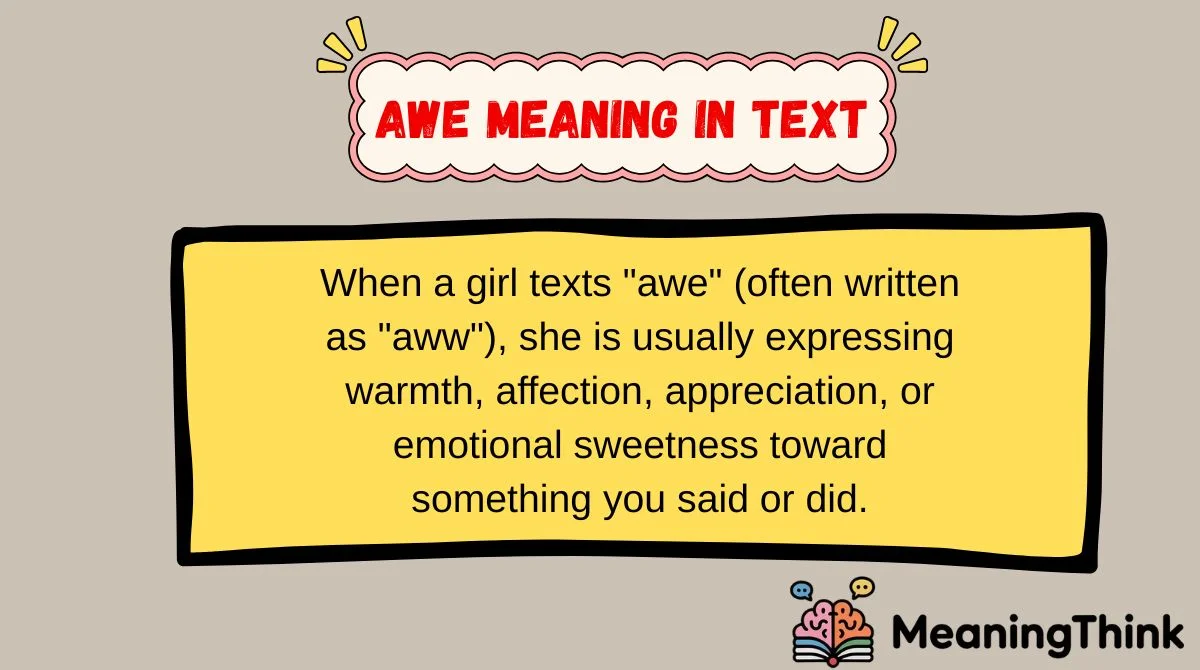
When a girl texts “awe” (often written as “aww”), she is usually expressing warmth, affection, appreciation, or emotional sweetness toward something you said or did. It commonly means she finds something cute, thoughtful, kind, or heartwarming.
In some situations, it may also express sympathy, admiration, surprise, or gentle encouragement rather than romantic interest. The exact meaning depends on the conversation and your relationship with her.
Detailed Meaning Breakdown
The Primary Meaning
Most of the time, “awe” in a text is an emotional reaction to something that touched her feelings.
She may think your message is:
- Cute
- Sweet
- Caring
- Thoughtful
- Romantic
- Funny in an adorable way
Instead of writing a long explanation, she responds with “awe” because it instantly communicates positive emotions.
For example:
You: “I remembered your favorite coffee.”
Her: “Awe, that’s so sweet.”
Here, “awe” shows genuine appreciation and happiness.
“Awe” as a Sign of Affection
Girls often use “awe” when they feel emotionally connected during a conversation.
This doesn’t automatically mean romantic love, but it usually indicates positive feelings.
Examples include:
- She appreciates your kindness.
- She enjoys your attention.
- She feels emotionally comfortable talking to you.
- She likes your caring personality.
When paired with emojis like 🥹, 😊, ❤️, 💕, or 🥰, the affectionate tone becomes even stronger.
“Awe” to Express Sympathy
Sometimes “awe” is used after hearing unfortunate news.
Example:
You: “I’ve been sick all week.”
Her: “Awe, I hope you feel better soon.”
Here, she is expressing compassion rather than attraction.
“Awe” as Appreciation
Girls also use “awe” to acknowledge thoughtful gestures.
Examples include:
- Birthday wishes
- Compliments
- Gifts
- Emotional support
- Acts of kindness
The word lets her show gratitude without writing a lengthy response.
“Awe” After Receiving a Compliment
Suppose you say:
“You’re honestly amazing.”
She replies:
“Awe, thank you!”
This usually means:
- She appreciated the compliment.
- She feels flattered.
- She accepts your kindness positively.
It does not always confirm romantic feelings, but it is generally a positive response.
“Awe” During Flirting
In romantic conversations, “awe” often becomes more meaningful.
For example:
You: “I’d bring you flowers just to see you smile.”
Her: “Awe… that’s adorable.”
Combined with continued conversation, playful teasing, or affectionate emojis, it can suggest growing romantic interest.
Secondary Meanings
Although sweetness is the most common interpretation, “awe” has several other meanings.
Emotional Appreciation
She genuinely values your words.
Example:
“Awe, you always know what to say.”
Admiration
Sometimes she is impressed by your actions.
Example:
“Awe, that’s really thoughtful of you.”
Gentle Surprise
She wasn’t expecting your message.
Example:
“Awe! You remembered?”
This combines happiness with surprise.
Comfort and Reassurance
Girls often use “awe” when trying to comfort someone.
Example:
“Awe, don’t worry. Everything will be okay.”
The tone is caring and supportive.
Friendly Warmth
Friends frequently use “awe” without romantic intentions.
Example:
“Awe, you’re the best friend ever!”
The emotion is sincere but completely platonic.
Rare Meanings
Less commonly, “awe” may be used sarcastically.
For example:
“Awe… how convenient.”
Here, the speaker isn’t being sweet. The tone depends entirely on context and punctuation.
Sarcastic usage is much less common than genuine affectionate use.
What “Awe Meaning in Text From a Girl” Means in Different Situations
Everyday Texting
In casual conversations, “awe” usually signals positive emotion.
Examples include:
- Appreciating compliments
- Reacting to cute photos
- Thanking someone
- Showing kindness
- Responding to thoughtful messages
The conversation normally remains friendly and warm.
Example:
You: “I saved you a slice of pizza.”
Her: “Awe, thank you!”
This response shows appreciation without adding unnecessary words.
Social Media Platforms
On Instagram, Snapchat, TikTok, Facebook, or X, girls often comment “awe” when they see something emotionally touching.
Common situations include:
- Baby photos
- Pet videos
- Romantic posts
- Friendship memories
- Graduation pictures
- Family celebrations
Examples:
- “Awe, this is adorable!”
- “Awe, you two are so cute!”
- “Awe, I love this!”
On social media, “awe” usually expresses admiration and emotional warmth rather than deep personal feelings.
Dating & Relationships
Dating conversations often give “awe” a stronger emotional meaning.
When a girl likes someone, she may respond with “awe” after receiving:
- Sweet compliments
- Good morning texts
- Romantic gestures
- Thoughtful surprises
- Caring messages
Example:
You: “I smiled today because I was thinking about you.”
Her: “Awe, you’re seriously so sweet.”
This response suggests she appreciates your affection and feels emotionally engaged.
However, “awe” alone should never be taken as proof of romantic interest. Look at her overall communication pattern. If she asks questions, keeps the conversation going, initiates chats, and responds enthusiastically, the positive meaning becomes much stronger.
Professional Communication
In workplaces, schools, or business conversations, “awe” appears less frequently.
Professional communication usually favors more neutral expressions like:
- Thank you.
- That’s thoughtful.
- I appreciate it.
- That means a lot.
If someone uses “awe” professionally, it usually reflects friendliness rather than personal affection.
Example:
Coworker: “I brought coffee for everyone.”
Reply: “Awe, thank you!”
This simply acknowledges a kind gesture.
Cultural or Regional Differences
The meaning of “awe” remains largely consistent across English-speaking countries, but usage styles vary.
United States
Americans commonly use “aww” to react to cute moments, kind gestures, pets, babies, and romantic messages. It is one of the most popular emotional texting expressions.
United Kingdom
British users also use “aww,” though they may combine it with phrases like:
- “That’s lovely.”
- “That’s sweet.”
- “Bless.”
The emotional meaning remains similar.
Canada and Australia
Canadian and Australian speakers frequently use “aww” in casual conversations with friends and family. It often expresses kindness, appreciation, or sympathy.
Non-Native English Speakers
Many people around the world have adopted “aww” through movies, television, social media, and messaging apps. Even if English is not their first language, they generally use it to express affection, admiration, or emotional warmth.
Understanding cultural habits can help you interpret the tone more accurately, but context always matters more than location.
Psychological & Tone Analysis
Why Do Girls Use “Awe” in Text Messages?
“Awe” is a quick emotional response that communicates feelings more naturally than a formal sentence.
Instead of typing:
“That was incredibly thoughtful, and I appreciate what you did.”
A girl may simply write:
“Awe 🥹❤️”
The shorter response feels genuine, relaxed, and emotionally expressive. It mirrors natural speech and helps maintain a friendly tone without making the conversation feel overly serious.
It Signals Emotional Appreciation
When a girl says “awe,” she is often acknowledging that something affected her emotionally.
That emotional trigger could be:
- A thoughtful compliment
- A caring message
- A kind action
- A sweet memory
- A funny but adorable joke
- A supportive gesture
Rather than analyzing your words logically, she is reacting emotionally. This is why “awe” often feels warm and sincere.
It Creates Social Connection
Expressions like “awe,” “aww,” “so cute,” and “that’s sweet” help strengthen relationships by encouraging positive interactions.
Using “awe” can make the other person feel:
- Appreciated
- Understood
- Valued
- Encouraged
- Emotionally closer
Because it communicates empathy and kindness, it often helps conversations feel more personal and comfortable.
The Emotional Layer Behind “Awe”
Although “awe” is a short word, it can carry several emotional layers depending on the context. It may express affection, gratitude, admiration, sympathy, or simple happiness.
For example:
- If she says “Awe, you’re so thoughtful,” the emotion is appreciation.
- If she says “Awe, I hope you’re okay,” the emotion is compassion.
- If she says “Awe, that’s adorable,” the emotion is delight.
- If she says “Awe ❤️,” the emotion may include affection.
The surrounding conversation, emojis, and her overall behavior are what reveal the true intention behind the message.
15 Real Conversation Examples (Explained)
Real conversations provide the best way to understand the awe meaning in text from a girl. While the word itself is simple, its meaning changes depending on the situation, relationship, and tone of the conversation.
Example 1
You: “I brought your favorite chocolate.”
Her: “Awe, you remembered!”
Meaning: She appreciates your thoughtfulness and is pleasantly surprised that you remembered something important to her.
Example 2
You: “Good morning! I hope you have an amazing day.”
Her: “Awe, thank you! That made me smile.”
Meaning: Your message brightened her day. She feels appreciated and responds with genuine warmth.
Example 3
You: “You deserve someone who treats you with kindness.”
Her: “Awe, that’s really sweet.”
Meaning: She values your supportive words and sees you as caring and considerate.
Example 4
You: “I hope your interview goes well today.”
Her: “Awe, thanks for believing in me.”
Meaning: She recognizes your encouragement and feels emotionally supported.
Example 5
You: Sends a picture of your puppy.
Her: “Awe!! He’s adorable!”
Meaning: She is reacting to something cute rather than expressing romantic feelings toward you.
Example 6
You: “I made this playlist because it reminded me of you.”
Her: “Awe ❤️”
Meaning: The heart emoji strengthens the affectionate tone. She appreciates the personal effort you made.
Example 7
You: “I’m having a rough day.”
Her: “Awe, I’m so sorry. Is everything okay?”
Meaning: She is expressing sympathy and concern for your well-being.
Example 8
You: “You’re honestly one of my favorite people.”
Her: “Awe, that’s so kind.”
Meaning: She appreciates the compliment. While positive, this alone doesn’t confirm romantic interest.
Example 9
You: “I saw something today that reminded me of you.”
Her: “Awe, that’s cute.”
Meaning: She finds your message thoughtful and enjoys the emotional connection.
Example 10
You: “I’d definitely save you the last slice of pizza.”
Her: “Awe 😂”
Meaning: She thinks your playful comment is funny and sweet at the same time.
Example 11
You: “You inspire me to work harder.”
Her: “Awe, thank you so much.”
Meaning: She feels appreciated and accepts your compliment graciously.
Example 12
You: “I can’t wait to see you this weekend.”
Her: “Awe, me too!”
Meaning: She shares your excitement and is looking forward to spending time together.
Example 13
You: “I stayed up to make sure you got home safely.”
Her: “Awe, you’re the sweetest.”
Meaning: She recognizes your care and values your concern for her safety.
Example 14
You: “Happy Birthday! I hope today is everything you wished for.”
Her: “Awe! Thank you so much.”
Meaning: She genuinely appreciates your thoughtful birthday message.
Example 15
You: “I believe in you even when you don’t believe in yourself.”
Her: “Awe 🥹”
Meaning: The teary-eyed emoji suggests your words touched her emotionally. She likely feels comforted and deeply appreciated.
When “Awe Meaning in Text From a Girl” Can Be Misunderstood
Although “awe” is generally a positive expression, it can easily be interpreted the wrong way if you ignore the context. Assuming too much from a single word can lead to confusion or unrealistic expectations.
Confusing Kindness With Romantic Interest
One of the most common misunderstandings is assuming that “awe” always means a girl likes you romantically.
In reality, many girls naturally use “awe” when they find something:
- Kind
- Cute
- Thoughtful
- Heartwarming
They may respond this way to friends, classmates, coworkers, or family members.
Example:
You: “I hope your exam goes well.”
Her: “Awe, thank you!”
This is a warm response, but it doesn’t automatically mean she has romantic feelings.
Reading Too Much Into One Message
A single “awe” should never be viewed as proof of attraction.
Instead, look for consistent signs such as:
- She starts conversations.
- She replies quickly.
- She asks personal questions.
- She enjoys talking with you.
- She remembers details about you.
- She makes plans to spend time together.
Patterns matter far more than one emotional word.
Generational Differences
Younger people often use “aww” much more frequently than older generations.
Gen Z
Gen Z uses “aww” casually in texts, comments, memes, and social media. It can describe almost anything cute or wholesome.
Examples include:
- Pets
- Friends
- Couples
- Funny videos
- Kind gestures
- Inspirational stories
Millennials
Millennials also use “aww,” though often in more personal conversations.
Older Adults
Older generations may use the word less often and instead choose phrases like:
- That’s sweet.
- That’s lovely.
- How thoughtful.
The emotional meaning remains similar, but the wording differs.
Platform Differences
The meaning of “awe” can also change depending on where it’s used.
Text Messages
Usually directed personally toward someone.
Example:
“Awe, you’re so thoughtful.”
This feels intimate because it’s part of a private conversation.
Often used in comments on:
- Couples’ photos
- Family pictures
- Pet posts
- Vacation memories
Example:
“Awe! You both look so happy!”
This expresses admiration rather than personal affection.
Snapchat
Because Snapchat conversations are casual and fast-paced, “awe” often serves as an immediate emotional reaction.
TikTok
On TikTok, “aww” frequently appears in comments about wholesome or emotional videos.
Example:
“Aww, this made my day.”
The focus is usually on the content rather than the creator.
Sarcasm Can Change the Meaning
Although uncommon, “awe” can occasionally be sarcastic.
For example:
Person A: “I forgot your birthday.”
Person B: “Awe… how thoughtful.”
The punctuation and wording clearly indicate irony instead of appreciation.
Pay attention to:
- Ellipses (…)
- Rolling-eye emojis 🙄
- Tone of the conversation
- Previous messages
These clues help determine whether the response is genuine or sarcastic.
Similar Words, Symbols, or Abbreviations
Many expressions communicate emotions similar to “awe.” Understanding these alternatives makes it easier to interpret digital conversations accurately.
| Term | Meaning |
|---|---|
| Aww | The most common spelling used to express affection, cuteness, or warmth. |
| Aw | A shorter variation of “aww” with the same general meaning. |
| Cute | Indicates something is charming, lovable, or adorable. |
| Adorable | Stronger than “cute,” expressing deep affection or admiration. |
| So Sweet | Shows appreciation for a thoughtful or kind gesture. |
| Precious | Suggests someone or something is deeply lovable or valuable. |
| Wholesome | Describes something pure, kind, heartwarming, or uplifting. |
| 🥹 (Face Holding Back Tears) | Shows emotional appreciation, gratitude, or heartfelt emotion. |
| 🥰 (Smiling Face With Hearts) | Expresses affection, love, admiration, or feeling cared for. |
| ❤️ (Red Heart Emoji) | Symbolizes love, support, care, or emotional closeness depending on the relationship. |
How These Terms Compare
Although these expressions are related, they are not identical.
- Aww focuses on an emotional reaction.
- Cute describes the subject itself.
- Wholesome emphasizes positivity and kindness.
- 🥹 adds a stronger emotional response than words alone.
- ❤️ often signals deeper affection but still depends on context.
Understanding these subtle differences helps you interpret conversations more accurately and avoid making incorrect assumptions.
When Not to Use “Awe”
Although “awe” is a friendly and positive expression, it is not appropriate in every situation. Using it in the wrong context can make your message sound unprofessional, confusing, or even insensitive.
Professional Communication
In formal workplaces, business emails, or academic settings, “awe” may appear too casual.
Instead of writing:
- “Awe, thanks!”
Consider using:
- “Thank you for your assistance.”
- “I appreciate your support.”
- “Thank you very much.”
- “That’s greatly appreciated.”
Professional communication should prioritize clarity and respect over emotional expressions.
Serious or Sensitive Situations
Avoid using “awe” when discussing serious topics such as:
- Medical emergencies
- Accidents
- Loss of a loved one
- Financial hardship
- Legal matters
For example:
Not Recommended:
“Awe, that’s sad.”
A more thoughtful response would be:
“I’m so sorry you’re going through this.”
or
“My condolences. I’m thinking of you.”
These responses show greater empathy and emotional maturity.
Cultural Differences
While “awe” is widely understood in English-speaking countries, some non-native English speakers may not recognize it immediately.
In international conversations, using complete phrases like:
- “That’s wonderful.”
- “I’m happy for you.”
- “That’s so thoughtful.”
can reduce confusion and improve communication.
When the Tone Is Unclear
If the conversation is already tense or emotional, replying with only “awe” may seem dismissive.
Example:
Friend: “I’m really stressed about everything.”
Replying with:
“Awe.”
may sound too brief.
A better response is:
“Awe, I’m sorry you’re dealing with that. Is there anything I can do to help?”
Adding supportive words makes your message feel more sincere.
Avoid Overusing It
Repeating “awe” in every conversation can make your responses feel repetitive.
Instead, mix in other expressions such as:
- That’s sweet.
- That’s adorable.
- I appreciate that.
- That’s thoughtful.
- That made me smile.
- You’re so kind.
Using a variety of expressions keeps your conversations natural and engaging.
Expert Tips for Using “Awe” Correctly
Using “awe” effectively isn’t just about knowing its definition. It’s about understanding timing, tone, and context. These practical tips will help you communicate naturally and avoid common misunderstandings.
1. Always Consider the Context
The same word can express affection, sympathy, appreciation, or admiration depending on the conversation.
Before interpreting “awe,” ask yourself:
- What happened just before she sent it?
- What was the topic?
- What emotion fits the situation best?
Context is the biggest clue to its true meaning.
2. Look at the Entire Conversation
Never judge someone’s feelings based on one message.
Instead, notice whether she:
- Keeps the conversation going.
- Asks questions.
- Replies enthusiastically.
- Initiates chats.
- Shows consistent interest over time.
Communication patterns reveal much more than a single word.
3. Pay Attention to Emojis
Emojis often strengthen or change the emotional meaning.
Examples:
- Awe ❤️ – Affection or emotional closeness.
- Awe 🥹 – Deep appreciation or heartfelt emotion.
- Awe 😊 – Friendly warmth.
- Awe 😂 – Finds something funny and sweet.
The emoji often provides additional emotional context.
4. Don’t Assume Romantic Interest
One of the biggest texting mistakes is believing every “awe” means someone has a crush on you.
It may simply mean she thinks you’re:
- Kind
- Funny
- Caring
- Thoughtful
Romantic interest should be judged by her overall behavior, not one expression.
5. Respond Naturally
If someone replies with “awe,” avoid overanalyzing it.
Continue the conversation naturally.
For example:
Her: “Awe, that’s so sweet.”
You could reply:
“I’m glad it made you smile.”
or
“You deserve to hear it.”
Natural responses keep the conversation comfortable.
6. Match the Other Person’s Tone
If the conversation is playful, stay playful.
If it’s emotional, respond with empathy.
Matching someone’s communication style helps build stronger connections and prevents misunderstandings.
7. Use It Sparingly
Because “awe” is an emotional expression, using it too frequently can reduce its impact.
Save it for moments that genuinely deserve a warm or heartfelt reaction.
8. Remember That Everyone Texts Differently
Some girls use “awe” almost every day, while others rarely use it at all.
Personality, texting habits, culture, and communication style all influence how often someone uses emotional expressions.
Avoid comparing one person’s texting style to another’s.
Frequently Asked Questions
What does “awe” mean in text from a girl?
In most cases, “awe” means a girl finds something sweet, thoughtful, cute, or emotionally touching. It usually expresses affection, appreciation, admiration, or sympathy. The exact meaning depends on the context of the conversation and your relationship with her.
Does “awe” mean she likes me?
Not necessarily. While “awe” is a positive response, it doesn’t automatically indicate romantic interest. She may simply appreciate your kindness or enjoy your message. Look for consistent signs such as frequent communication, genuine curiosity, and continued engagement before assuming attraction.
Why do girls say “awe” instead of “thank you”?
Many girls use “awe” because it expresses emotion as well as gratitude. It shows that your words or actions made them feel touched, appreciated, or happy, making the response warmer than a simple “thank you.”
Is “awe” the same as “aww”?
Yes. In texting, “awe” and “aww” are often used interchangeably. However, “aww” is the more common spelling when reacting to something cute or heartwarming. Both typically convey similar emotions.
What should I reply when a girl says “awe”?
A natural response works best. You can continue the conversation by saying something thoughtful, asking a question, or simply appreciating her reaction. Avoid overthinking the message or immediately assuming it has a hidden meaning.
Can “awe” be used in a friendly way?
Absolutely. Friends frequently use “awe” to respond to kind gestures, compliments, funny moments, or supportive messages. It often reflects warmth and appreciation without any romantic intent.
Can “awe” ever be sarcastic?
Yes, but it’s relatively uncommon. Sarcastic usage usually includes clues such as exaggerated punctuation, eye-roll emojis, or a negative conversation. Reading the surrounding messages will help you determine the intended tone.
Is “awe” still popular in texting in 2026?
Yes. “Awe” and “aww” remain popular expressions in texting, social media, and messaging apps in 2026. They continue to be widely used to express affection, sympathy, appreciation, and emotional warmth in both personal and online conversations.
Final Summary
Understanding the awe meaning in text from a girl is about more than translating a single word. It’s about recognizing the emotion behind it.
In most conversations, “awe” is a positive expression that communicates kindness, appreciation, affection, admiration, or sympathy.
Whether she is reacting to a thoughtful compliment, a caring gesture, a funny moment, or a cute photo, the response usually reflects genuine emotional warmth.
However, context is everything. A single “awe” does not automatically mean romantic interest, just as it doesn’t always indicate friendship alone.
The surrounding conversation, emojis, relationship, and her overall communication patterns provide the clearest picture of what she truly means.
When interpreting text messages, avoid jumping to conclusions based on one word. Instead, focus on consistency, tone, and the broader interaction. This approach leads to better communication, fewer misunderstandings, and stronger relationships.
As digital conversations continue to evolve in 2026, emotional expressions like “awe” remain an important part of online communication.
By understanding when and why people use them, you can respond more confidently, communicate more effectively, and build genuine connections both online and offline.