Have you ever received a message that simply said “ey” and wondered what it meant? Maybe a friend texted “ey, where are you?” or someone commented “ey!” under a social media post.
Because digital communication moves quickly, short expressions like ey can be confusing, especially when they have different meanings depending on the situation.
In most cases, “ey” is an informal attention-getter similar to “hey”, “yo”, or “hi”. People often use it to start a conversation, get someone’s attention, or express mild surprise.
However, on some platforms and in certain regions, it can carry additional meanings, including agreement, excitement, or a playful tone.
This guide explains exactly what ey means in text messages, social media, dating conversations, and professional communication.
You’ll also see real examples, common misunderstandings, and expert tips so you can understand and use the term confidently.
Quick Definition of “ey”
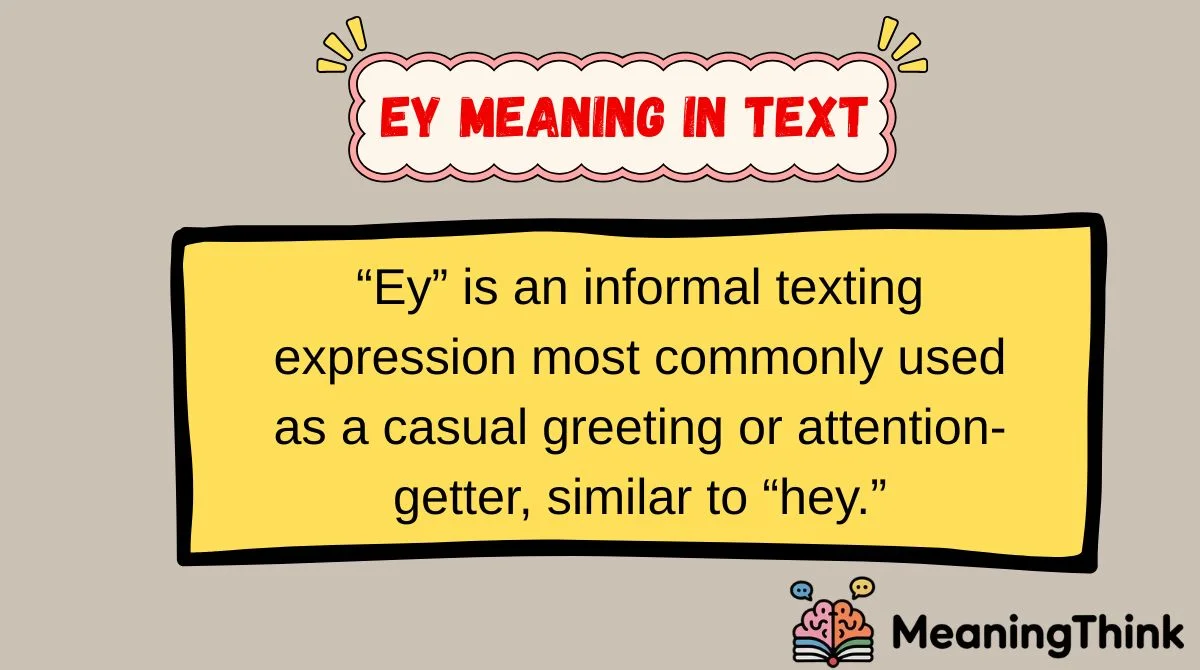
“Ey” is an informal texting expression most commonly used as a casual greeting or attention-getter, similar to “hey.” It can also express surprise, excitement, agreement, or a friendly call for someone’s attention. The exact meaning depends on context, tone, punctuation, and the relationship between the people communicating.
Detailed Meaning Breakdown
Primary Meaning: A Casual Greeting
The most common meaning of ey is simply “hey.” People often shorten words when texting, and dropping the h makes the message even quicker to type.
Examples
Most common
“Ey, what are you doing?”
= “Hey, what are you doing?”
“Ey! Long time no see.”
= Friendly greeting
This use is common among friends, classmates, siblings, and online communities.
Secondary Meaning: Getting Attention
Sometimes ey functions like a verbal tap on the shoulder.
Examples
Attention
“Ey, listen to this.”
= “Hey, pay attention.”
“Ey, check your email.”
= Friendly reminder
Secondary Meaning: Surprise or Reaction
In some conversations, ey expresses a quick emotional reaction.
Examples
Reaction
“Ey! That was amazing.”
= Excitement or admiration
“Ey, seriously?”
= Surprise or disbelief
Rare Meaning: Agreement or Approval
In certain regional dialects and online communities, ey can indicate approval.
Examples
Less common
“We won the game.”
“Ey!”
= “Nice!” or “Great!”
What “ey” Means in Different Situations
Everyday Texting
In regular text conversations, ey is usually a relaxed replacement for hey.
Message
Meaning
“Ey, you free?”
Checking availability
“Ey bro”
Friendly greeting
“Ey, call me”
Requesting contact
Texting tends to favor shorter forms, so ey feels quick and casual.
Social Media Platforms
On platforms such as Instagram, TikTok, Snapchat, Facebook, and X, ey often appears in comments, captions, or direct messages.
Post
Meaning
“Ey 🔥”
Impressed
“Ey nice fit”
Compliment
“Ey 😂”
Amused reaction
Emojis usually help clarify the intended emotion.
Dating & Relationships
In dating conversations, ey can feel less formal than hello.
Examples
Flirty / Casual
“Ey 😊”
= Soft, friendly opening
“Ey, missed you today.”
= Affectionate and conversational
The shorter spelling may feel more playful and less serious.
Professional Communication
In workplaces, schools, or formal emails, ey is generally not appropriate.
Instead of
Use
“Ey, send the report”
“Hi, please send the report.”
“Ey professor”
“Hello Professor”
Using ey in formal settings can appear careless or overly familiar.
Cultural or Regional Differences
In some Spanish-speaking, Latin American, and multicultural online communities, ey may sound closer to “eh” or “hey” and can carry a friendly conversational tone.
Examples include:
- “Ey, amigo”
- “Ey, qué pasó?”
The meaning remains informal and social rather than technical.
Psychological & Tone Analysis
Why People Use It
People choose ey because it is:
- Faster to type
- Less formal than “hello”
- Warmer than a direct request
- Common in mobile messaging culture
What It Signals Socially
Signal
Meaning
“We know each other”
Familiarity
“This is casual”
Relaxed interaction
“I’m comfortable”
Informal relationship
“I want attention”
Conversation starter
Emotional Layer
The punctuation changes the emotional tone:
| Form | Emotion |
|---|---|
| ey | Neutral |
| ey! | Excited |
| ey? | Questioning |
| eyyy | Playful or enthusiastic |
| EY! | Strong attention or emphasis |
15 Real Conversation Examples (Explained)
1
“Ey, are you home?”
Meaning: Casual greeting before a question.
2
“Ey! You made it.”
Meaning: Happy to see someone.
3
“Ey bro, check this out.”
Meaning: Friendly attention-getter.
4
“Ey 😂”
Meaning: Laughing reaction.
5
“Ey, no way!”
Meaning: Surprise or disbelief.
6
“Ey 😊”
Meaning: Warm, friendly greeting.
7
“Ey, where did everyone go?”
Meaning: Seeking information.
8
“Ey! Great job on the project.”
Meaning: Praise and enthusiasm.
9
“Ey, can we talk?”
Meaning: Gentle conversation opener.
10
“Ey man, thanks.”
Meaning: Informal appreciation.
11
“Ey, seriously?”
Meaning: Skepticism.
12
“Ey, I’m outside.”
Meaning: Informing someone of arrival.
13
“Ey 🔥🔥”
Meaning: Strong approval.
14
“Ey, don’t forget tomorrow.”
Meaning: Friendly reminder.
15
“Eyyy, let’s go!”
Meaning: Excitement and celebration.
When “ey” Can Be Misunderstood
Context Confusion
Without punctuation, ey can be unclear.
“Ey”
Is it a greeting? A reaction? A call for attention? The surrounding message usually reveals the meaning.
Generational Gap
Older users may interpret ey as a typo for hey, while younger users often recognize it immediately as intentional slang.
Platform Differences
| Platform | Common Interpretation |
|---|---|
| Text messages | Greeting |
| Instagram comments | Reaction or compliment |
| TikTok | Excitement |
| Gaming chat | Attention-getter |
| Usually inappropriate |
Similar Words, Symbols, or Abbreviations
| Term | Meaning |
|---|---|
| hey | Standard casual greeting |
| yo | Informal greeting |
| sup | “What’s up?” |
| hiya | Friendly hello |
| heyy | Extra friendly or flirty hello |
| eiii | Playful variation in some regions |
| eh | Questioning or conversational tag |
| 👋 | Waving hello |
| 🔥 | Approval or excitement |
| 😂 | Laughter reaction |
When Not to Use “ey”
Professional Risks
Avoid ey in:
- Job applications
- Business emails
- Client messages
- Academic submissions
Cultural Risks
Some people may see ey as too casual, especially in formal cultures or with people you do not know well.
Tone Risks
Using ey before criticism can sound abrupt.
Avoid
“Ey, your work has problems.”
Better
“Hi, I’d like to discuss a few improvements.”
Expert Tips for Using “ey” Correctly
- Use it with people you already know. It works best among friends and peers.
- Add punctuation for clarity. “Ey?” and “Ey!” communicate different emotions.
- Pair it with emojis when needed. Emojis reduce misunderstanding.
- Avoid it in formal writing. Choose “Hello” or “Hi” instead.
- Consider the platform. Casual apps are safer places to use slang.
- Match the other person’s tone. If they write formally, respond formally.
- Don’t overuse extended versions. “Eyyyyyyyy” can look immature in some contexts.
- Use it as an opener, not a replacement for clear communication. The main message should still be understandable.
FAQs
Is “ey” the same as “hey”?
Yes, in most text conversations ey is simply a shortened, more informal version of hey.
What does “ey” mean from a girl?
Usually it means hello, hey, or a casual attempt to start a conversation. The tone depends on emojis, punctuation, and the relationship between the two people.
What does “ey” mean from a guy?
Most commonly it is a friendly greeting or attention-getter. It does not automatically imply flirting.
Is “ey” considered slang?
Yes. It is informal internet and texting slang derived from hey.
What does “eyy” or “eyyy” mean?
Adding extra letters usually increases enthusiasm, friendliness, excitement, or playfulness.
Can “ey” be rude?
By itself, usually no. However, it can sound abrupt if used with criticism or commands.
Should I use “ey” in an email?
No. Professional emails should generally use Hi, Hello, or a more formal greeting.
Why do people spell “hey” as “ey”?
People often shorten words in digital communication to type faster and create a more casual, conversational tone.
Final Summary
“Ey” in text most commonly means “hey”—a quick, informal greeting used to start a conversation or get someone’s attention. Depending on context, it can also express surprise, excitement, approval, or playful energy.
The key to understanding ey is context. Look at:
- The rest of the message
- Punctuation
- Emojis
- Your relationship with the sender
- The platform where it appears
For casual texting and social media, ey is perfectly normal and widely understood. For professional or formal communication, stick with Hi, Hello, or a complete greeting.
When used appropriately, ey can make conversations feel friendly, relaxed, and natural—helping you communicate with confidence in modern digital culture.