You’re texting someone, and they reply with a simple “)” — nothing else. No words. No emoji. Just that one symbol. You pause. Is it friendly? Awkward? Passive-aggressive? Or did they just hit the wrong key?
This small symbol creates big confusion. In modern texting and online communication, even a single character can carry emotional tone, intention, and social meaning. The “)” is one of those subtle signals that people use without thinking — but interpreting it correctly can make or break a conversation.
This guide removes all guesswork. You’ll learn exactly what “)” means, how it’s used across platforms, and what it says about the sender’s tone and intent. By the end, you’ll understand when it’s friendly, when it feels cold, and how to use it naturally in your own messages.
Quick Definition of “)”
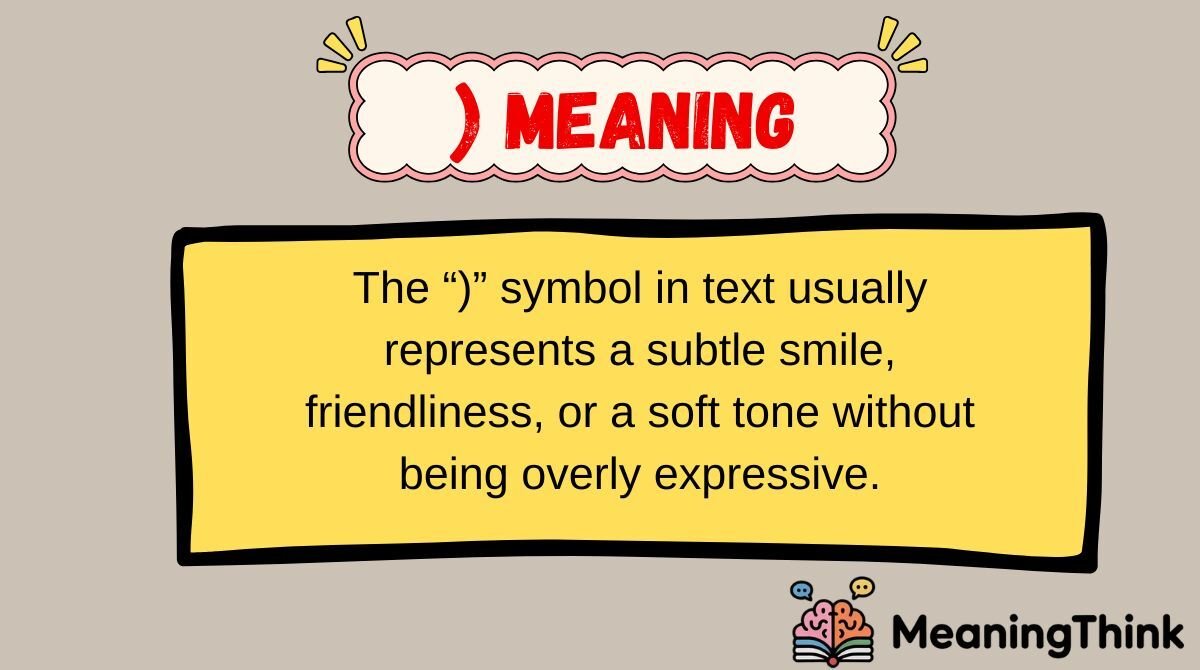
The “)” symbol in text usually represents a subtle smile, friendliness, or a soft tone without being overly expressive. It often replaces a full emoji like 🙂 and adds a light, casual emotional layer to a message.
Secondary meanings can include:
- Politeness or softening tone
- Slight sarcasm or dryness (depending on context)
- Minimal emotional expression
Detailed Meaning Breakdown
Primary Meaning
At its core, “)” is a simplified smile. It comes from the classic emoticon “:)”, where the colon represents eyes and the parenthesis represents a smiling mouth. Over time, people dropped the colon for speed and style, leaving just “)”.
This creates a softer, less expressive smile than full emojis.
Secondary Meanings
Depending on context, “)” can signal:
- Subtle friendliness
A light, calm tone — not overly excited. - Emotional restraint
The sender is being polite but not overly warm. - Low-effort positivity
A quick way to avoid sounding rude.
Rare Meanings
In some cases, “)” may indicate:
- Awkwardness — when someone doesn’t know what else to say
- Dry humor or sarcasm — especially if the message content is ambiguous
- Passive tone — when used after blunt statements
What “)” Means in Different Situations
Everyday Texting
In casual chats, “)” usually means:
- Friendly tone
- Relaxed conversation
- Not overly emotional
Example:
“Okay)” → Friendly but not excited
Social Media Platforms
On platforms like Twitter, Instagram, or TikTok comments:
- It adds a soft emotional touch
- Feels more personal than plain text
- Less expressive than emojis
Example:
“Nice post)” → Supportive but subtle
Dating & Relationships
Here, “)” becomes more nuanced:
- Early stages → polite interest
- Flirting → very mild, almost neutral
- Established relationships → normal and comfortable
Example:
“Good night)” → Gentle, calm affection (not intense)
Professional Communication
In work settings, “)” is risky but sometimes used:
- Makes tone less harsh
- Adds friendliness in informal chats
- Can appear unprofessional in formal emails
Example:
“Please send the file)” → Softer than without it
Cultural or Regional Differences
In some regions (especially Eastern Europe):
- “)” is used frequently
- Multiple parentheses mean stronger emotion
- “))” = happy
- “)))” = very happy
In Western cultures:
- A single “)” is more common
- Multiple may feel unusual
Psychological & Tone Analysis
Why People Use It
People use “)” because it’s:
- Faster than emojis
- Less expressive (safer emotionally)
- Habitual for long-time internet users
What It Signals Socially
Using “)” suggests:
- You are approachable
- You’re keeping things casual
- You don’t want to appear too intense
Emotional Layer Behind It
Compared to 🙂:
- “)” = subtle, controlled emotion
- 🙂 = clear, visible emotion
It often reflects emotional restraint — the sender is being nice, but not overly expressive.
15 Real Conversation Examples (Explained)
- “Thanks)”
→ Friendly gratitude, slightly soft tone - “Okay)”
→ Agreement, but not excited - “Sure)”
→ Polite acceptance - “I see)”
→ Neutral acknowledgment, possibly distant - “That’s funny)”
→ Mild amusement, not laughing hard - “Good job)”
→ Encouraging but calm - “No worries)”
→ Reassuring and relaxed - “Alright)”
→ Ending conversation politely - “Maybe later)”
→ Soft rejection - “It’s fine)”
→ Could be genuine or slightly passive-aggressive - “I’ll think about it)”
→ Uncertain, possibly avoiding decision - “Sounds good)”
→ Positive but not enthusiastic - “Okay then)”
→ Slight emotional distance - “Whatever)”
→ Often passive-aggressive or dismissive - “Good night)”
→ Calm, gentle closure
When “)” Can Be Misunderstood
Context Confusion
Without tone or voice, “)” can feel:
- Friendly
- Cold
- Passive-aggressive
Example:
“It’s fine)” → Could mean “it’s NOT fine”
Generational Gap
- Younger users prefer emojis
- Older users prefer “)”
This creates misinterpretation:
- Younger people may see it as dry
- Older people see it as friendly
Platform Differences
- Messaging apps → normal
- Emails → may seem unprofessional
- Social media → neutral
Similar Words, Symbols, or Abbreviations
- 🙂 — Classic smile, more expressive
- 🙂 — Clear friendly emoji
- 😊 — Warm and kind
- :)) — Stronger happiness
- )) — Casual happiness (regional style)
- lol — Laughing tone
- haha — Light humor
- 😂 — Strong laughter
- 👍 — Approval or agreement
- ^_^ — Playful happiness
When Not to Use “)”
Professional Risks
Avoid in:
- Formal emails
- Job applications
- Business proposals
It may seem:
- Unprofessional
- Too casual
Cultural Risks
In some cultures:
- It may feel confusing
- Not widely used
Tone Risks
Avoid when:
- Delivering serious news
- Addressing conflict
- Giving criticism
Example:
“You made a mistake)” → Feels passive-aggressive
Expert Tips for Using “)” Correctly
- Use it to soften short messages
- Avoid overusing it in serious conversations
- Match the other person’s tone
- Don’t rely on it to express strong emotions
- Combine with clear wording to avoid confusion
- Use emojis when clarity matters more
- Avoid using it after negative statements
- Keep it minimal — one is enough
FAQs
What does “)” mean in texting?
It usually means a subtle smile or friendly tone without strong emotion.
Is “)” the same as 🙂?
No. “)” is more subtle and less expressive than the emoji.
Why do people use “)” instead of emojis?
It’s faster, simpler, and feels less emotionally intense.
Can “)” be passive-aggressive?
Yes, depending on context — especially after negative statements.
What does “))” mean?
It shows stronger happiness or friendliness, often used in some regions.
Is “)” rude?
Not usually, but it can feel cold or distant if used incorrectly.
Should I use “)” in professional messages?
Only in informal chats — avoid in formal communication.
Does “)” mean flirting?
Not strongly. It can show mild friendliness but not clear romantic interest.
Final Summary
The “)” symbol is small but powerful. It adds tone, softens messages, and helps avoid sounding too direct. At its best, it creates a calm, friendly vibe. At its worst, it can feel distant or passive-aggressive.
The key is context.
Use it when you want to sound polite but relaxed. Avoid it when clarity or emotional depth matters. Always consider the platform, the relationship, and the message itself.
Mastering subtle signals like “)” helps you communicate more clearly — even without words.