You’re texting someone, and they suddenly reply with “smw.” You pause. Is it a typo? A slang term? Something sarcastic? You reread the message, trying to figure it out—but the meaning isn’t obvious.
This is a common situation in modern digital communication. Abbreviations evolve quickly, and new ones appear faster than most people can keep up with. “smw” is one of those short, ambiguous terms that can mean different things depending on context, tone, and even the platform where it’s used.
If you’ve ever felt confused by this acronym, you’re not alone. Many people misinterpret it or miss the subtle tone behind it entirely.
This guide will give you complete clarity. You’ll learn exactly what “smw” means, how to use it correctly, when to avoid it, and how to interpret it in real conversations. By the end, you’ll be able to understand and use “smw” confidently in any situation.
Quick Definition of “smw”
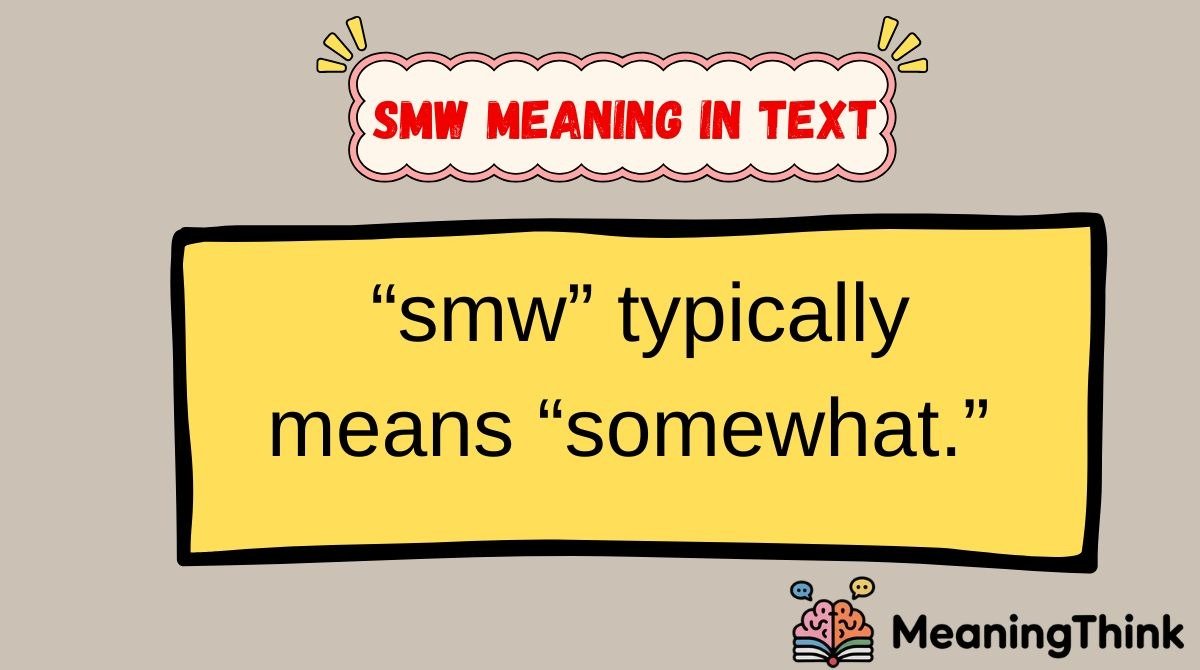
“smw” typically means “somewhat.” It is used to express partial agreement, uncertainty, or a moderate degree of feeling.
In some contexts, it can also mean:
- “So much win” (rare, positive slang)
- A shortened or stylized response indicating mild approval or hesitation
Detailed Meaning Breakdown
Primary Meaning: “Somewhat”
The most widely accepted meaning of “smw” in texting is “somewhat.”
It softens a statement. Instead of sounding absolute or strong, it adds a layer of uncertainty or moderation.
Example:
- “I like it smw” → I like it, but not fully
This makes communication feel more casual and less intense.
Secondary Meanings
- Soft Agreement
- Used when you agree, but not strongly
- Example: “smw yeah” → kind of yes
- Hesitation or Uncertainty
- Shows you’re unsure or not fully convinced
- Example: “smw true” → partly true
- Low-Energy Response
- Sometimes signals minimal effort or lack of enthusiasm
- Example: replying “smw” alone can feel neutral or dismissive
Rare Meanings
- “So Much Win”
- Older internet slang
- Used sarcastically or humorously
- Rare in modern texting
What “smw” Means in Different Situations
Everyday Texting
In casual chats, “smw” is used to soften opinions.
- “That movie was good smw”
- “I agree smw”
It keeps conversations relaxed and avoids sounding too strong or opinionated.
Social Media Platforms
On platforms like Instagram, TikTok, or X:
- Used in comments or captions
- Often paired with humor or sarcasm
Example:
- “This trend is fun smw”
It reflects mild engagement without full commitment.
Dating & Relationships
Here, “smw” becomes more sensitive.
- “I like you smw” → can feel unclear or emotionally distant
- “smw interested” → suggests hesitation
In relationships, it may signal uncertainty or emotional caution.
Professional Communication
“smw” is generally inappropriate in formal settings.
- It can appear unclear or unprofessional
- Better alternatives: “somewhat,” “partially,” “to some extent”
Example:
- Avoid: “I agree smw”
- Use: “I somewhat agree”
Cultural or Regional Differences
- More common among younger users
- Less understood by older generations
- Usage may vary depending on online communities
In some regions, it may not be recognized at all.
Psychological & Tone Analysis
Why People Use It
People use “smw” for efficiency and tone control.
- Saves time while typing
- Softens statements
- Avoids conflict
What It Signals Socially
“smw” often signals:
- Mild agreement
- Emotional distance
- Uncertainty
- Casual tone
It can also show that someone doesn’t want to fully commit to an opinion.
Emotional Layer Behind It
Depending on context, “smw” can feel:
- Neutral
- Indifferent
- Slightly hesitant
- Politely reserved
In some cases, it may come across as low effort or disengaged.
15 Real Conversation Examples (Explained)
- “That show is good smw”
→ They like it, but not strongly. - “smw agree with you”
→ Partial agreement. - “I’m excited smw”
→ Mild excitement, not fully enthusiastic. - “smw tired today”
→ Slightly tired, not exhausted. - “That idea works smw”
→ It’s okay, but not perfect. - “smw true tbh”
→ Somewhat true, but with doubt. - “I get it smw”
→ Partial understanding. - “smw interested in going”
→ Not fully committed. - “That was funny smw”
→ Slightly amusing. - “smw yes”
→ Hesitant agreement. - “I like the design smw”
→ Mild approval. - “smw confusing tho”
→ Partially confusing. - “I agree smw but not fully”
→ Reinforces partial agreement. - “smw better than before”
→ Improvement, but limited. - “That’s cool smw”
→ Casual, low-energy approval.
When “smw” Can Be Misunderstood
Context Confusion
Without context, “smw” can feel vague.
- Is it agreement?
- Is it sarcasm?
- Is it indifference?
This ambiguity can lead to misinterpretation.
Generational Gap
Older users may not recognize “smw.”
- They may think it’s a typo
- Or misread the tone entirely
Platform Differences
- On casual platforms → acceptable
- In formal emails → confusing or inappropriate
Context always matters.
Similar Words, Symbols, or Abbreviations
- kinda – Informal version of “kind of”
- sorta – Casual “sort of”
- imo – In my opinion
- tbh – To be honest
- idk – I don’t know
- meh – Indifference or lack of interest
- ish – Approximate or uncertain
- ngl – Not gonna lie
- fr – For real
- lowkey – Slightly or secretly
Each of these carries a similar tone of softness or moderation.
When Not to Use “smw”
Professional Risks
Avoid using “smw” in:
- Emails
- Reports
- Business chats
It may appear unprofessional or unclear.
Cultural Risks
If the other person is unfamiliar with slang:
- It may confuse them
- It may reduce clarity
Tone Risks
“smw” can sometimes sound:
- Indifferent
- Uninterested
- Passive
In emotional conversations, it may weaken your message.
Expert Tips for Using “smw” Correctly
- Use it only in casual conversations
- Avoid it in serious or emotional discussions
- Pair it with clear context to reduce confusion
- Don’t overuse it—it can sound lazy
- Know your audience before using slang
- Replace it with full words in formal settings
- Use it to soften opinions, not to avoid clarity
- Be aware of tone—it can feel distant if used poorly
FAQs
What does “smw” stand for in texting?
It usually stands for “somewhat,” meaning partially or moderately.
Is “smw” a positive or negative term?
It is neutral. The tone depends on context and how it’s used.
Can “smw” be used in formal writing?
No, it is informal slang and should be avoided in professional communication.
Why do people use “smw” instead of “somewhat”?
It’s faster to type and fits casual texting style.
Does “smw” mean agreement?
It can mean partial agreement, but not full agreement.
Is “smw” commonly used in 2026?
Yes, but mainly in informal digital communication among younger users.
Can “smw” sound rude?
Yes, if it comes across as low effort or emotionally distant.
What’s the difference between “smw” and “kinda”?
Both mean similar things, but “kinda” is more widely understood.
Final Summary
“smw” is a simple but nuanced texting abbreviation that mainly means “somewhat.” It helps people express partial agreement, mild feelings, or uncertainty without sounding too strong.
However, its strength is also its weakness. Because it softens meaning, it can sometimes feel vague or unclear. In casual conversations, it works well. In professional or emotional contexts, it can create confusion or weaken your message.
The key to using “smw” effectively is understanding tone and audience. Use it when you want to sound relaxed and non-committal—but avoid it when clarity matters.
When used correctly, it’s a useful tool for modern communication.