You’re texting a friend, and they reply with “preesh.” You pause. Is it a typo? Slang? Something sarcastic? Y
ou’ve probably seen it in chats, social media comments, or even casual group messages—and it’s not always clear what it means.
Modern texting language moves fast. Words get shortened, meanings shift, and tone can be tricky to read.
“Preesh” is one of those terms that feels obvious once you know it—but confusing until you do.
This guide breaks it all down. You’ll learn exactly what “preesh” means, where it came from, how people use it in different situations, and how to avoid using it the wrong way.
By the end, you’ll understand not just the definition, but the tone, psychology, and real-world usage—so you can read and use it with confidence.
Quick Definition of “preesh meaning in text”
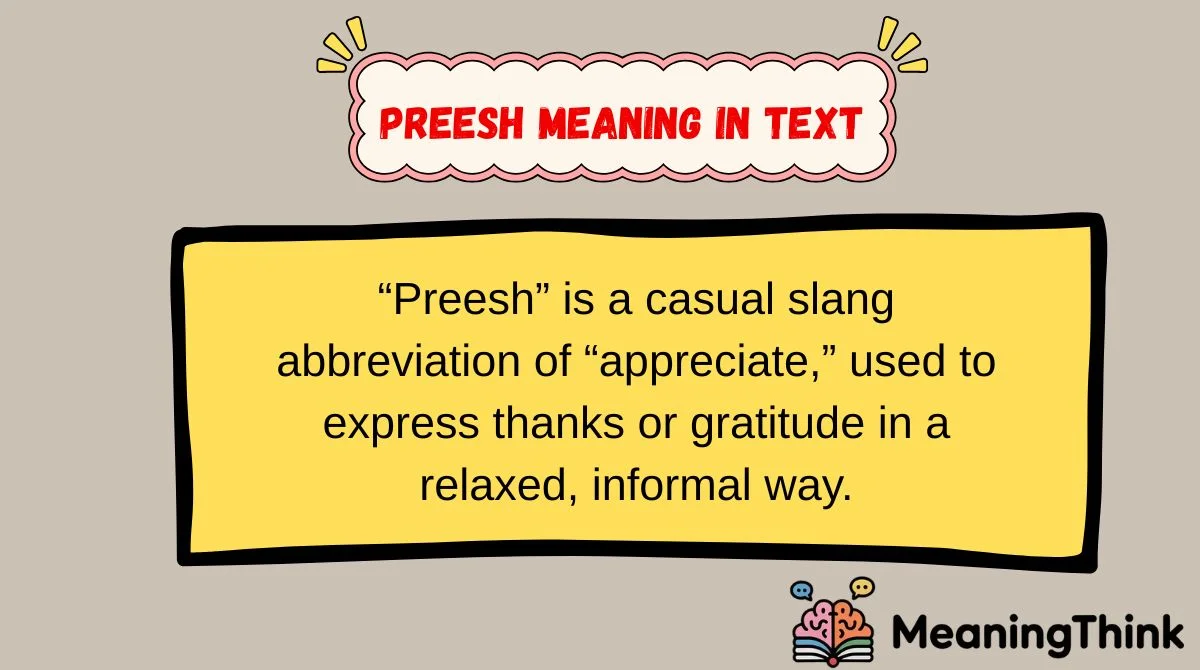
“Preesh” is a casual slang abbreviation of “appreciate,” used to express thanks or gratitude in a relaxed, informal way.
It can also carry a friendly, laid-back tone or even mild sarcasm depending on context.
Detailed Meaning Breakdown
Primary Meaning
At its core, “preesh” is short for “appreciate.”
Instead of saying:
- “I appreciate it”
People say: - “Preesh”
It’s quick, informal, and fits perfectly in fast-paced texting. It shows gratitude without sounding overly formal or serious.
Secondary Meanings
While the main meaning is gratitude, “preesh” can also:
- Show acknowledgment: “Got it, thanks.”
- Signal casual friendliness: It keeps the tone light.
- Add personality: It makes messages feel more human and less robotic.
Rare Meanings
In some cases, “preesh” may be used:
- Sarcastically: “Yeah, preesh…” (meaning the opposite)
- Playfully: Especially among close friends
Tone and context are everything here.
Preesh Meaning Appreciate
Preesh is a casual slang abbreviation of “appreciate” and is commonly used in texting, social media, and everyday online conversations. People usually say “preesh” when they want to thank someone for doing something helpful, kind, or thoughtful. It has a relaxed and friendly tone, making it more suitable for casual conversations than formal writing. For example, if a friend sends you useful information, you might reply, “Preesh!” to mean “I appreciate it” or “Thanks, I appreciate that.” The word is popular because it is short, easy to type, and sounds natural in informal conversations. Depending on the situation, preesh can also express gratitude without sounding overly serious or formal. You may see it in text messages, TikTok comments, Instagram DMs, gaming chats, and other online spaces. While it is generally positive, the exact tone can depend on the conversation. When used sincerely, it simply communicates appreciation and thanks.
What “preesh” Means in Different Situations
Everyday Texting
In daily chats, “preesh” is a quick way to say thanks.
Example:
- “I sent you the file.”
- “Preesh!”
It replaces longer phrases like:
- “Thanks”
- “Much appreciated”
Social Media Platforms
On platforms like Instagram, TikTok, or X:
- Used in comments: “Preesh the support!”
- Used in captions: “Preesh y’all for showing love”
It often feels more expressive than a simple “thanks.”
Dating & Relationships
In romantic or casual dating contexts:
- It can sound warm but not too intense
- Example: “You remembered? Preesh 😊”
It keeps things light without sounding overly emotional.
Professional Communication
Here’s where caution matters.
- “Preesh” is usually too informal for work emails or formal chats
- It may be acceptable in:
- Slack messages
- Friendly team environments
Example:
- “Preesh the quick turnaround!”
Cultural or Regional Differences
“Preesh” is more common in:
- American slang culture
- Younger demographics (Gen Z, Millennials)
In more formal or non-English-speaking environments, it may not be understood.
Psychological & Tone Analysis
Why People Use It
People use “preesh” because:
- It saves time
- It feels casual and friendly
- It avoids sounding stiff or formal
What It Signals Socially
Using “preesh” often signals:
- You’re relaxed and approachable
- You’re part of modern texting culture
- You’re comfortable with the person
Emotional Layer Behind It
“Preesh” carries:
- Light gratitude (not heavy emotion)
- Friendly tone
- Sometimes playful energy
Compared to “I really appreciate it,” it feels less serious and more conversational.
15 Real Conversation Examples (Explained)
- “Sent you the notes.”
“Preesh!”
→ Simple thank you. - “I covered your shift.”
“Preesh, you’re the best.”
→ Gratitude + warmth. - “Here’s the link you asked for.”
“Preesh 🙌”
→ Appreciation with enthusiasm. - “I fixed your code.”
“Preesh bro.”
→ Casual, friendly thanks. - “Got your coffee.”
“Preesh ☕”
→ Everyday gratitude. - “I reminded them about your request.”
“Preesh, seriously.”
→ Slightly deeper appreciation. - “You forgot to reply.”
“Yeah, I know. Preesh…”
→ Mild sarcasm. - “I tagged you in the post.”
“Preesh!”
→ Social media acknowledgment. - “I helped you move.”
“Preesh big time.”
→ Strong appreciation. - “I stayed up to help you.”
“Preesh, that means a lot.”
→ Emotional layer added. - “I handled the meeting for you.”
“Preesh 🙏”
→ Respect + thanks. - “You owe me now 😄”
“Preesh lol”
→ Playful tone. - “I told them you did a great job.”
“Preesh!”
→ Appreciation for support. - “I fixed your mistake.”
“Preesh… I owe you one.”
→ Gratitude with accountability. - “I reminded you again.”
“Yeah yeah, preesh 😅”
→ Slight humor + acknowledgment.
When “preesh” Can Be Misunderstood
Context Confusion
Without tone or emojis, “preesh” can feel:
- Genuine
- Or sarcastic
Example:
- “Preesh.” (Could sound cold or grateful)
Generational Gap
Older users may:
- Not recognize the term
- Think it’s a typo
Younger users understand it instantly.
Platform Differences
- Works well in texting and social media
- May feel out of place in emails or formal apps
Similar Words, Symbols, or Abbreviations
- Thx – Short for “thanks”
- TY – “Thank you”
- TYSM – “Thank you so much”
- Appreciate it – Full version of “preesh”
- Much obliged – Formal gratitude
- 🙏 (prayer hands emoji) – Respectful thanks
- 👍 (thumbs up) – Quick acknowledgment
- Cheers – Casual thanks (common in UK)
- Grateful – Deeper emotional thanks
- Props – Giving credit or respect
When Not to Use “preesh”
Professional Risks
Avoid in:
- Job applications
- Formal emails
- Client communication
Example (bad):
- “Preesh your time.”
Cultural Risks
If the audience:
- Isn’t familiar with slang
- Speaks English as a second language
It may confuse them.
Tone Risks
Avoid when:
- Serious gratitude is needed
- Emotional depth matters
Example:
- Instead of “preesh,” say:
- “I truly appreciate your help.”
Expert Tips for Using “preesh” Correctly
- Know your audience
Use it with friends or peers, not formal contacts. - Match the tone
If the conversation is casual, “preesh” fits. - Add emojis for clarity
Prevents misinterpretation:- “Preesh 🙏” = sincere
- “Preesh 😅” = playful
- Avoid overuse
Using it too often can feel lazy. - Use it for light gratitude
Not for serious or emotional thanks. - Pair it with context
Example:- “Preesh, that helped a lot.”
- Watch for sarcasm
Be careful—it can sound dismissive. - Adapt to platform
Great for texts, less for emails.
FAQs
What does “preesh” mean in texting?
It means “appreciate” or “thanks,” used in a casual and informal way.
Is “preesh” rude or polite?
It’s polite in casual settings, but can seem lazy or unclear in formal situations.
Is “preesh” slang?
Yes, it’s modern slang derived from “appreciate.”
Can “preesh” be sarcastic?
Yes, depending on tone and context, it can be used sarcastically.
Who uses “preesh” the most?
Mostly younger people, especially Gen Z and Millennials.
Can I use “preesh” at work?
Only in informal chats with colleagues—not in formal communication.
Is “preesh” the same as “thanks”?
Yes, but more casual and relaxed.
How do you respond to “preesh”?
You can say:
- “Anytime!”
- “No problem!”
- “Got you!”
Big Preesh Meaning
Big preesh is an informal way of saying “big appreciation,” “I really appreciate it,” or “thanks a lot.” The word “big” adds emphasis, so it shows more gratitude than simply saying “preesh.” Someone might say “big preesh” after receiving a favor, helpful advice, a compliment, or support from another person. For example, if your friend helps you finish an important task, you could respond, “Big preesh!” to show that you are especially thankful. The phrase is casual, friendly, and commonly suited to texts, social media, group chats, and conversations between friends. It does not usually sound formal, so you would generally avoid using it in professional emails or official communication. The phrase can also be used playfully, depending on the relationship between the people talking. In simple terms, “big preesh” means “I really appreciate you” or “thanks so much.” It is a quick way to show genuine gratitude while keeping the conversation relaxed and natural.
Final Summary
“Preesh” is a simple but powerful piece of modern slang.
It means “appreciate” and works as a quick, casual way to say thanks. It fits best in relaxed conversations—texts, social media, and friendly chats.
But like all slang, it depends on context. Used correctly, it makes you sound natural and approachable. Used incorrectly, it can feel unclear or unprofessional.
The key is balance. Know your audience, match the tone, and use it where it feels natural. When in doubt, go with a clearer phrase.
Mastering small words like “preesh” helps you communicate better in today’s fast digital world—where tone, speed, and clarity all matter.