Have you ever received a message that simply says “O” and wondered what the sender actually meant?
Maybe a friend replied with “O” after you shared some news. Perhaps you saw someone comment “O” on TikTok or Instagram.
Or maybe someone texted “O…” during a conversation, leaving you confused about whether they were surprised, disappointed, or simply acknowledging your message.
The truth is that “O” is one of the shortest yet most flexible expressions used in digital communication. Its meaning changes depending on the conversation, the platform, punctuation, and even the relationship between the people talking.
A single letter can express surprise, understanding, hesitation, disappointment, excitement, or even emotional silence.
Because texting relies on short messages and limited context, interpreting “O” isn’t always straightforward. The same reply can sound friendly in one conversation and cold in another.
This guide explains everything you need to know about the O meaning in text, including its definitions, different uses, examples, emotional tone, common misunderstandings, and practical tips for using it correctly in everyday conversations.
Quick Definition of “O”
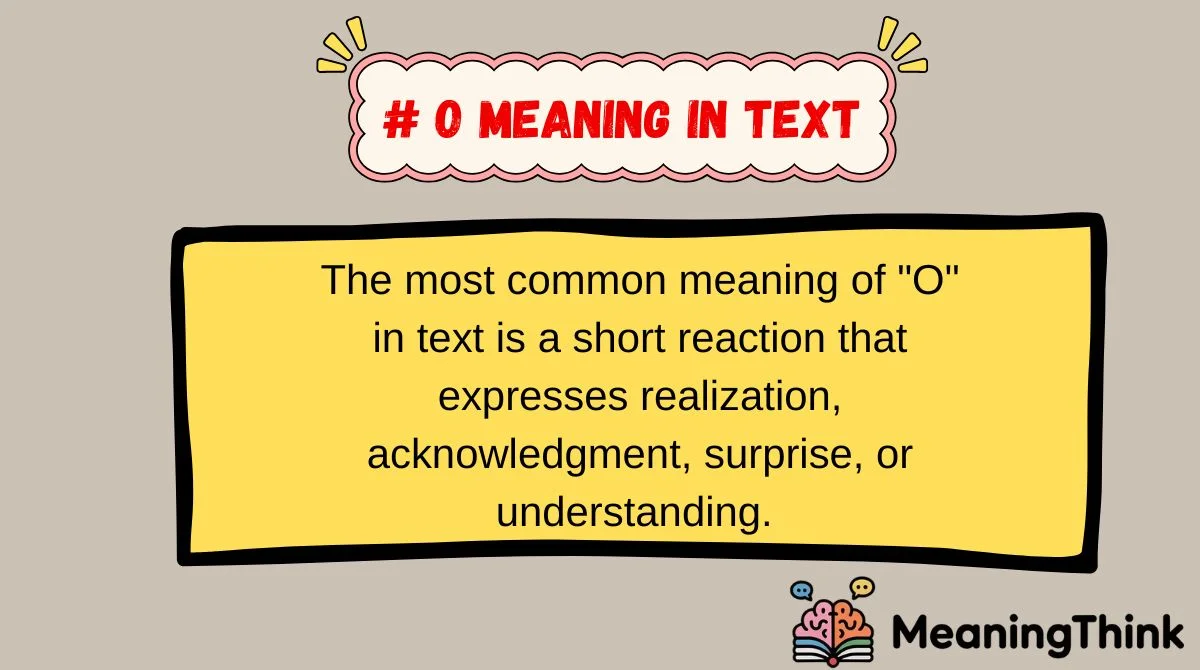
The most common meaning of “O” in text is a short reaction that expresses realization, acknowledgment, surprise, or understanding. Depending on the context, it can also show hesitation, disappointment, curiosity, or simply act as a brief response before continuing the conversation.
Unlike many internet abbreviations, “O” doesn’t have one fixed definition. Instead, its meaning depends almost entirely on the surrounding conversation, punctuation, emojis, and the sender’s tone.
Detailed Meaning Breakdown
The Primary Meaning: A Short Reaction
In modern texting, “O” usually serves as an immediate reaction.
Rather than typing a full sentence like:
- “Oh, I understand.”
- “Oh, really?”
- “Oh, that’s interesting.”
- “Oh, okay.”
People often shorten everything to a simple “O.”
The message saves time while still acknowledging what another person said.
For example:
Person A: I finally passed my driving test.
Person B: O nice! Congratulations!
Here, “O” works the same as saying “Oh!”
“O” as Realization
Many people type “O” when they suddenly understand something.
Instead of writing:
Oh, now I get it.
they simply write:
O, that makes sense.
This meaning is especially common in casual chats with friends or classmates.
Example:
Alex: The meeting starts at 3 PM, not 2 PM.
Jordan: O, thanks for letting me know.
In this situation, “O” signals that Jordan has understood the correction.
“O” as Surprise
Sometimes “O” expresses unexpected news.
Imagine someone sends:
I won free concert tickets.
A reply of:
O!
shows immediate surprise.
Adding punctuation changes the emotional strength.
Compare these:
- O
- O.
- O!
- O??
- O…
Each version carries a slightly different feeling.
“O” as Acknowledgment
Sometimes the sender simply wants to show they have seen your message.
Example:
You: I’ll be about 20 minutes late.
Friend: O.
This doesn’t necessarily mean they’re upset.
It often means:
- I understand.
- Got it.
- Okay.
- Thanks for telling me.
The context determines whether it sounds neutral or cold.
“O” as Disappointment
Sometimes “O” reflects disappointment.
Imagine this conversation:
You: Sorry, I can’t come tonight.
Friend: O…
The three dots change everything.
Instead of simple acknowledgment, the message now feels emotional.
It may suggest:
- That’s unfortunate.
- I was looking forward to it.
- That’s disappointing.
“O” as Hesitation
A single letter can also show someone is thinking.
For example:
Friend: Do you really think that’s a good idea?
You: O… maybe you’re right.
Here, “O…” introduces uncertainty before the speaker changes their opinion.
“O” as Emotional Silence
Sometimes people don’t know what to say.
Instead of sending a long message, they reply with:
O
This often happens after hearing shocking or unexpected news.
Example:
Friend: My family is moving overseas next month.
You: O…
The response communicates that you’re processing the information.
Rare Meanings of “O”
Although uncommon, “O” can have other meanings depending on the situation.
A poetic expression
Older literature often uses “O” as an emotional way to address someone.
Example:
O Lord
O friend
This usage is rare in modern texting but still appears in quotes, songs, speeches, and religious writing.
Part of another abbreviation
Sometimes “O” is not a standalone message.
It may appear within abbreviations such as:
- OMW (On My Way)
- OMG (Oh My God)
- OTP (One True Pairing)
- OOO (Out Of Office)
In these cases, the letter itself doesn’t carry the standalone meanings discussed earlier.
A typing habit
Some people naturally shorten “Oh” to “O” simply because it’s faster to type.
They don’t intend any hidden meaning.
It’s just their texting style.
What “O” Means in Different Situations
Everyday Texting
In personal conversations, “O” usually replaces “Oh.”
Friends often use it to respond quickly without typing complete sentences.
Examples include:
- O okay.
- O really?
- O nice.
- O wow.
- O that’s cool.
The tone is generally casual and friendly.
Because texting is informal, people naturally shorten words whenever possible.
For many users, typing “O” feels quicker than writing “Oh” while still expressing the same reaction.
For example:
Emma: I finally finished my exams.
Liam: O nice! Now you can relax.
Here, the message communicates excitement and acknowledgment at the same time.
Another common situation is when someone shares information.
Sophia: The restaurant closes at 9 tonight.
Noah: O, good thing you told me.
In this conversation, “O” shows realization rather than surprise.
Sometimes people also use “O” to soften their response before asking another question.
Example:
Friend: I’m moving to another city next month.
You: O, when are you leaving?
The single letter acts as a natural conversational bridge.
Social Media Platforms
On platforms like Instagram, TikTok, Snapchat, Facebook, and X, “O” is often used as a quick public reaction.
Instead of writing a long comment, users may simply post:
- O
- O wow
- O no
- O okay
- O that’s chaotic
Because social media moves quickly, short responses are common.
In comment sections, “O” often expresses immediate emotion without adding much explanation.
For example:
Video Caption: I met my favorite singer today!
Comment: O that’s amazing!
Here, the comment shows genuine excitement.
On Snapchat, where conversations are fast and informal, “O” often replaces “Oh” entirely.
Example:
Friend: Guess who texted me today?
You: O who?
Similarly, on TikTok, users sometimes comment “O…” after watching an emotional or unexpected video.
The dots suggest they are processing what they just saw.
Although the letter is simple, punctuation plays a major role in shaping its meaning.
For instance:
- O! feels excited.
- O? feels curious.
- O… feels thoughtful or disappointed.
- O. may seem neutral or even slightly cold.
Because social media lacks vocal tone, readers often rely on these small details to interpret the writer’s emotions.
Dating & Relationships
In romantic conversations, the meaning of “O” can become much more emotional.
A short reply might seem harmless, but depending on the situation, it can be interpreted in different ways.
For example, if someone sends:
Taylor: I really like spending time with you.
A reply of:
Jordan: O ❤️
usually feels warm, happy, and appreciative.
However, if the response is simply:
Jordan: O.
it may appear distant or uninterested, even if that wasn’t the intention.
People in relationships often pay close attention to texting habits, so a one-letter response can sometimes be overanalyzed.
Another example:
Chris: I can’t make it to dinner tonight.
Morgan: O…
The ellipsis suggests disappointment rather than simple acknowledgment.
In flirting, “O?” is also common when someone wants to encourage the other person to keep talking.
Example:
Alex: I have something to tell you.
Jamie: O?
The question mark adds curiosity and keeps the conversation flowing.
When chatting with a romantic partner, it’s usually a good idea to include a few extra words if your message could be misunderstood.
For instance, writing “O, that’s exciting!” sounds much friendlier than sending only “O.”
Professional Communication
In workplace conversations, business emails, or messages to clients, using only “O” is generally not recommended.
Professional communication values clarity and respect, and a single-letter reply can easily seem careless or confusing.
Instead of replying:
O
it’s better to write:
- Oh, I understand.
- Thanks for the update.
- Got it.
- That makes sense.
- I appreciate the clarification.
These responses leave little room for misunderstanding and create a more professional impression.
Many organizations also communicate across cultures, where short replies may be interpreted differently. Choosing complete sentences helps avoid confusion and keeps conversations clear.
Psychological & Tone Analysis
The meaning of “O” goes far beyond a single letter. In digital communication, people often choose short responses to save time while still expressing an emotion. Because text messages don’t include facial expressions or voice tone, readers naturally try to interpret the feeling behind even the smallest reply.
Understanding the psychology of “O” helps explain why it can feel friendly in one conversation and distant in another.
Why People Use “O”
People usually type “O” because it is:
- Fast to type
- Easy to understand
- Less formal than “Oh”
- A natural reaction to unexpected information
- A way to acknowledge a message without writing a full sentence
Many people don’t even realize they use it. It becomes part of their everyday texting style.
For younger generations, especially those who communicate through messaging apps, shortening words has become normal. Just as people type “u” instead of “you,” many type “O” instead of “Oh.”
What It Signals Socially
The social meaning of “O” depends on how it is written.
O
Usually means:
- I understand.
- Okay.
- I heard you.
- Interesting.
It often feels neutral.
O!
Usually expresses:
- Excitement
- Surprise
- Happiness
- Amazement
Example:
Friend: I got promoted!
You: O! Congratulations!
O?
Usually shows:
- Curiosity
- Confusion
- Interest
Example:
Friend: I have a secret.
You: O?
O…
Usually suggests:
- Disappointment
- Thinking
- Sadness
- Emotional processing
Example:
Friend: I’m moving away next week.
You: O…
O.
Adding a period can sometimes make the message feel cold or final.
It may unintentionally sound like:
- Conversation over.
- I don’t have much to say.
- Okay.
Not everyone intends this meaning, but readers sometimes interpret it that way.
The Emotional Layer Behind “O”
Unlike many abbreviations, “O” is highly emotional.
The same letter can communicate:
- Shock
- Happiness
- Sympathy
- Curiosity
- Acceptance
- Surprise
- Uncertainty
- Disappointment
This emotional flexibility is one reason the expression remains popular across different messaging platforms.
Because people rely heavily on context, punctuation, and emojis, understanding the conversation is always more important than focusing on the letter itself.
For example:
O 😊 feels warm.
O 😂 feels playful.
O 😢 feels sympathetic.
O 😳 feels surprised.
The emoji often carries more emotional weight than the letter itself.
15 Real Conversation Examples (Explained)
Below are real-world examples showing how “O” changes meaning in different conversations.
Example 1
Emma: I finally passed my driving test.
Liam: O! That’s awesome!
Meaning: Liam is expressing excitement and happiness.
Example 2
Friend: The movie starts at 8 PM.
You: O, thanks.
Meaning: You have understood the information.
Example 3
Alex: I lost my wallet today.
Jordan: O… I’m sorry.
Meaning: The response shows sympathy and concern.
Example 4
Taylor: Guess who followed me on Instagram?
Chris: O? Who?
Meaning: Curiosity.
Example 5
Friend: I can’t come tonight.
You: O…
Meaning: Mild disappointment.
Example 6
Sarah: I quit my job today.
Emma: O wow.
Meaning: Surprise.
Example 7
Friend: Your package has arrived.
You: O nice!
Meaning: Happiness.
Example 8
Alex: I already knew that.
Jordan: O.
Meaning: A simple acknowledgment.
Example 9
Friend: The exam has been canceled.
You: O seriously?
Meaning: Disbelief mixed with surprise.
Example 10
Taylor: I forgot your birthday.
Jamie: O…
Meaning: Emotional silence before responding.
Example 11
Friend: We won first place!
You: O YES!!
Meaning: Strong excitement.
Example 12
Chris: I think you’re right.
Alex: O good.
Meaning: Agreement.
Example 13
Friend: I accidentally deleted the project.
You: O no…
Meaning: Concern and disappointment.
Example 14
Jamie: I’ll call you later.
Taylor: O okay.
Meaning: Acceptance.
Example 15
Friend: I got engaged yesterday.
You: O! Congratulations!
Meaning: Genuine excitement and happiness.
When “O” Can Be Misunderstood
Although “O” seems simple, it is one of the easiest text expressions to misinterpret.
The reason is that digital communication removes tone of voice, facial expressions, and body language. Readers fill in the missing emotion themselves.
Here are the most common situations where misunderstandings happen.
Context Confusion
The biggest challenge is that “O” has no fixed meaning.
Compare these conversations:
Friend: I got accepted into college.
You: O!
This sounds excited.
Now compare:
Friend: I got accepted into college.
You: O.
This may sound uninterested.
The punctuation completely changes the tone.
Generational Differences
Different age groups often interpret “O” differently.
Younger users
Many teenagers and young adults see “O” as a normal shortcut for “Oh.”
To them, it feels casual and friendly.
Older users
Some older users expect complete words.
Receiving only “O” may seem:
- Too short
- Confusing
- Cold
- Rude
This difference can create misunderstandings during conversations between generations.
Platform Differences
The platform also affects the meaning.
Text Messages
Usually interpreted as acknowledgment or surprise.
Snapchat
Often means quick reaction.
Frequently appears in comments expressing amazement.
TikTok
Can express shock, disbelief, or sympathy depending on the video.
Discord or Gaming Chats
Often serves as an immediate reaction before the conversation continues.
Each platform develops its own communication style, so users naturally adjust their language.
Punctuation Changes Everything
One small punctuation mark can completely change the message.
| Version | Common Meaning |
|---|---|
| O | Neutral acknowledgment |
| O! | Excitement or surprise |
| O? | Curiosity |
| O… | Thinking or disappointment |
| O. | Neutral, serious, or slightly cold |
This is why punctuation should never be ignored when interpreting text messages.
Relationship Matters
The same message feels different depending on who sends it.
If your best friend replies:
O
you may not think much about it.
If your romantic partner replies:
O.
you might wonder if they’re upset.
People naturally read more emotion into messages from those they care about.
Cultural Differences
In English-speaking countries, “O” usually functions as a shortened version of “Oh.”
However, people whose first language is not English may interpret it differently.
Some may think it is simply the letter O, while others may not recognize it as an emotional reaction at all.
Because of this, international conversations sometimes require more complete responses to avoid confusion.
When Context Solves Everything
Whenever you’re unsure what “O” means, ask yourself these questions:
- What was said immediately before it?
- Was punctuation used?
- Were emojis included?
- Who sent the message?
- What is the relationship between the speakers?
Answering these questions almost always reveals the intended meaning.
Instead of assuming the worst, consider the full conversation before interpreting a one-letter reply.
Similar Words, Symbols, or Abbreviations
Many internet slang terms and short expressions are used in the same way as “O.” While each has its own meaning, they all help people react quickly during online conversations.
| Term | Meaning |
|---|---|
| Oh | The full version of “O.” Used to express surprise, understanding, or realization. |
| OK / Okay | Shows agreement, acceptance, or acknowledgment. |
| Ah | Expresses realization, understanding, or relief after learning something new. |
| Hmm | Indicates that someone is thinking, unsure, or considering a response. |
| Wow | Shows amazement, excitement, or admiration. |
| Oops | Used after making a mistake or noticing an accident. |
| OMG | Short for “Oh My God.” Expresses shock, surprise, excitement, or disbelief. |
| LOL | Means “Laughing Out Loud.” Used to show amusement or that something is funny. |
| FR | Short for “For Real.” Used to agree with someone or emphasize sincerity. |
| IKR | Means “I Know, Right?” Used when strongly agreeing with another person’s opinion. |
Although these expressions are similar, “O” stands out because it can represent several emotions depending entirely on the context.
When Not to Use “O”
While “O” works well in casual conversations, there are situations where it is better to avoid it. Using only one letter can create confusion or make your message seem less thoughtful than you intended.
Professional Risks
Avoid using “O” in professional settings such as:
- Job applications
- Business emails
- Client conversations
- Workplace messaging
- Academic communication with teachers or professors
For example, if your manager sends important instructions, replying with only:
O
may appear careless or unprofessional.
A better response would be:
- Thank you for the update.
- Understood.
- I’ll take care of it.
- Thanks for letting me know.
These replies sound more respectful and leave no room for misunderstanding.
Cultural Risks
Not everyone is familiar with internet slang or texting shortcuts.
People from different countries or age groups may not recognize “O” as a shortened version of “Oh.”
They could interpret it as:
- The letter “O”
- A typing mistake
- An incomplete message
When communicating with someone you don’t know well, using complete words is usually the safer choice.
Tone Risks
One of the biggest risks of using “O” is that it can accidentally sound cold.
Imagine this conversation:
Friend: I got promoted today!
You: O.
Even if you meant “Oh, that’s nice,” the message may seem uninterested.
Instead, write:
- O! That’s amazing!
- Oh, congratulations!
- That’s great news!
Adding just a few extra words makes your response feel much warmer.
Sensitive Conversations
Avoid replying with only “O” when someone shares emotional or serious news.
Examples include:
- A family emergency
- Losing a loved one
- Health problems
- Relationship issues
- Financial struggles
A one-letter response may seem uncaring, even if that wasn’t your intention.
Instead, acknowledge the person’s feelings with a thoughtful reply.
For example:
“I’m so sorry to hear that. I hope everything gets better soon.”
A little empathy goes a long way.
Formal Writing
You should also avoid using “O” in:
- Essays
- Reports
- Research papers
- Official letters
- Legal documents
Formal writing values clarity, and complete words are always the better choice.
Expert Tips for Using “O” Correctly
Using “O” effectively is mostly about understanding context. These practical tips will help you avoid confusion and communicate more naturally.
1. Consider the Conversation
Always read the previous message before deciding what “O” means or before using it yourself. Context is everything.
2. Use Punctuation Carefully
Small punctuation marks can completely change your tone.
- O! = Excited
- O? = Curious
- O… = Thoughtful or disappointed
- O. = Neutral or serious
Choose the version that best matches your emotions.
3. Add Extra Words When Needed
Instead of sending only:
O
consider writing:
- O, that’s great!
- O, I understand.
- O, thanks for explaining.
- O, that makes sense.
These responses sound friendlier and reduce the chance of being misunderstood.
4. Think About Your Audience
Close friends usually understand your texting style.
However, coworkers, teachers, clients, or people you’ve just met may not.
When in doubt, write complete words.
5. Don’t Overanalyze Every “O”
If someone replies with only “O,” it doesn’t automatically mean they are upset or annoyed.
Many people simply type quickly and don’t attach any special meaning to the letter.
Look at the entire conversation before making assumptions.
6. Use Emojis to Clarify Emotion
Adding an emoji can instantly make your message clearer.
Examples:
- O 😊
- O 😂
- O ❤️
- O 😮
- O 😢
The emoji helps readers understand your intended tone.
7. Match the Platform
A quick “O” feels perfectly natural on Snapchat, Instagram, or text messages.
For emails or workplace chats, choose more complete responses instead.
8. When Unsure, Be More Specific
If you think your message could be misunderstood, add a few extra words.
Clear communication is always better than leaving someone guessing.
Frequently Asked Questions
What does “O” mean in text messages?
The most common meaning of “O” in text messages is a shortened version of “Oh.” It usually expresses surprise, understanding, acknowledgment, realization, or a quick emotional reaction. The exact meaning depends on the conversation and punctuation.
Is “O” the same as “Oh”?
In most casual conversations, yes. Many people type “O” instead of “Oh” simply because it is faster. Both generally express the same reaction, although tone and punctuation can slightly change the meaning.
What does “O” mean on Snapchat?
On Snapchat, “O” is commonly used as a quick reaction. It may show surprise, curiosity, understanding, or acknowledgment during fast-paced conversations.
What does “O” mean on TikTok?
On TikTok, “O” often appears in comments as an immediate emotional response. Depending on the video, it can express amazement, sympathy, disbelief, or surprise.
Is replying with only “O” considered rude?
Not necessarily. Many people use “O” as a normal texting habit. However, in certain situations—especially emotional or professional conversations—it may seem short or distant. Adding a few extra words usually creates a warmer impression.
Why do people type “O” instead of “Oh”?
Most people do it for speed and convenience. Digital communication encourages shorter messages, and replacing “Oh” with “O” saves time while keeping the same basic meaning.
Can “O” have different meanings?
Yes. Depending on the context, “O” can express realization, surprise, curiosity, disappointment, acknowledgment, hesitation, or emotional processing. The surrounding conversation determines the intended meaning.
Should I use “O” in professional communication?
Generally, no. In business emails, workplace chats, or academic settings, complete responses such as “Understood,” “Thank you,” or “I appreciate the update” are more professional and easier to understand.
Final Summary
The O meaning in text may look simple, but its interpretation depends heavily on context, punctuation, platform, and the relationship between the people communicating.
Most of the time, “O” is simply a shortened version of “Oh.” It can express surprise, realization, understanding, curiosity, acknowledgment, or a brief emotional reaction.
Small changes like adding a period, question mark, exclamation mark, or ellipsis can completely shift the tone of the message.
Whether you’re texting friends, chatting on Snapchat, commenting on TikTok, or messaging someone on Instagram, understanding the context is the key to interpreting “O” correctly. Rather than focusing on the single letter, consider the conversation as a whole.
When using “O” yourself, remember that it works best in casual conversations. For professional, formal, or emotionally sensitive situations, choose more complete and thoughtful responses to avoid misunderstandings.
As online communication continues to evolve, short expressions like “O” will remain a natural part of digital language. Learning how they work helps you communicate more clearly, respond with confidence, and better understand the subtle emotions behind everyday text messages.