You’re scrolling through messages, and someone replies with “ion know.” At first glance, it looks like a typo. But then you see it again—and again.
Now you’re wondering: is it slang, shorthand, or something else entirely?
This confusion is common, especially as texting language evolves faster than ever. Words are shortened, sounds are blended, and grammar rules are often ignored for speed and style.
“Ion know” is one of those phrases that seems strange at first but makes perfect sense once you understand how it works.
This guide will break everything down clearly. You’ll learn what “ion know” means, how people use it, what tone it carries, and when you should—or shouldn’t—use it. By the end, you’ll be able to understand and use it confidently in modern digital conversations.
Quick Definition of “ion know”
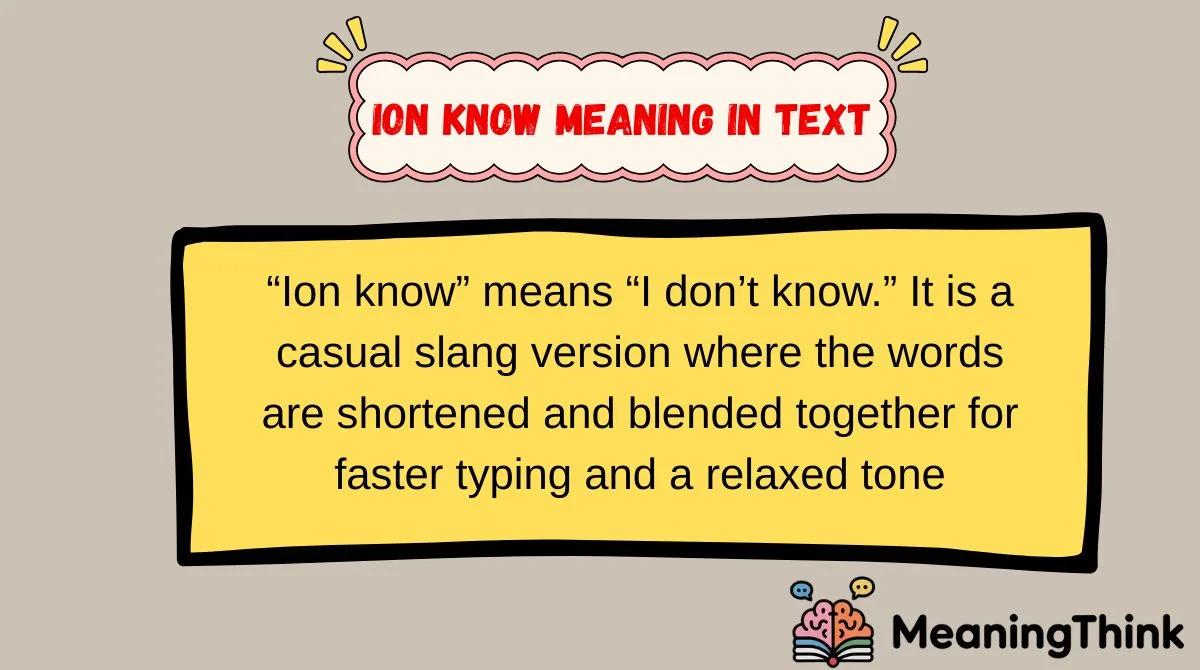
“Ion know” means “I don’t know.” It is a casual slang version where the words are shortened and blended together for faster typing and a relaxed tone.
It can also carry a softer, more laid-back feeling compared to the full phrase “I don’t know,” sometimes sounding less serious or more indifferent.
Detailed Meaning Breakdown
Primary Meaning
At its core, “ion know” is simply a phonetic spelling of “I don’t know.”
When spoken quickly, “I don’t know” can sound like “ion know.” Texting culture adopted this sound and turned it into a written shortcut. It reflects how people actually speak in casual conversation.
Example:
- “What time is the movie?”
- “Ion know.”
Same meaning as:
- “I don’t know.”
Secondary Meanings
Depending on context, “ion know” can also suggest:
- Uncertainty: The person genuinely doesn’t have the answer.
- Indifference: They may not care enough to find out.
- Avoidance: They might know but don’t want to say.
Rare Meanings
In rare cases, “ion know” can be used sarcastically:
- To dodge responsibility
- To act playful or teasing
Tone is everything here.
What “ion know” Means in Different Situations
Everyday Texting
In daily chats, “ion know” is quick and casual.
Example:
- “Where did I leave my keys?”
- “Ion know bro.”
It feels friendly, informal, and natural.
Social Media Platforms
On platforms like TikTok, Instagram, or Twitter (X), “ion know” is often used in captions or comments.
Example:
- “Ion know why this is so funny 😂”
Here, it adds personality and a relaxed tone.
Dating & Relationships
In relationships, “ion know” can mean more than just uncertainty.
Example:
- “Do you still like me?”
- “Ion know…”
This could signal:
- Confusion
- Emotional distance
- Avoidance
Context matters a lot here.
Professional Communication
In professional settings, “ion know” is usually inappropriate.
Instead of sounding relaxed, it may appear:
- Unprofessional
- Careless
- Disrespectful
Better alternative:
- “I’m not sure, but I’ll check.”
Cultural or Regional Differences
“Ion know” is more common in:
- Younger generations (Gen Z, late Millennials)
- Informal digital spaces
- Certain English-speaking communities
It reflects spoken language patterns, especially in fast, casual speech.
Psychological & Tone Analysis
Why People Use It
People use “ion know” because:
- It’s faster to type
- It feels natural
- It matches how they speak
What It Signals Socially
Using “ion know” can signal:
- Casual personality
- Comfort with the other person
- Informal communication style
Emotional Layer Behind It
The phrase can carry subtle emotions:
- Neutral: Genuine lack of knowledge
- Chill: Not worried about the answer
- Dismissive: Doesn’t care
- Avoidant: Doesn’t want to engage
Tone depends on context, punctuation, and relationship.
15 Real Conversation Examples (Explained)
- “Ion know what to eat.”
- Simple uncertainty.
- “Ion know, do whatever.”
- Indifference.
- “Ion know why he acting like that.”
- Confusion mixed with curiosity.
- “Ion know 😂”
- Playful or lighthearted tone.
- “Ion know bro, that’s weird.”
- Casual agreement with confusion.
- “Ion know… maybe later.”
- Hesitation or avoidance.
- “Ion know anything about that.”
- Clear lack of knowledge.
- “Ion know if I can make it.”
- Uncertainty about plans.
- “Ion know why I did that 😭”
- Regret with humor.
- “Ion know, ask someone else.”
- Deflecting responsibility.
- “Ion know fr.”
- Emphasizing honesty (“for real”).
- “Ion know, sounds risky.”
- Concern or caution.
- “Ion know you like that?”
- Surprise.
- “Ion know what you mean.”
- Confusion about explanation.
- “Ion know… it just feels off.”
- Emotional uncertainty.
When “ion know” Can Be Misunderstood
Context Confusion
Without tone or voice, people may misread intent:
- Genuine vs sarcastic
- Careless vs thoughtful
Generational Gap
Older audiences may:
- Not understand it
- Think it’s a typo
Younger users see it as normal.
Platform Differences
- On TikTok: normal
- On email: inappropriate
- On LinkedIn: unprofessional
Same phrase, different impact.
Similar Words, Symbols, or Abbreviations
- IDK – Short for “I don’t know”
- Dunno – Informal spoken version
- Idek – “I don’t even know”
- IDRK – “I don’t really know”
- IDC – “I don’t care”
- IKR – “I know, right”
- Fr – “For real”
- Tbh – “To be honest”
- Nvm – “Never mind”
- Bruh – Expression of disbelief or reaction
Each carries slightly different tone and context.
When Not to Use “ion know”
Professional Risks
Avoid in:
- Emails
- Job applications
- Business chats
It can harm credibility.
Cultural Risks
Some audiences may:
- See it as incorrect English
- View it as disrespectful
Tone Risks
Using “ion know” can accidentally sound:
- Lazy
- Uninterested
- Dismissive
Especially in serious conversations.
Expert Tips for Using “ion know” Correctly
- Use it only in casual conversations
- Avoid it in formal or professional settings
- Match the tone of the other person
- Be careful in emotional discussions
- Add emojis if you want to soften tone
- Don’t overuse it—it can sound repetitive
- Use full “I don’t know” when clarity matters
- Understand your audience before using slang
FAQs
What does “ion know” mean in texting?
It means “I don’t know,” written in a casual, shortened slang form.
Is “ion know” grammatically correct?
No, it’s informal slang and not considered standard grammar.
Why do people say “ion” instead of “I don’t”?
Because it mimics fast speech where “I don’t” sounds like “ion.”
Is “ion know” rude?
Not usually, but it can sound dismissive depending on context.
Can I use “ion know” in professional messages?
No, it’s best to avoid it in professional communication.
Is “ion know” used worldwide?
It’s mainly used in English-speaking online communities, especially among younger users.
What’s the difference between “IDK” and “ion know”?
Both mean the same thing, but “ion know” sounds more conversational and relaxed.
Does “ion know” mean someone doesn’t care?
Sometimes, but not always. It depends on tone and context.
Final Summary
“Ion know” is a modern slang phrase that simply means “I don’t know.” It reflects how language evolves in digital spaces—faster, more casual, and more expressive.
While it’s perfectly fine in texting, social media, and friendly chats, it doesn’t belong in professional or formal communication. The key to using it correctly is understanding tone, context, and audience.
Use it when you want to sound relaxed and natural. Avoid it when clarity, respect, or professionalism matters.
Mastering small phrases like this helps you communicate more effectively in today’s fast-moving digital world.