Have you ever received a text that simply said “mmk” and wondered what the sender actually meant? At first glance, it looks like a typing mistake or a random group of letters.
However, in modern texting, online chats, and social media conversations, mmk has a specific meaning that depends on the situation, tone, and relationship between the people talking.
The challenge is that mmk does not always express the same emotion. Sometimes it means someone agrees with you. Other times, it can sound impatient, sarcastic, dismissive, or simply like a quicker version of saying “okay.”
Because digital communication lacks facial expressions and voice tone, understanding the context is important.
This guide explains the complete mmk meaning in text, including what it stands for, how people use it on different platforms, when it sounds friendly or rude, and how to respond correctly.
You’ll also discover real-life examples and practical communication tips so you can confidently understand and use mmk in everyday conversations.
Quick Definition of “MMK”
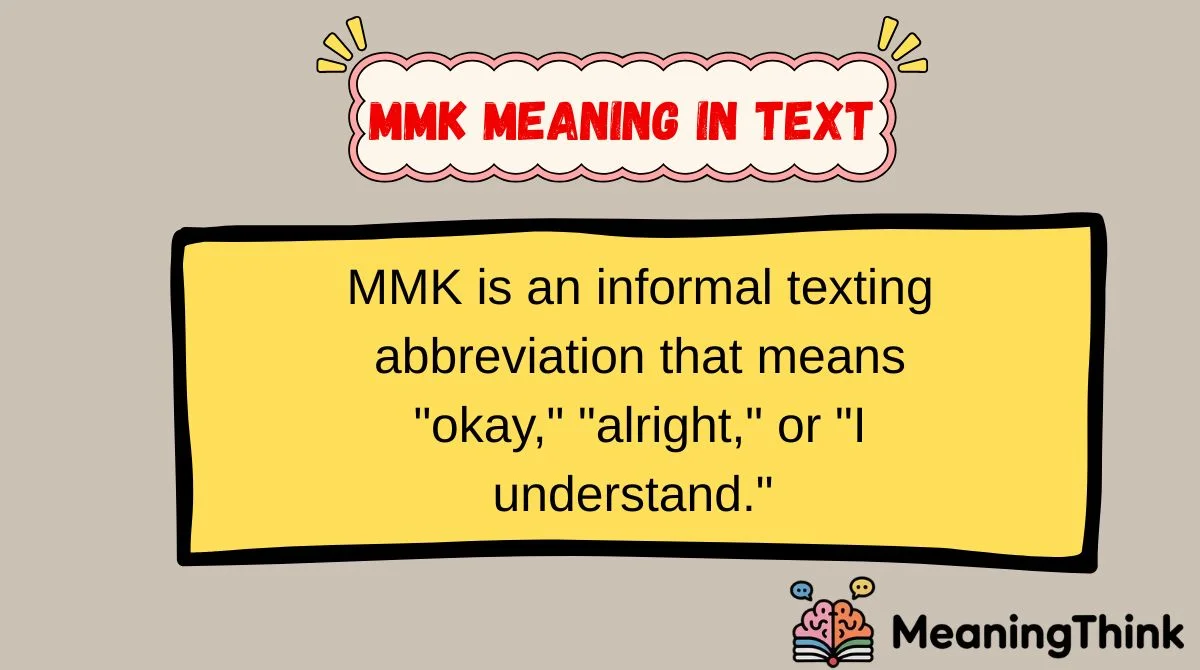
MMK is an informal texting abbreviation that means “okay,” “alright,” or “I understand.” It is usually a shorter, more casual version of “mm-kay,” which is simply another way of saying “OK.”
Depending on the conversation, mmk can also express agreement, acknowledgment, impatience, reluctance, sarcasm, or the desire to end a discussion quickly. The intended meaning depends entirely on context, punctuation, and the relationship between the people communicating.
Detailed Meaning Breakdown
Primary Meaning
The most common meaning of mmk is simply “okay.”
Instead of typing “okay,” “ok,” or “alright,” many people type mmk because it feels quicker and more conversational. It tells the other person that the message has been received and understood.
For example:
- “Meet me at 7.”
- “MMK.”
In this conversation, the sender simply agrees with the plan.
Unlike a full sentence, mmk sounds relaxed and informal, making it common in everyday texting between friends and family members.
Where “MMK” Comes From
The expression “mm-kay” has existed in spoken English for many years. People often say it aloud instead of “okay” to sound casual or conversational.
As texting became popular, users started spelling the spoken sound as mmk, creating the abbreviation commonly seen today in chats, text messages, gaming conversations, and social media comments.
Because it represents spoken language rather than a formal abbreviation, there is no single official spelling. You may also see:
- mmkay
- mmkay
- mm-kay
- mm’kay
All of these generally carry the same basic meaning.
Secondary Meanings
Although mmk usually means “okay,” its emotional tone can change significantly.
Agreement
Many people use mmk to show they accept a suggestion or instruction.
Example:
“Let’s order pizza tonight.”
“MMK.”
Here, the reply simply means “Sounds good.”
Acknowledgment
Sometimes mmk only confirms that a message has been seen.
Example:
“Don’t forget your appointment tomorrow.”
“MMK.”
The person is acknowledging the reminder without adding more to the conversation.
Ending the Conversation
Some people use mmk when they have nothing else to say.
Example:
“I’ll text you later.”
“MMK.”
This politely closes the conversation.
Mild Frustration
Depending on punctuation, mmk can sound slightly annoyed.
Example:
“You changed the plans again?”
“Mmk.”
Here, the reply may suggest reluctant acceptance rather than genuine excitement.
Sarcasm
In some conversations, especially among close friends, mmk may be sarcastic.
Example:
“I’m definitely going to finish this project in ten minutes.”
“MMK…”
The response suggests doubt rather than agreement.
Rare Meanings
While mmk almost always means “okay,” it occasionally has different meanings in specialized communities.
Online Gaming
Players sometimes use mmk as a quick acknowledgment before starting a match or completing a task.
Example:
“Cover the left side.”
“MMK.”
Team Chats
In group chats, mmk may simply confirm that someone has read instructions.
Example:
“Meeting starts at 3 PM.”
“MMK.”
Humorous Usage
Some people intentionally type mmk because it sounds playful or exaggerated compared to a simple “OK.”
In these situations, the word adds personality rather than changing the meaning.
What “MMK” Means in Different Situations
Everyday Texting
In personal conversations, mmk usually means:
- Okay
- Sure
- I understand
- Sounds good
- Got it
Friends often use it because it feels casual and natural.
Examples:
- “See you tomorrow.”
- “MMK.”
- “Don’t stay up too late.”
- “MMK.”
Most of the time, there is nothing negative about the reply.
However, if someone normally sends long messages but suddenly replies with only mmk, it could suggest they are busy, tired, upset, or no longer interested in continuing the conversation.
Social Media Platforms
On platforms like Instagram, TikTok, Snapchat, Facebook, X, Discord, and Reddit, mmk usually serves as a brief acknowledgment.
People often use it to:
- Reply to comments
- Confirm plans
- Respond in direct messages
- React during casual conversations
- Keep chats moving quickly
Examples include:
- “I’ll tag you later.”
- “MMK.”
Or:
- “Check your DMs.”
- “MMK.”
Because social media conversations move quickly, shorter replies like mmk help keep communication fast without sounding overly formal.
Dating & Relationships
In romantic conversations, the meaning of mmk depends heavily on tone.
When used warmly, it simply means:
- Okay
- Sure
- Sounds good
Example:
“Let’s watch a movie tonight.”
“MMK ❤️”
The heart emoji makes the response sound friendly and affectionate.
However, if someone replies with only:
“mmk”
without emojis or additional words, it may sound distant or uninterested.
For example:
“Can we talk later?”
“mmk”
This response could suggest:
- They are busy.
- They are annoyed.
- They are emotionally tired.
- They don’t want to continue the conversation.
Always consider the person’s normal texting style before assuming they are upset.
Professional Communication
In workplaces, mmk is generally not recommended.
Although coworkers may understand it, the abbreviation can appear:
- Too casual
- Unprofessional
- Abrupt
- Dismissive
Instead of replying with mmk, consider using:
- Okay.
- Understood.
- Certainly.
- Will do.
- Sounds good.
- I appreciate the update.
These alternatives create a more professional impression and reduce the chance of misunderstanding.
Cultural or Regional Differences
The meaning of mmk is generally consistent across English-speaking countries, including the United States, Canada, the United Kingdom, Australia, and New Zealand.
However, how people interpret its tone can vary.
In some friend groups, mmk feels friendly and relaxed.
In others, it may sound passive-aggressive or slightly rude, especially if it replaces a normally detailed response.
Age also influences interpretation.
Younger users who grew up with texting often see mmk as completely normal. Older users, however, may perceive it as abrupt or lacking enthusiasm because they are more accustomed to full-word responses like “okay” or “alright.”
For this reason, always consider the person’s age, communication style, and relationship with you before interpreting the emotional meaning behind mmk.
Psychological & Tone Analysis
Although mmk is only three letters long, it can communicate much more than a simple “okay.” The way people use it often reflects their mood, personality, and relationship with the person they are messaging.
Understanding the emotional tone behind mmk helps you avoid misunderstandings and respond appropriately.
Why People Use “MMK”
Most people use mmk because it is quick and effortless. In today’s fast-paced digital world, short replies help keep conversations moving without requiring long messages.
Common reasons include:
- Saving time while texting
- Confirming that a message was received
- Showing casual agreement
- Ending a conversation politely
- Keeping the tone relaxed and informal
Instead of typing “Okay, I understand,” many people simply type mmk because it feels more natural in casual chats.
What It Signals Socially
The social meaning of mmk depends on the conversation.
It may signal:
- Agreement without excitement
- Understanding without adding extra information
- A casual and friendly attitude
- Confidence in an informal conversation
- A desire to move on to another topic
For example:
Friend: “I’ll pick you up at 6.”
You: “MMK.”
The reply simply confirms the plan.
However, if someone expected a longer response, the same reply might seem less enthusiastic.
The Emotional Layer Behind “MMK”
Unlike many abbreviations, mmk has flexible emotional meaning.
It can express:
Neutral Acceptance
The most common use is simple acknowledgment.
Example:
“I’ll send the files tonight.”
“MMK.”
There is no hidden emotion. The person simply understands.
Friendly Agreement
Among close friends, mmk often sounds playful.
Example:
“Movie night?”
“MMK 😄”
The emoji makes the message feel warm and positive.
Mild Annoyance
Sometimes mmk suggests the sender is accepting something they do not completely like.
Example:
“We have to work this weekend.”
“Mmk.”
Here, the reply may indicate reluctant acceptance.
Impatience
A short mmk after a long discussion can suggest the person wants the conversation to end.
Example:
“Okay, we’ve talked about this enough.”
“Mmk.”
The response may indicate they have nothing more to add.
Sarcasm
Close friends sometimes use mmk humorously.
Example:
“I’m going to become a millionaire tomorrow.”
“MMK…”
The reply expresses doubt rather than agreement.
Always consider previous messages, punctuation, emojis, and the person’s usual texting style before deciding what emotional meaning mmk carries.
15 Real Conversation Examples (Explained)
The following examples show how mmk changes meaning depending on the situation.
1. Making Plans
Alex: “Let’s meet at 5 PM.”
Taylor: “MMK.”
Explanation: Taylor agrees with the plan.
2. Reminder
Mom: “Don’t forget to lock the door.”
Sam: “MMK.”
Explanation: Sam confirms the reminder has been received.
3. Homework
Teacher: “Submit your assignment before midnight.”
Student: “MMK.”
Explanation: The student acknowledges the instruction.
4. Group Chat
Emma: “I’ll create the presentation slides.”
Jake: “MMK.”
Explanation: Jake confirms he understands the update.
5. Gaming Session
Player 1: “Defend the right side.”
Player 2: “MMK.”
Explanation: A quick acknowledgment before continuing the game.
6. Dinner Plans
Chris: “Pizza tonight?”
Jordan: “MMK 😋”
Explanation: The emoji makes the response sound happy and enthusiastic.
7. Busy Conversation
Friend: “Can we talk later?”
You: “MMK.”
Explanation: You agree to continue the conversation later.
8. Parent’s Advice
Dad: “Drive carefully.”
Child: “MMK.”
Explanation: The child acknowledges the advice.
9. Mild Frustration
Friend: “We’re changing the meeting again.”
You: “Mmk.”
Explanation: The lowercase spelling and short reply may suggest slight disappointment or annoyance.
10. Ending a Discussion
Friend: “That’s everything I wanted to say.”
You: “MMK.”
Explanation: The conversation naturally comes to a close.
11. Relationship Chat
Partner: “I’ll call you after work.”
You: “MMK ❤️”
Explanation: The heart emoji keeps the reply affectionate.
12. Sarcastic Response
Friend: “I’m definitely finishing this project in five minutes.”
You: “MMK…”
Explanation: The ellipsis suggests playful disbelief.
13. Workplace Chat
Manager: “Please review the report before lunch.”
Employee: “Understood.”
Explanation: Although “mmk” could communicate understanding, using a full response is more professional.
14. Social Media DM
Follower: “I’ll tag you in the video.”
Creator: “MMK.”
Explanation: A quick acknowledgment that keeps the conversation moving.
15. Family Chat
Sibling: “Movie starts at eight.”
You: “MMK.”
Explanation: You confirm the information without needing a longer reply.
When “MMK” Can Be Misunderstood
Although mmk usually means “okay,” it is not always interpreted the same way.
Because text messages lack facial expressions and voice tone, people may misunderstand the sender’s intention.
Context Confusion
The same word can carry different meanings depending on the conversation.
Compare these examples:
“I’ll see you tomorrow.”
“MMK.”
This sounds friendly.
Now compare it with:
“We need to discuss your mistake.”
“MMK.”
Here, the reply may sound reluctant or dismissive.
Always read the messages before and after mmk to understand its true meaning.
Generational Gap
Younger people often view mmk as a completely normal texting shortcut.
Older adults may interpret it differently.
Some may think it sounds:
- Too casual
- Impolite
- Uninterested
- Abrupt
If you’re texting someone who prefers formal communication, writing “Okay” or “Understood” is usually a better choice.
Platform Differences
The platform where mmk appears can also influence its meaning.
Text Messages
Usually means simple agreement.
Instagram or Snapchat
Often used as a fast reply while chatting casually.
Gaming Chats
Typically means “Got it” before continuing the game.
Workplace Apps
Can appear overly informal and may not leave the best professional impression.
Punctuation Changes the Tone
Small punctuation changes can completely change how mmk feels.
MMK!
Friendly and energetic.
MMK 😊
Warm and positive.
mmk
Neutral or casual.
Mmk…
Uncertain, doubtful, or sarcastic.
MMK.
Can sometimes feel firm or slightly cold, depending on the conversation.
Pay attention to punctuation before assuming someone’s emotional state.
Similar Words, Symbols, or Abbreviations
Many texting abbreviations have meanings similar to mmk. While they all acknowledge a message in some way, each has its own tone and level of formality.
| Term | Meaning |
|---|---|
| OK | Standard way to say “okay” or “I agree.” |
| Okay | A complete, neutral response suitable for most conversations. |
| K | Very short acknowledgment that may sound abrupt depending on context. |
| KK | Friendly version of “okay,” often used between friends. |
| Got it | Confirms understanding of information or instructions. |
| Roger | Means “message received,” commonly associated with radio communication but also used humorously in texts. |
| Sure | Expresses agreement or willingness to do something. |
| Yep | Informal way to say “yes.” |
| 👍 | Thumbs-up emoji meaning “okay,” “approved,” or “I understand.” |
| Noted | Professional acknowledgment often used in workplaces and email conversations. |
Although these expressions are similar, they are not always interchangeable. Choosing the right one depends on your audience, the platform, and the tone you want to communicate.
When Not to Use “MMK”
Although mmk is a popular texting abbreviation, it is not suitable for every conversation. Using it in the wrong situation can make your message sound unprofessional, uninterested, or even disrespectful. Knowing when to avoid mmk helps you communicate more clearly and maintain positive relationships.
Professional Risks
In professional settings, clear communication is essential. A reply like mmk may appear too casual or give the impression that you are not taking the conversation seriously.
Avoid using mmk in:
- Business emails
- Job interviews
- Client conversations
- Workplace meetings
- Formal project discussions
- Customer support messages
Instead, choose more professional alternatives such as:
- Understood.
- Certainly.
- Will do.
- Thank you for the update.
- Sounds good.
- I appreciate the information.
These responses sound respectful while clearly confirming that you understand the message.
Cultural Risks
Not everyone interprets texting abbreviations the same way.
People from different countries, age groups, or professional backgrounds may not recognize mmk at all. Others may assume it sounds dismissive or rude.
If you are communicating with someone whose texting style you do not know, using the full word “okay” is usually the safer choice.
Tone Risks
One of the biggest challenges with mmk is that it lacks emotional detail.
Without emojis or additional words, it may accidentally sound:
- Cold
- Uninterested
- Passive-aggressive
- Impatient
- Annoyed
For example:
Friend: “I’m sorry I couldn’t make it today.”
Reply: “mmk”
Even if you simply mean “I understand,” the other person may think you are upset.
A warmer response such as “No worries, okay!” or “That’s okay, thanks for letting me know.” communicates much more empathy.
Expert Tips for Using “MMK” Correctly
Using mmk effectively is less about the word itself and more about understanding your audience and the conversation. These practical tips will help you avoid confusion.
1. Use It in Casual Conversations
MMK works best when chatting with friends, siblings, classmates, or people you know well.
Casual conversations naturally allow for abbreviations and short replies.
2. Consider the Other Person’s Texting Style
Some people love short messages.
Others prefer complete sentences.
If someone rarely uses abbreviations, replying with mmk may feel abrupt. Matching the other person’s communication style often creates smoother conversations.
3. Add Emojis When You Want to Sound Friendly
A simple emoji can completely change the tone.
Examples:
- MMK 😊
- MMK 👍
- MMK 😄
- MMK ❤️
These additions make the reply feel warmer and more positive.
4. Avoid Using It During Serious Conversations
If the discussion involves emotions, conflict, or important decisions, a three-letter response may seem insensitive.
Instead of:
“mmk”
Try:
- I understand.
- That makes sense.
- Thanks for explaining.
- I appreciate you telling me.
These replies show attention and empathy.
5. Don’t Overuse It
If every reply is mmk, conversations can become repetitive and feel one-sided.
Mix it with other responses such as:
- Sounds good.
- Sure.
- Absolutely.
- Got it.
- Okay.
- Will do.
Variety makes your conversations feel more natural.
6. Pay Attention to Context
The same word can sound friendly in one conversation and rude in another.
Always ask yourself:
- What was said before this?
- Is the other person joking?
- Are they upset?
- Is this a formal conversation?
Context is the key to understanding mmk correctly.
7. Use Proper Capitalization if Needed
People commonly write:
- mmk
- MMK
- Mmk
All are acceptable in casual texting.
However, consistent capitalization can make your messages look cleaner and easier to read.
8. Choose Clarity Over Speed
Saving one second by typing mmk is not worth creating confusion.
If there is any chance your message could be misunderstood, write the complete response instead.
Clear communication is always more valuable than a shorter message.
Frequently Asked Questions
What does MMK mean in text messages?
In most text messages, mmk simply means “okay,” “alright,” or “I understand.” It confirms that the sender has received and understood the message. Depending on the context, it may also express agreement, acknowledgment, or a casual response.
Is MMK the same as OK?
Yes. In most situations, mmk and OK have the same basic meaning. However, mmk is much more informal and conversational, while OK is appropriate in both casual and many professional settings.
Can MMK be considered rude?
Sometimes. On its own, mmk may sound short or dismissive, especially during serious conversations or when replying to emotional messages. The surrounding context, punctuation, emojis, and relationship between the people involved all influence how it is interpreted.
What is the difference between MMK and K?
Both express acknowledgment, but mmk usually sounds softer and more conversational than K. A single K can sometimes appear abrupt or uninterested, while mmk often feels more relaxed and friendly.
Do people still use MMK in 2026?
Yes. MMK continues to appear in text messages, group chats, gaming communities, and social media conversations. While newer slang terms appear regularly, mmk remains a familiar and widely understood way to say “okay.”
Should I use MMK in work emails?
No. It is better to avoid mmk in professional emails, client communications, and formal workplace discussions. Responses such as “Understood,” “Certainly,” or “Will do” create a more professional impression.
How should I reply to MMK?
Usually, no special response is needed because mmk already acknowledges the previous message. If the conversation continues, simply move on to the next topic or provide the next piece of information.
Does MMK always mean agreement?
Not always. While it often indicates agreement or understanding, mmk can also suggest impatience, reluctance, sarcasm, or a desire to end the conversation. Reading the surrounding messages helps determine the intended meaning.
Final Summary
The mmk meaning in text is simple on the surface but surprisingly flexible in real conversations. In most cases, it means “okay,” “alright,” or “I understand.”
It is a casual, informal way to acknowledge a message, accept a plan, or confirm that information has been received.
However, like many texting abbreviations, mmk takes on different emotional tones depending on the situation. It can sound friendly, neutral, playful, reluctant, impatient, or even sarcastic.
Factors such as punctuation, emojis, conversation history, and the relationship between the people involved all influence how the message is interpreted.
For everyday texting with friends and family, mmk is a perfectly natural response. In professional communication or emotionally sensitive conversations, choosing a more complete reply is usually the better option.
The smartest approach is to focus on clarity and context. Before sending mmk, think about who you are messaging, what the conversation is about, and whether a longer response would communicate your intentions more effectively. By using it thoughtfully, you can keep your messages brief while still sounding friendly, respectful, and easy to understand.