You’re texting a friend, and they reply with just one word: “txt.”
No punctuation. No emojis. Just that.
Now you pause. Is it a typo? A command? A shortcut? Something deeper?
Short text abbreviations like “txt” are everywhere, yet they can still confuse even regular texters. The same three letters can mean different things depending on context, tone, and platform.
That’s why people often misunderstand simple messages—or overthink them.
This guide clears that confusion.
Here, you’ll learn exactly what “txt” means, how it’s used in real conversations, and when it’s appropriate (or risky) to use. By the end, you’ll not only understand it—you’ll use it confidently and correctly in any situation.
Quick Definition of “txt”
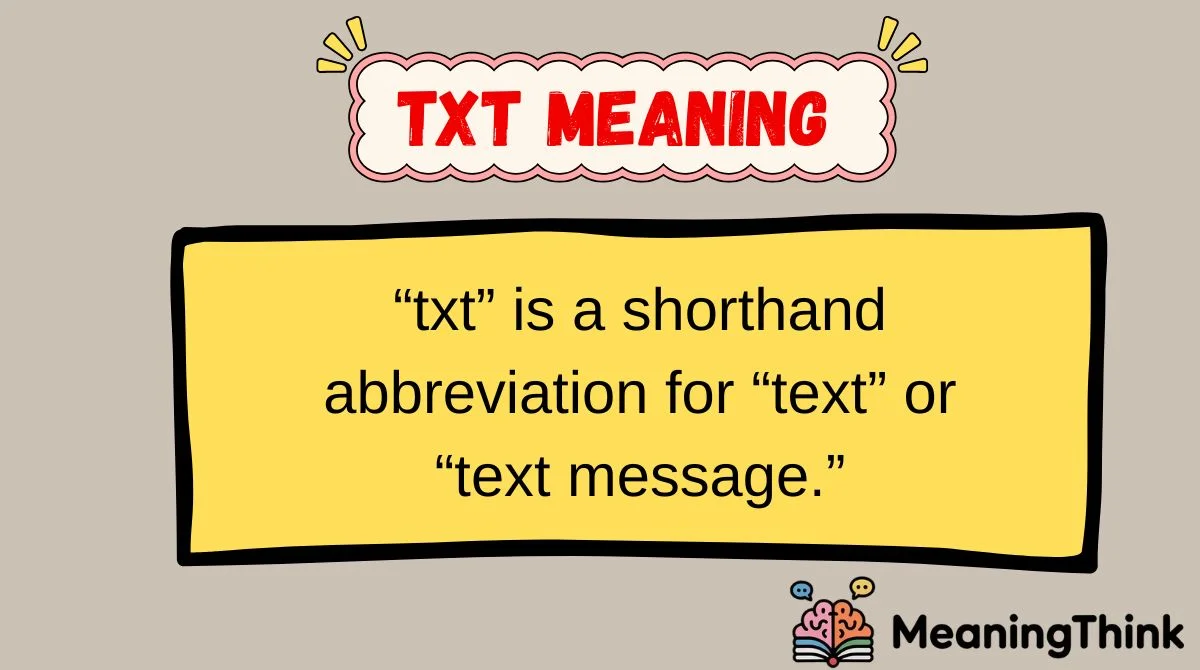
“txt” is a shorthand abbreviation for “text” or “text message.”
It is commonly used in digital communication to refer to sending, receiving, or discussing messages. In some cases, it can also mean the content of a written message or act as a casual instruction (e.g., “txt me”).
Detailed Meaning Breakdown
Primary Meaning
The most common meaning of “txt” is simply:
- A shortened form of the word “text”
- Used to refer to text messaging
Example:
“Just txt me later” → “Just text me later”
It saves time and effort, especially in fast-paced chats.
Secondary Meanings
Depending on context, “txt” can also mean:
- A message itself
“Did you get my txt?” → Referring to a specific message - The act of texting
“I’ll txt you” → Future action - Casual instruction
“txt me when you arrive” → Request
Rare Meanings
Less commonly, “txt” may appear as:
- File format reference (.txt) in technical contexts
- Stylized spelling in usernames or branding
However, in everyday communication, these meanings are rare.
What “txt” Means in Different Situations
Everyday Texting
In daily conversations, “txt” is a quick and informal replacement for “text.”
Examples:
- “Can you txt me the address?”
- “I’ll txt you later”
Tone: Casual, friendly, efficient.
Social Media Platforms
On platforms like messaging apps or comment sections:
- Used in captions or replies
- Often signals informality
Example:
“Don’t call, just txt”
Tone: Relaxed, modern, sometimes minimalist.
Dating & Relationships
In personal communication:
- Suggests casual closeness
- Can feel less intense than “call me”
Example:
“Txt me when you get home ❤️”
Tone: Soft, caring, low-pressure.
Professional Communication
Here, “txt” becomes risky.
- It may appear too informal
- Can reduce perceived professionalism
Example:
Avoid: “Please txt me the report”
Better: “Please send me a message”
Cultural or Regional Differences
- Younger users adopt “txt” more often
- Older audiences may prefer full words
- Some regions lean toward full spelling for clarity
Psychological & Tone Analysis
Why People Use It
- Saves time
- Reduces typing effort
- Matches fast communication habits
What It Signals Socially
Using “txt” can signal:
- Informality
- Comfort with the recipient
- Digital fluency
Emotional Layer Behind It
“txt” often softens communication:
- Feels less demanding than “call”
- Sounds more casual than “message”
- Can reduce pressure in conversations
It subtly communicates:
“Keep things easy.”
15 Real Conversation Examples (Explained)
- “Txt me when you arrive.”
→ A simple request for an update. - “Did you txt him yet?”
→ Asking about communication status. - “I’ll txt you later.”
→ Delayed response without urgency. - “Just txt, don’t call.”
→ Preference for low-effort communication. - “Why didn’t you txt back?”
→ Expressing mild frustration. - “Can you txt me the link?”
→ Request for information. - “She said she’ll txt.”
→ Reporting someone’s plan. - “Txt me if anything changes.”
→ Keeping communication open. - “I forgot to txt you.”
→ Apology for missing communication. - “Txt me ASAP.”
→ Urgent but still informal. - “He never txts first.”
→ Observation about behavior. - “Just got your txt.”
→ Acknowledging receipt. - “Txt me the details.”
→ Request for specifics. - “I’ll txt instead.”
→ Choosing texting over calling. - “Stop overthinking, just txt them.”
→ Encouraging action.
When “txt” Can Be Misunderstood
Context Confusion
Without context, “txt” can feel incomplete.
Example:
“txt?”
→ Could mean:
- “Did you text?”
- “Text me?”
- “What about the message?”
Generational Gap
- Younger users: Understand instantly
- Older users: May find it unclear or abrupt
Platform Differences
- Messaging apps: Normal
- Email: Unprofessional
- Workplace tools: Depends on culture
Similar Words, Symbols, or Abbreviations
- msg – Message
- dm – Direct message
- pm – Private message
- im – Instant message
- ping – Notify or message someone
- hit me up – Contact me
- drop a text – Send a message
- buzz – Informal alert or call
- reach out – Contact (more formal)
- text me – Full version of “txt me”
When Not to Use “txt”
Professional Risks
Avoid using “txt” in:
- Emails
- Job applications
- Formal business messages
It can reduce credibility.
Cultural Risks
In some cultures:
- Abbreviations may seem lazy
- Clarity is preferred over speed
Tone Risks
Using “txt” can:
- Sound too casual
- Seem dismissive in serious conversations
- Appear careless if overused
Expert Tips for Using “txt” Correctly
- Use it only in casual conversations
- Avoid it in formal writing
- Match the tone of the other person
- Don’t overuse abbreviations
- Use full words if clarity matters
- Consider your audience’s age and familiarity
- Pair it with context to avoid confusion
- Keep communication balanced and readable
FAQs
What does “txt” mean in texting?
It means “text” or “text message,” often used as a shorter way to refer to messaging.
Is “txt” the same as “text”?
Yes, it’s simply an abbreviated version used in informal communication.
Is it okay to use “txt” in professional emails?
No, it is considered too informal for professional settings.
Why do people use “txt” instead of “text”?
Mainly for speed, convenience, and casual tone.
Can “txt” have different meanings?
Mostly no, but context can slightly change how it’s interpreted (action vs message).
Is “txt” outdated in 2026?
No, it is still used, though many people now prefer full words or voice messaging.
Does using “txt” sound rude?
Not usually, but it can feel abrupt depending on context and tone.
Should I avoid abbreviations like “txt”?
Only in formal or unclear situations. Otherwise, they are fine in casual use.
Final Summary
“txt” is a simple, efficient abbreviation that reflects how modern communication works—fast, casual, and minimal.
At its core, it just means “text” or “send a message.” But how it feels depends on context, tone, and audience. Used correctly, it keeps conversations smooth and relaxed. Used poorly, it can create confusion or seem unprofessional.
The key is awareness.
Know when to use it. Know when to avoid it. Match your tone to the situation.
If you do that, you won’t just understand “txt”—you’ll communicate smarter, clearer, and more confidently in every message you send.