You’re texting a friend, asking a simple question: “Where are we meeting?”
They reply: “idfk.”
Now you pause. Are they annoyed? Confused? Being rude? Or just honest?
Short text slang like this often creates more questions than answers. One tiny phrase can carry different tones depending on context, mood, and even the platform it’s used on.
That’s exactly why “idfk” can feel confusing—especially if you’re not used to modern digital communication.
In this guide, you’ll get a clear, complete understanding of what “idfk” really means. You’ll learn how it’s used, when it works, when it backfires, and how to read the tone behind it. By the end, you’ll be able to use it confidently—or avoid it when needed.
Quick Definition of “idfk”
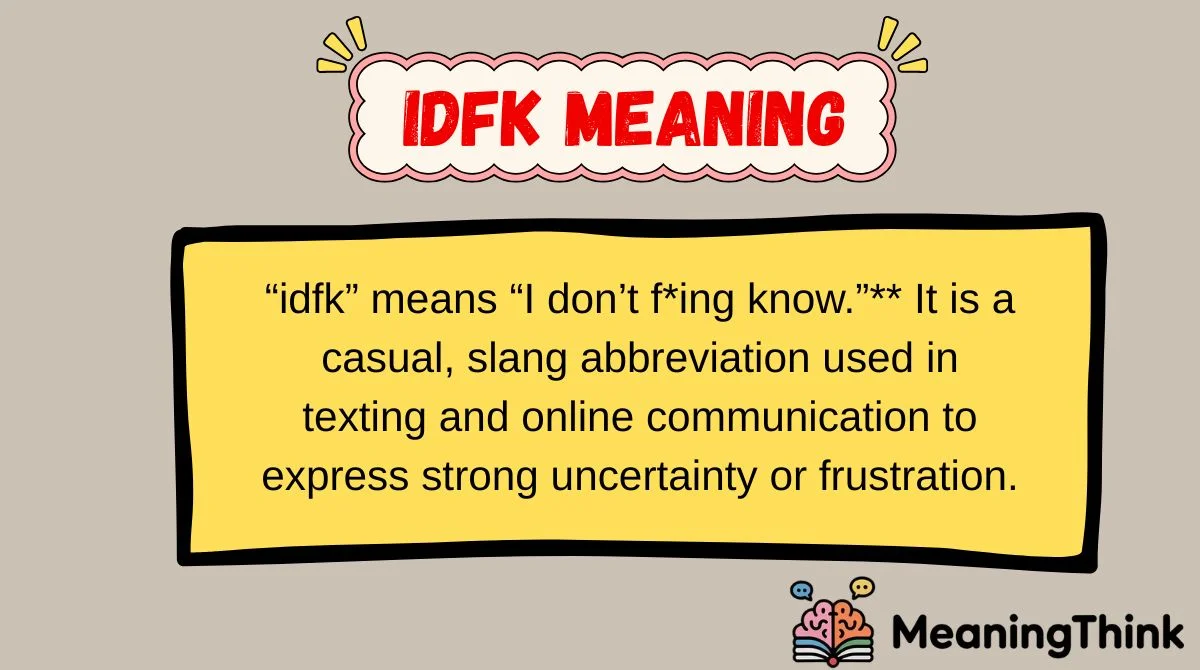
“idfk” means “I don’t f*ing know.”** It is a casual, slang abbreviation used in texting and online communication to express strong uncertainty or frustration.
It can also carry emotional tones like annoyance, sarcasm, or honesty depending on context. In some cases, it may simply mean “I don’t know,” but with added intensity.
Detailed Meaning Breakdown
Primary Meaning
The main meaning of “idfk” is straightforward:
“I don’t f***ing know.”
It’s a stronger version of “I don’t know” (IDK). The added word intensifies the emotion, often signaling frustration, impatience, or emphasis.
Example:
“Why is this not working?”
“idfk”
Here, the person isn’t just unsure—they may also feel irritated or overwhelmed.
Secondary Meanings
Depending on tone and context, “idfk” can mean:
- Casual confusion: The person genuinely doesn’t know, without strong emotion.
- Sarcastic response: Used humorously to avoid answering.
- Dismissive attitude: The speaker doesn’t care enough to figure it out.
Rare Meanings
Rarely, “idfk” may be used jokingly or playfully among close friends, where the tone is not serious at all. In such cases, it’s more about humor than frustration.
What “idfk” Means in Different Situations
Everyday Texting
In daily conversations, “idfk” usually shows:
- Quick uncertainty
- Mild frustration
- Informal tone
Example:
“What time does the movie start?”
“idfk, check online”
Social Media Platforms
On platforms like Twitter, Instagram, or TikTok:
- It may express confusion about trends
- Often used humorously
- Can be part of memes
Example:
“Why is everyone doing this dance?”
“idfk but it’s funny”
Dating & Relationships
Here, tone matters a lot.
- Can signal emotional distance
- May show frustration during arguments
- Sometimes used to avoid deeper conversation
Example:
“What’s wrong with you lately?”
“idfk”
This can feel dismissive or defensive.
Professional Communication
“idfk” is not appropriate in professional settings.
Using it in work emails or messages can:
- Appear unprofessional
- Suggest lack of respect
- Damage credibility
Instead, use:
“I’m not sure, but I’ll find out.”
Cultural or Regional Differences
In some cultures, direct language is normal. In others, it may feel rude.
- Younger audiences accept it more
- Older generations may see it as disrespectful
Psychological & Tone Analysis
Why People Use It
People use “idfk” for several reasons:
- To save time
- To express strong emotion quickly
- To sound casual or relatable
What It Signals Socially
Using “idfk” can signal:
- Informality
- Emotional intensity
- Honesty (sometimes blunt honesty)
Emotional Layer Behind It
The phrase can carry different emotional layers:
- Frustration: “idfk why this keeps happening”
- Exhaustion: “idfk anymore”
- Indifference: “idfk, do whatever”
- Humor: “idfk lol”
Understanding tone depends on context, punctuation, and relationship.
15 Real Conversation Examples (Explained)
- “Where’s my charger?”
“idfk”
→ Simple uncertainty, neutral tone. - “Why is the app crashing?”
“idfk, it’s so annoying”
→ Frustration. - “What should we eat?”
“idfk, you pick”
→ Indecision or lack of interest. - “Why did she say that?”
“idfk…”
→ Confusion, possibly emotional. - “When is the deadline?”
“idfk check the email”
→ Slight impatience. - “What’s going on here?”
“idfk lol”
→ Light humor. - “Why are you upset?”
“idfk”
→ Emotional confusion or avoidance. - “Who broke this?”
“idfk don’t look at me”
→ Defensive tone. - “What’s the plan tonight?”
“idfk yet”
→ Uncertainty without frustration. - “Why is he acting weird?”
“idfk maybe stress”
→ Guessing with uncertainty. - “Where’s the remote?”
“idfk again??”
→ Mild annoyance. - “What’s wrong?”
“idfk honestly”
→ Emotional vulnerability. - “Why didn’t you reply?”
“idfk I forgot”
→ Casual honesty. - “What’s this trend about?”
“idfk but it’s everywhere”
→ Observational tone. - “Why does this always happen?”
“idfk man”
→ Shared frustration.
When “idfk” Can Be Misunderstood
Context Confusion
Without tone or facial expression, “idfk” can feel:
- Rude
- Dismissive
- Angry
Even if the sender didn’t mean it that way.
Generational Gap
- Younger users: Normal, casual
- Older users: May see it as disrespectful or aggressive
Platform Differences
- Text messages: Can feel blunt
- Social media: Often humorous
- Work chats: Inappropriate
Similar Words, Symbols, or Abbreviations
- IDK – I don’t know (neutral)
- IDC – I don’t care
- IKR – I know, right?
- TBH – To be honest
- BRB – Be right back
- SMH – Shaking my head
- WTF – What the f***
- IMO – In my opinion
- NVM – Never mind
- LOL – Laugh out loud
Each has a different tone level. “idfk” is more intense than “idk.”
When Not to Use “idfk”
Professional Risks
Avoid in:
- Emails
- Meetings
- Client messages
It can harm your image and professionalism.
Cultural Risks
In formal or respectful cultures:
- May be seen as offensive
- Could damage relationships
Tone Risks
Using “idfk” in sensitive conversations can:
- Escalate conflict
- Sound dismissive
- Hurt feelings
Example:
“Why are you upset?” → “idfk”
This may feel emotionally distant.
Expert Tips for Using “idfk” Correctly
- Know your audience
Use it only with people comfortable with slang. - Avoid serious situations
Don’t use it during emotional or important discussions. - Watch your tone
Add context if needed: “idfk lol” vs “idfk…” - Use sparingly
Overuse can make you sound careless. - Choose alternatives when needed
Use “I’m not sure” in formal settings. - Consider relationship closeness
Works best among friends, not strangers. - Be mindful of timing
In arguments, it can escalate tension. - Add clarity when needed
Example: “idfk, but I can check”
FAQs
What does “idfk” stand for in texting?
It stands for “I don’t f***ing know,” expressing strong uncertainty or frustration.
Is “idfk” rude?
It can be, depending on tone and context. It may sound blunt or dismissive in serious conversations.
Can I use “idfk” at work?
No, it’s not appropriate for professional communication.
What’s the difference between “idk” and “idfk”?
“idk” is neutral. “idfk” adds emotional intensity, often frustration.
Is “idfk” offensive?
It contains profanity, so it may be offensive in formal or sensitive settings.
Do people use “idfk” in social media?
Yes, often in a humorous or casual way.
How should I reply to “idfk”?
Respond based on tone—offer help, change topic, or clarify the situation.
Is “idfk” common in 2026?
Yes, it remains widely used in informal digital communication.
Final Summary
“idfk” is a simple but powerful phrase. At its core, it means “I don’t f***ing know,” but the tone can range from casual and funny to frustrated or dismissive.
Understanding how it works depends on context:
- Who you’re talking to
- Where you’re communicating
- What emotional tone is present
Used correctly, it can make conversations feel natural and expressive. Used poorly, it can create confusion or even tension.
The key is awareness. Match your language to the situation. When in doubt, choose clarity over intensity.
Communicate with purpose, and you’ll never have to worry about being misunderstood.