You’re scrolling through messages or comments, and suddenly someone writes, “That was so OP!” or “He’s the OP.” It looks simple, but what does it actually mean?
Depending on where you see it—gaming, texting, or social media—it can mean very different things.
This is where confusion begins. One abbreviation, multiple meanings. You might misunderstand a message or even respond incorrectly if you don’t know the context. That can lead to awkward conversations or missed signals.
This guide removes that confusion completely. You’ll learn what “op” means in text, how it changes across platforms, and how to use it correctly in real-life conversations. By the end, you’ll not only understand it—you’ll use it naturally and confidently.
Quick Definition of “op”
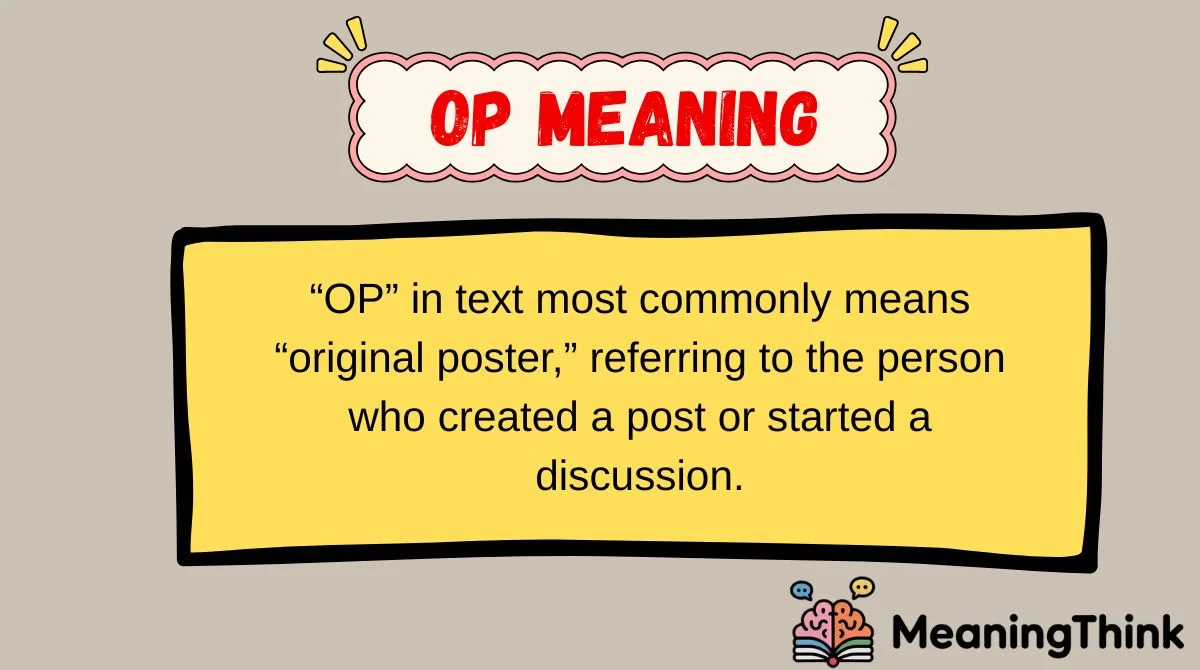
“OP” in text most commonly means “original poster,” referring to the person who created a post or started a discussion.
It can also mean “overpowered” (especially in gaming) or, less commonly, “operation” or “opponent,” depending on context.
Detailed Meaning Breakdown
Primary Meaning: Original Poster
The most common meaning of “OP” is Original Poster. This is used in forums, comment threads, and social platforms.
If someone says, “Ask OP for details,” they are referring to the person who made the original post.
This meaning is widely used on platforms like Reddit, Quora, and discussion boards.
Secondary Meaning: Overpowered
In gaming and online slang, “OP” means Overpowered.
It describes something that is too strong or unfair compared to others.
Example:
- “That weapon is OP” → It’s too powerful.
This meaning has spread beyond gaming into casual texting and memes.
Other Less Common Meanings
- Operation (Op): Used in military or tactical discussions.
- Opponent (Op): Sometimes used in sports or competitive contexts.
- Opinion (rare misuse): Some people incorrectly use “op” to mean opinion, but this is not standard.
What “op” Means in Different Situations
Everyday Texting
In normal conversations, “op” can mean either:
- Original poster (if discussing a thread)
- Overpowered (if discussing something strong or impressive)
Example:
- “The OP explained it well.” → Refers to the person who posted.
Social Media Platforms
On platforms like Reddit or Facebook groups:
- “OP” almost always means Original Poster
Example:
- “OP, can you update us?” → Talking directly to the person who posted.
Dating & Relationships
In dating conversations, “OP” is less common, but it can appear when discussing posts or stories.
Example:
- “The OP seems confused about their relationship.”
It’s not typically used directly between partners.
Professional Communication
In professional settings, “OP” should be used carefully.
It may appear in:
- Technical discussions
- Forums
- Internal communication threads
However, it’s better to use full terms like “original author” in formal communication.
Cultural or Regional Differences
The meaning of “OP” doesn’t change much globally, but usage frequency does.
- Western online communities use “OP” heavily
- Some regions may prefer full phrases instead of abbreviations
Gaming communities worldwide strongly use “OP” as “overpowered.”
Psychological & Tone Analysis
Why People Use It
People use “OP” because:
- It’s short and efficient
- It signals familiarity with online culture
- It speeds up communication
What It Signals Socially
Using “OP” correctly shows:
- You understand internet culture
- You are comfortable in digital communication spaces
- You belong to a specific community (like gamers or forum users)
Emotional Layer Behind It
The tone depends on context:
- Neutral: “OP made a good point”
- Positive: “That move was OP!” (admiration)
- Critical: “That’s OP, needs balancing” (complaint)
15 Real Conversation Examples (Explained)
- “OP didn’t mention the full story.”
→ Refers to the original poster missing details. - “Ask OP for clarification.”
→ Directing someone to the person who posted. - “This character is OP.”
→ Too strong in a game. - “Bro, that combo is OP!”
→ Impressive or unbeatable move. - “OP, can you share more info?”
→ Addressing the original poster directly. - “That gun is way too OP.”
→ Unfair advantage in gaming. - “The OP handled it well.”
→ Respect for the poster. - “Stop using that OP strategy.”
→ Suggesting something is unfair. - “OP hasn’t replied yet.”
→ Waiting for original poster response. - “That skill is OP in ranked matches.”
→ Game-related context. - “OP clearly knows what they’re doing.”
→ Complimenting the poster. - “This update made everything OP.”
→ Game imbalance. - “OP, what happened next?”
→ Asking for continuation. - “That move is too OP, it ruins the game.”
→ Negative criticism. - “The OP explained it better than anyone.”
→ Acknowledging clarity.
When “op” Can Be Misunderstood
Context Confusion
Someone might think “OP” means “overpowered” when it actually means “original poster.”
Example:
- “OP is wrong” → Not about strength, but about the person.
Generational Gap
Younger users understand “OP” easily. Older users may:
- Misinterpret it
- Not recognize it at all
Platform Differences
- Reddit → Original Poster
- Gaming → Overpowered
- Workplace → Possibly confusing or unclear
Context always determines meaning.
Similar Words, Symbols, or Abbreviations
- OG – Original gangster; someone authentic or original
- NPC – Non-playable character; someone acting robotic
- AFK – Away from keyboard
- GG – Good game
- IRL – In real life
- IMO – In my opinion
- TL;DR – Too long; didn’t read
- Noob – Beginner or inexperienced person
- Buff – Strengthen something (gaming)
- Nerf – Weaken something (gaming)
When Not to Use “op”
Professional Risks
Avoid using “OP” in:
- Formal emails
- Business reports
- Client communication
It may appear unprofessional or unclear.
Cultural Risks
Not everyone understands internet slang. Using “OP” with the wrong audience can confuse or alienate them.
Tone Risks
Using “OP” casually in serious conversations can:
- Make you seem dismissive
- Reduce clarity
Example:
- In serious discussions, it may feel too informal.
Expert Tips for Using “op” Correctly
- Always check context first
Determine if it means “original poster” or “overpowered.” - Match the platform style
Use it freely on forums, but limit it in formal spaces. - Avoid overusing it
Too much slang reduces clarity. - Know your audience
If they may not understand, use full phrases. - Use it naturally
Don’t force it into conversations. - Stay consistent
Don’t switch meanings mid-conversation. - Use tone carefully
Make sure your intent (positive or critical) is clear.
FAQs
What does OP stand for in texting?
It usually means “original poster,” referring to the person who started a conversation or post.
What does OP mean in gaming?
In gaming, “OP” means “overpowered,” describing something too strong or unbalanced.
Is OP a compliment or insult?
It can be both. It’s a compliment when praising strength and a criticism when pointing out unfairness.
Can OP mean something else?
Yes, it can mean “operation” or “opponent,” but those meanings are less common in casual texting.
Is it okay to use OP in professional messages?
It’s better to avoid it in formal communication and use full terms instead.
Why do people say OP on social media?
It’s a quick way to refer to the person who created the post.
What’s the difference between OP and OG?
OP refers to the original poster or something overpowered, while OG means someone original or authentic.
How do I know which meaning is correct?
Look at the context. If it’s a discussion thread, it means original poster. If it’s about strength or performance, it means overpowered.
Final Summary
“OP” is a simple abbreviation with powerful meaning—but only when used correctly. Most of the time, it refers to the original poster in discussions.
In gaming and casual slang, it shifts to mean something overpowered or exceptionally strong.
The key to using it well is context awareness. Always consider where you are, who you’re talking to, and what the conversation is about.
When used correctly, “OP” makes your communication faster, sharper, and more natural. When used incorrectly, it creates confusion.
Use it with intention, and you’ll sound informed, confident, and fluent in modern digital language.