You might have seen someone send a message like “i-” and wondered what it means.
At first glance, it looks incomplete, like the person stopped typing mid-sentence. In texting, social media chats, and casual conversations, short fragments like this often carry meaning that is not obvious to everyone.
This is where confusion starts—some people think it is a typo, others think it is slang, and a few assume it has a hidden emotional meaning.
In modern digital communication, even tiny symbols or partial words can change the tone of a message. “i-” is one of those expressions that can confuse readers because it depends heavily on context, platform, and the relationship between people chatting.
This guide breaks everything down in a simple way. You will learn what “i-” means, how people use it, why it appears in messages, and how to understand it correctly in different situations. By the end, you will be able to read and interpret it with confidence in any conversation.
Quick Definition of “i-” in Text
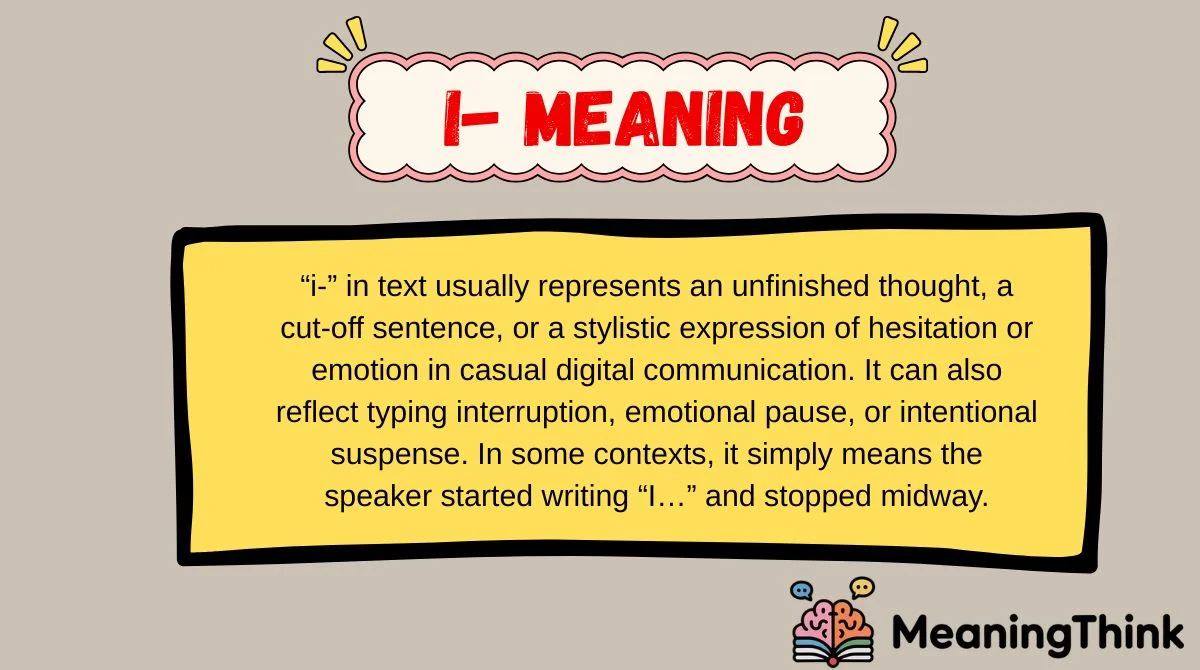
“i-” in text usually represents an unfinished thought, a cut-off sentence, or a stylistic expression of hesitation or emotion in casual digital communication. It can also reflect typing interruption, emotional pause, or intentional suspense. In some contexts, it simply means the speaker started writing “I…” and stopped midway.
Detailed Meaning Breakdown
The meaning of “i-” is not fixed. It changes depending on context and intent.
Primary Meaning: Interrupted Thought
Most commonly, “i-” shows that someone started typing a sentence beginning with “I” but stopped suddenly. This can happen due to:
- Emotional hesitation
- Distraction while typing
- Decision to delete the rest of the message
- Intentional suspense
Example:
- “i-” → The person wanted to say something but stopped.
Secondary Meaning: Emotional Pause
Sometimes, “i-” reflects hesitation or emotional uncertainty. It may show:
- Nervousness
- Awkwardness
- Surprise
- Embarrassment
Rare Meaning: Stylized Internet Speech
In rare cases, users may use “i-” as a stylistic fragment in aesthetic texting or dramatic expression, especially in Gen Z chat culture.
What “i-” Means in Different Situations
Everyday Texting
In normal texting, “i-” usually means the person stopped mid-sentence. It is often unintentional.
Example:
- “i- forgot what I was going to say”
Here, it signals a broken thought.
Social Media Platforms
On platforms like TikTok, Instagram, or X (Twitter), “i-” can be used for dramatic effect or humor.
Example:
- “i- can’t believe this happened 💀”
It adds emotional suspense before completing a thought or joke.
Dating & Relationships
In personal conversations, especially emotional ones, “i-” may show hesitation.
Example:
- “i- miss you but I don’t know if I should say it”
Here, it reflects vulnerability or emotional conflict.
Professional Communication
In professional contexts, “i-” is generally not intentional. It is usually:
- A typo
- An unfinished message
- A drafting error
Example:
- “i- will send the report” (likely incomplete typing)
Cultural or Regional Differences
There is no strong regional meaning for “i-”. However:
- Younger users interpret it as emotional or aesthetic
- Older users see it as incomplete typing or mistake
- Internet-native users may see it as stylistic expression
Psychological & Tone Analysis
The use of “i-” reveals subtle emotional signals in digital communication.
Why People Use It
People may use or leave “i-” because:
- They hesitate emotionally
- They feel unsure
- They get distracted
- They want to soften a message
Social Meaning
It can signal:
- Vulnerability
- Awkwardness
- Emotional restraint
- Playful hesitation
Emotional Layer
Even though it looks small, “i-” can carry emotional weight. It often reflects something unsaid, which can make the reader curious or emotionally engaged.
15 Real Conversation Examples (Explained)
- “i- don’t know what to say”
→ The person is confused or overwhelmed. - “i- guess that’s fine”
→ Hesitation or lack of confidence. - “i- miss you”
→ Emotional vulnerability. - “i- was going to text you earlier”
→ Explanation of delay. - “i- can’t believe it”
→ Shock or disbelief. - “i- think we should talk”
→ Serious conversation initiation. - “i- forgot lol”
→ Casual admission of forgetfulness. - “i- need help”
→ Immediate request but emotionally unsure. - “i- didn’t mean that”
→ Apology or clarification. - “i- feel weird about this”
→ Emotional discomfort. - “i- just saw your message”
→ Explanation of delayed response. - “i- was sleeping”
→ Simple justification. - “i- don’t wanna argue”
→ Conflict avoidance. - “i- should go now”
→ Ending conversation. - “i- …”
→ Complete emotional pause or unfinished thought.
When “i-” Can Be Misunderstood
Context Confusion
Without context, “i-” may look like:
- A typo
- A broken message
- A technical error
Generational Gap
- Younger users see emotional tone
- Older users see mistake or incomplete typing
Platform Differences
On fast-paced apps, “i-” is more common. In formal email or work chat, it is seen as an error.
Similar Words, Symbols, or Abbreviations
- “I…” – hesitation or unfinished thought
- “uh” – verbal hesitation
- “umm” – uncertainty
- “idk” – I don’t know
- “tbh” – to be honest
- “fr” – for real
- “lol” – light emotion or softness
- “…” – silence or pause
- “I mean” – correction or softening
- “kinda” – uncertainty
When Not to Use “i-”
Professional Risks
Avoid using it in:
- Emails
- Work reports
- Academic writing
It looks unprofessional or incomplete.
Cultural Risks
In formal cultures or serious discussions, it may seem careless.
Tone Risks
It can be misunderstood as:
- Indecision
- Lack of clarity
- Emotional instability
Expert Tips for Using “i-” Correctly
- Use it only in casual chats
- Avoid it in professional communication
- Don’t rely on it for clarity
- Use full sentences when possible
- Consider your audience before sending
- Do not overuse it or it loses meaning
- Pair it with emojis if you want tone clarity
- Replace it with full words in serious conversations
FAQs
What does “i-” mean in text messages?
It usually means an unfinished thought or hesitation in typing.
Is “i-” a typo or slang?
It can be both, depending on context.
Why do people send “i-”?
To show hesitation, interruption, or emotional pause.
Does “i-” have romantic meaning?
Not directly, but it can appear in emotional or romantic chats.
Is “i-” formal or informal?
It is strictly informal.
Can “i-” mean something offensive?
No, it is generally neutral.
Why do Gen Z use “i-”?
For expressive, emotional, or aesthetic texting style.
Should I use “i-” in work chats?
No, it is not appropriate for professional communication.
Final Summary
The expression “i-” in text is simple but context-sensitive. Most of the time, it represents an unfinished thought, hesitation, or emotional pause in digital communication.
It is widely used in casual conversations, especially in informal chats and social media, where people type quickly and express emotions in fragments.
However, its meaning is not fixed. It can be a typo, a stylistic choice, or a reflection of emotional uncertainty. Understanding the situation, tone, and relationship between speakers is the key to interpreting it correctly.
In short, “i-” is less about grammar and more about emotion and interruption in modern digital speech. Use it only in casual contexts and always ensure clarity when communicating in serious or professional environments.