You’re texting a friend, and instead of replying with words, they send a short looping animation of someone laughing, dancing, or reacting dramatically.
You pause for a second and think: what does that even mean? Is it a joke, an emotion, or just decoration?
This confusion is common, especially for people who didn’t grow up using modern messaging apps where visuals often replace words.
The term “GIF” shows up everywhere in chats, social media, and even professional platforms, but its meaning in text messages isn’t always obvious at first glance.
Understanding what a GIF means in texting is important because it changes how you interpret tone, emotion, and intent in digital conversations. A GIF can replace entire sentences, express sarcasm, or even soften a message.
In this guide, you’ll get a complete breakdown of what “GIF” means in text messages, how it’s used, why people rely on it, and how to interpret it correctly in different situations.
By the end, you’ll confidently understand every GIF you receive and know exactly when and how to use them.
Quick Definition of “GIF” Meaning in Text Message
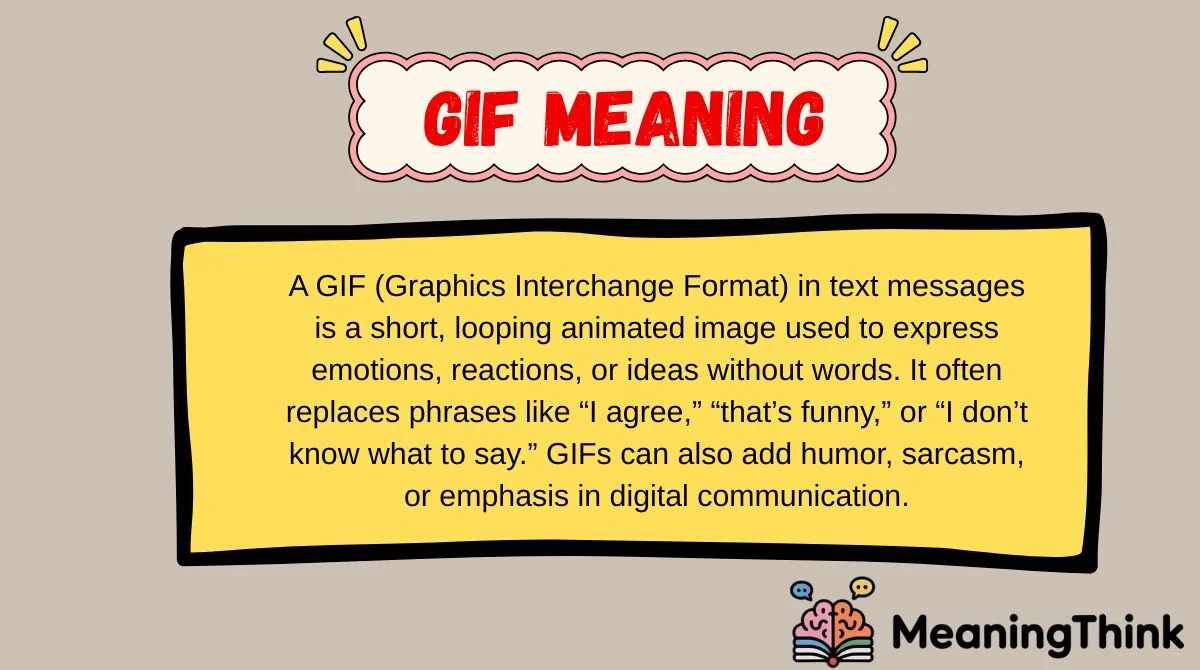
A GIF (Graphics Interchange Format) in text messages is a short, looping animated image used to express emotions, reactions, or ideas without words. It often replaces phrases like “I agree,” “that’s funny,” or “I don’t know what to say.” GIFs can also add humor, sarcasm, or emphasis in digital communication.
Detailed Meaning Breakdown
Primary Meaning
A GIF is a short animated image that plays in a loop without sound. In texting, it is used as a visual reaction instead of writing a full response. It helps communicate emotion quickly and clearly.
For example:
- A laughing GIF replaces “That’s hilarious.”
- A facepalm GIF replaces “I can’t believe this happened.”
Secondary Meaning
In some contexts, “GIF” is also used informally to refer to:
- A reaction sticker or animated emoji
- A meme clip used in messaging apps
- A visual shorthand for emotional expression
Rare or Technical Meaning
Outside texting, GIF still stands for “Graphics Interchange Format,” a digital image file type created for compressing images and animations. However, in everyday messaging, most people only think of GIFs as reactions.
What “GIF” Means in Different Situations
Everyday Texting
In casual chats, GIFs are used to:
- React instantly
- Replace long sentences
- Add humor or exaggeration
They make conversations faster and more expressive.
Social Media Platforms
On platforms like Instagram, WhatsApp, and Snapchat:
- GIFs are used in comments and stories
- They enhance engagement
- They replace written reactions like “wow” or “lol”
Dating & Relationships
In romantic chats, GIFs can:
- Show affection (cute or romantic GIFs)
- Add playfulness
- Lighten emotional conversations
Example: sending a hugging GIF instead of saying “I miss you.”
Professional Communication
In work-related chats (Slack, Teams):
- GIFs are used carefully
- They express quick reactions like approval or celebration
- Overuse can look unprofessional in formal settings
Cultural or Regional Differences
- Younger users rely heavily on GIFs
- Older users may prefer text or emojis
- In some cultures, GIFs are less common in formal messaging
Psychological & Tone Analysis
GIFs work because humans respond faster to visuals than text. They:
- Reduce emotional effort in typing
- Convey tone instantly
- Prevent misunderstandings in short messages
Why People Use GIFs
- To express emotions they can’t type easily
- To make conversations more fun
- To save time
Social Meaning
Using a GIF often signals:
- Humor
- Relatability
- Emotional openness
Emotional Layer
GIFs often carry stronger emotional impact than words because they show movement, expression, and timing.
15 Real Conversation Examples (Explained)
- “I passed my exam!” → 🎉 celebration GIF
Shows excitement and congratulations. - “I’m so tired today” → sleeping GIF
Expresses exhaustion visually. - “Guess what happened?” → shocked face GIF
Builds suspense and curiosity. - “That joke was bad” → eye-roll GIF
Shows playful criticism. - “I miss you” → hugging GIF
Adds emotional warmth. - “Let’s go!” → cheering GIF
Shows motivation and energy. - “I messed up…” → facepalm GIF
Expresses embarrassment. - “I don’t know” → confused GIF
Replaces uncertainty. - “That’s expensive” → shocked reaction GIF
Shows disbelief. - “See you later” → waving GIF
Friendly goodbye. - “I’m angry” → steam-out-of-ears GIF
Shows frustration. - “You’re funny” → laughing GIF
Reinforces humor. - “I’m late” → running GIF
Shows urgency. - “Good job!” → thumbs-up GIF
Simple approval. - “This is awkward” → cringe GIF
Expresses discomfort.
When “GIF” Can Be Misunderstood
Context Confusion
A GIF without context may confuse the receiver if its meaning is unclear.
Generational Gap
Older users may not understand the emotional meaning behind GIFs.
Platform Differences
Some apps autoplay GIFs, while others require tapping, changing the experience.
Similar Words, Symbols, or Abbreviations
- Emoji – small digital icons for emotion
- Meme – humorous image or video
- Sticker – decorative chat image
- Reaction – quick response feature
- Emoticon – text-based smiley faces
- Clip – short video segment
- Loop – repeating animation
- Reply – direct message response
- Tag – labeled response or mention
- Post – shared content update
When Not to Use “GIF”
Professional Risks
- Overuse in formal emails or reports
- Can appear unprofessional in strict corporate environments
Cultural Risks
- Some cultures prefer text-based communication
- GIFs may be seen as informal or distracting
Tone Risks
- Can be misinterpreted as sarcasm
- May weaken serious messages
Expert Tips for Using “GIF” Correctly
- Match GIF tone with message intent
- Avoid using GIFs in serious conversations
- Keep GIFs relevant to context
- Don’t overuse in professional chats
- Use simple GIFs for clarity
- Consider the receiver’s age and culture
- Use GIFs to enhance, not replace, clarity
- Choose high-quality, recognizable animations
FAQs
What does GIF mean in text messages?
A GIF is a short animated image used to express emotions or reactions instead of words in digital conversations.
Are GIFs the same as emojis?
No. GIFs are animated images, while emojis are static icons.
Why do people send GIFs in chats?
People use GIFs to express emotions quickly, add humor, or make conversations more engaging.
Can GIFs be used in professional chats?
Yes, but only in informal or friendly work environments like team chats.
Do GIFs replace typing?
Sometimes yes, especially for reactions like “lol,” “wow,” or “I agree.”
Are GIFs modern memes?
GIFs can be meme-like, but not all GIFs are memes.
Do GIFs use internet data?
Yes, they load like images or videos and require internet access.
Why are GIFs so popular?
Because they communicate emotion faster and more clearly than text.
Final Summary
A GIF in a text message is more than just a moving image—it’s a powerful communication tool.
It replaces words, expresses emotion, and adds personality to digital conversations. Whether it’s laughter, shock, confusion, or excitement, GIFs help people communicate faster and more visually.
The key to using GIFs effectively is context. When used correctly, they make conversations more engaging and expressive. When used poorly, they can confuse or weaken your message.
In modern digital communication, GIFs have become a universal language of reaction. Understanding them helps you communicate more naturally and confidently across texting, social media, and online platforms.