Imagine your friend texts, “Why are you being so emo today?” You pause for a moment. Are they talking about music? Fashion? Sadness? A joke?
The word “emo” has changed a lot over the years, and its meaning in text messages is not always obvious.
Many people first learned “emo” as a music and fashion subculture associated with emotional expression.
Today, however, the term is commonly used in texting, social media comments, memes, and online conversations to describe someone acting unusually emotional, dramatic, sensitive, or sentimental.
The confusion comes from context. In one message, “emo” may refer to genuine sadness. In another, it may be playful teasing between friends. Younger users often use it casually, while older users may associate it with the original emo subculture.
This guide explains exactly what “emo” means in text, how it is used across different platforms, what emotional tone it carries, and how to avoid misunderstandings when using it yourself.
Quick Definition of “Emo”
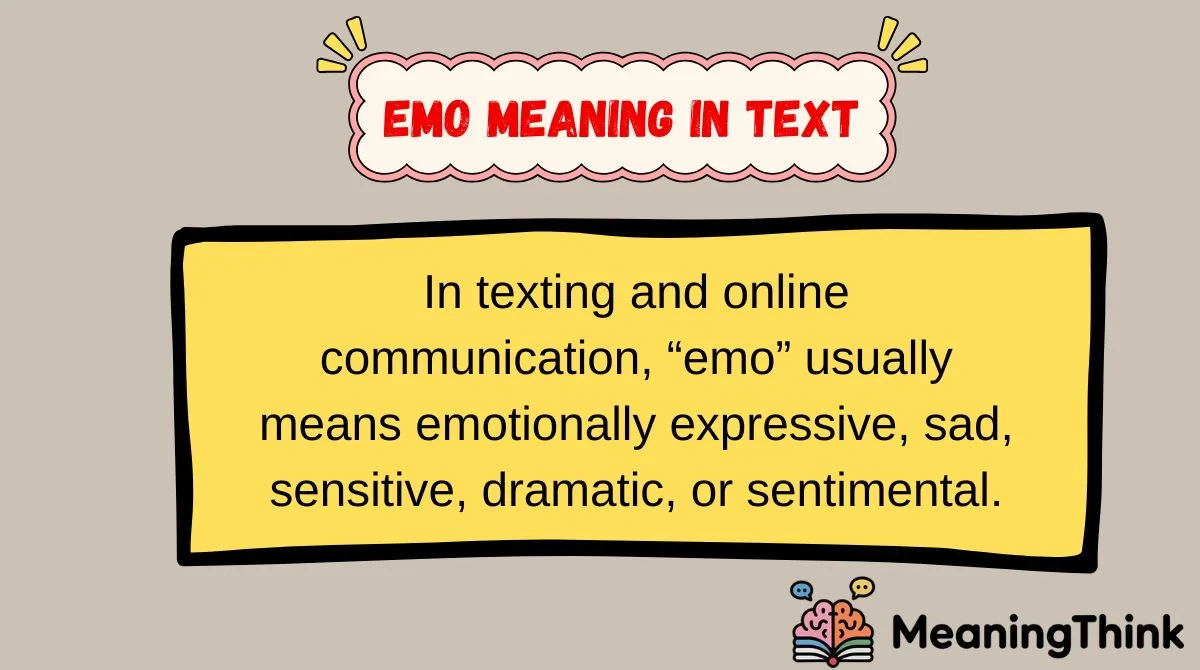
In texting and online communication, “emo” usually means emotionally expressive, sad, sensitive, dramatic, or sentimental.
For example, if someone says “That song made me emo”, they mean the song made them feel emotional. The term can also refer to the emo subculture related to music, fashion, and emotional self-expression.
Primary meaning: emotional, sad, or sentimental.
Secondary meaning: a person associated with emo music, fashion, or culture.
Detailed Meaning Breakdown
Primary Meaning in Texting
Most common
The most common modern meaning is “emotionally affected.” When someone uses “emo” in a text, they are often describing a mood.
Example
Text message
“I listened to our old playlist and got emo.”
Meaning: The person became nostalgic, emotional, or a little sad.
Here, “emo” is not about fashion or music style. It is about feelings.
Secondary Meaning: The Emo Subculture
Original meaning
“Emo” originally came from emotional hardcore, a music genre that developed from punk rock.
In this sense, an emo person may be associated with:
- Emo music bands
- Dark clothing
- Expressive lyrics
- Alternative fashion
- Introspective personality
Example
Cultural reference
“My cousin was really into emo music in high school.”
Meaning: The speaker is referring to the cultural movement, not a temporary mood.
Rare Meanings
Less common
In some online communities, “emo” can be used jokingly to describe:
- Overreacting emotionally
- Posting dramatic captions
- Being overly sentimental
- Listening to sad songs repeatedly
Example
Playful slang
“Stop being emo over a three-day situationship.”
Meaning: The speaker is teasing someone for being too emotionally invested.
What “Emo” Means in Different Situations
Everyday Texting
In regular texting, “emo” usually means sad, emotional, or sentimental.
Example
Common
“This weather is making me emo.”
Meaning: The weather is creating a reflective or melancholy mood.
Social Media Platforms
On Instagram, TikTok, and X, “emo” is often attached to posts, photos, or songs.
Example
Social media
“Late-night emo playlist.”
Meaning: A playlist featuring emotional or sad music.
Hashtags such as #emo may refer to both the mood and the music subculture.
Dating & Relationships
In dating conversations, “emo” often describes emotional vulnerability.
Example
Relationships
“I got emo after reading your message.”
Meaning: The message touched the person emotionally.
It can also be used playfully between partners.
Example
Playful
“Aww, you’re getting emo again.”
Meaning: The speaker notices emotional affection or sentimentality.
Professional Communication
Using “emo” in professional emails or workplace chats is generally not recommended.
Avoid
Unprofessional
“The client feedback made me emo.”
A better professional alternative would be:
Use instead
Professional
“The client feedback was emotionally impactful.”
Cultural or Regional Differences
In the United States and United Kingdom, “emo” is widely recognized. In some countries, younger internet users may know only the slang meaning, while older users may associate it strongly with the 2000s music scene.
This generational difference is a major source of misunderstanding.
Psychological & Tone Analysis
Why People Use It
People use “emo” because it quickly communicates an emotional state without writing a long explanation.
Instead of saying:
“I’m feeling nostalgic, reflective, and slightly sad after remembering the past.”
They can simply say:
“I’m feeling emo.”
What It Signals Socially
Using “emo” can signal:
- Emotional openness
- Self-awareness
- Humor
- Nostalgia
- Sensitivity
- A connection to internet culture
The Emotional Layer
The tone can range from genuine sadness to light teasing.
Genuine
“I’m emo because I miss my grandmother.”
Tone: sincere and emotional.
Playful
“You’re emo because your favorite team lost.”
Tone: teasing and lighthearted.
15 Real Conversation Examples (Explained)
1
“That movie made me emo.”
Explanation: The movie caused an emotional reaction.
2
“Why are you so emo tonight?”
Explanation: Asking why someone seems unusually emotional.
3
“I went through an emo phase in high school.”
Explanation: Refers to the subculture and lifestyle.
4
“This playlist is peak emo.”
Explanation: The music is highly emotional.
5
“Don’t get emo over it.”
Explanation: Don’t become overly emotional.
6
“Rainy days make me emo.”
Explanation: Rain creates a reflective mood.
7
“Your caption is so emo.”
Explanation: The caption sounds dramatic or sentimental.
8
“I got emo reading old messages.”
Explanation: Nostalgia triggered emotions.
9
“That breakup turned him emo.”
Explanation: He became noticeably emotional.
10
“I’m in my emo era.”
Explanation: A trendy way of describing a sentimental phase.
11
“You’re acting emo.”
Explanation: Someone appears moody or sensitive.
12
“That song is classic emo.”
Explanation: Refers to the music genre.
13
“I’m feeling emo today.”
Explanation: The person feels emotional or sad.
14
“Stop posting emo quotes.”
Explanation: The quotes seem overly emotional.
15
“The anniversary made us both emo.”
Explanation: The event created shared emotional feelings.
When “Emo” Can Be Misunderstood
Context Confusion
Someone may think “emo” refers to the music scene when you only mean “emotional.”
“I’m feeling emo.”
This could mean:
- I feel sad.
- I’m listening to emo music.
- I’m expressing deep emotions.
Generational Gap
| Age Group | Likely Interpretation |
|---|---|
| Teens & Gen Z | Emotional or dramatic |
| Millennials | Emotional + music subculture |
| Older adults | Primarily the subculture |
Platform Differences
| Platform | Common Meaning |
|---|---|
| TikTok | Emotional mood |
| Emotional aesthetic | |
| Discord | Mood or personality |
| Often the subculture |
Similar Words, Symbols, or Abbreviations
| Term | Meaning |
|---|---|
| Moody | Frequently changing emotions |
| Sadboy / Sadgirl | Someone who embraces sadness |
| Melancholy | Deep reflective sadness |
| Dramatic | Overly expressive emotionally |
| Nostalgic | Missing the past |
| In my feels | Emotionally affected |
| 🥀 | Sad or emotional vibe |
| 🖤 | Dark emotional aesthetic |
| 😭 | Strong emotional reaction |
| “In my emo era” | A trendy phrase for an emotional phase |
When Not to Use “Emo”
Professional Risks
Avoid using it in:
- Job applications
- Client emails
- Formal reports
- Business presentations
Cultural Risks
Not everyone understands modern internet slang. Some people may interpret it as an insult or stereotype.
Tone Risks
Avoid calling someone “emo” if they are discussing serious emotional struggles. It can sound dismissive.
Insensitive
Avoid
“You’re being emo”
when someone is talking about grief, anxiety, or depression.
Expert Tips for Using “Emo” Correctly
Best Practices
Use these
- Use it for light emotional conversations. Example: “That memory made me emo.”
- Consider your audience. Older users may interpret it differently.
- Avoid it in formal communication.
- Pair it with context if clarity matters. Example: “I’m feeling emo after watching that documentary.”
- Don’t use it to mock genuine mental health issues.
- Use emojis carefully. 🖤 and 🥀 reinforce the emotional meaning.
- Recognize when it’s playful versus serious.
- If there is any chance of confusion, say “emotional” instead.
FAQs
What does “emo” mean in a text message?
It usually means emotional, sad, sentimental, or deeply affected by something.
Is “emo” an insult?
Not always. It can be playful, descriptive, or affectionate. However, it may sound insulting if used to dismiss someone’s genuine feelings.
What does “getting emo” mean?
It means becoming emotional, nostalgic, sad, or sentimental.
Does “emo” still refer to music?
Yes. The original meaning relates to the emo music genre and subculture, though modern texting often uses it more broadly.
What does “emo era” mean?
It refers to a period when someone is feeling especially emotional, reflective, or drawn to emotional music and aesthetics.
Is “emo” the same as depressed?
No. Feeling “emo” is usually a temporary emotional mood, while depression is a serious mental health condition.
Why do people say “that song is emo”?
They mean the song has emotional lyrics, a melancholic mood, or belongs to the emo music style.
Can I use “emo” in professional emails?
It is best to avoid it. Use clearer professional language such as “emotional,” “reflective,” or “personally impactful.”
Final Summary
The meaning of “emo” in text has evolved from a specific music subculture into a widely used internet expression for feeling emotional, sad, nostalgic, sentimental, or dramatic.
In modern texting, the most common interpretation is “emotionally affected.” A person who says “I’m feeling emo” is usually describing their mood rather than their fashion style.
The key to understanding the term is context:
- Texting: emotional or sentimental
- Social media: emotional aesthetic or mood
- Music discussions: the emo genre
- Playful conversations: teasing someone for being dramatic
Use “emo” confidently in casual conversations, but avoid it in professional settings and be careful not to dismiss serious emotions. When used thoughtfully, it is a quick, expressive way to communicate a complex emotional state in just one word.
Understanding this modern usage will help you read messages more accurately, respond appropriately, and communicate with greater confidence online in 2026 and beyond.