You are texting someone about plans for tomorrow. You ask for a final time and get a reply: “TBU.” Now you are stuck. Is it confirmed? Is it canceled? Or are they still thinking?
This small three-letter abbreviation often creates confusion in chats, emails, and social media. Many people see it in messages related to schedules, events, or updates but do not fully understand what it means or how to respond to it.
The problem is simple: “TBU” looks easy, but its meaning changes depending on context. That is why misinterpretation happens so often in both personal and professional conversations.
In this guide, you will learn exactly what “TBU” means in text, how it is used, where it appears, and how to respond correctly in real situations. By the end, you will be confident using and interpreting it without confusion.
Quick Definition of “TBU” Meaning
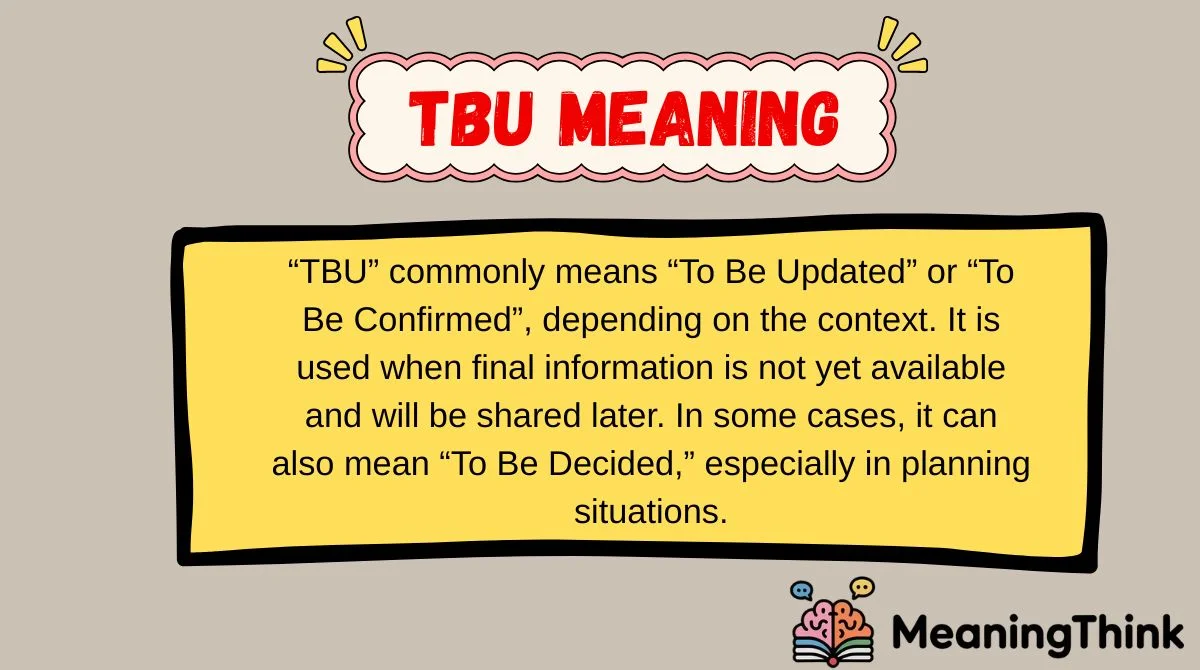
“TBU” commonly means “To Be Updated” or “To Be Confirmed”, depending on the context. It is used when final information is not yet available and will be shared later. In some cases, it can also mean “To Be Decided,” especially in planning situations.
It signals that something is still in progress and not finalized yet.
Detailed Meaning Breakdown
Primary Meaning
The most widely accepted meaning of TBU in text is “To Be Updated.”
It indicates that details are not final and will be shared later once confirmed.
Example:
- “Meeting time TBU” → The meeting time is not finalized yet.
Secondary Meanings
Depending on context, TBU can also mean:
- To Be Confirmed (TBC) – sometimes used interchangeably
- To Be Decided – used in group decisions or planning
- To Be Updated Later – when information is pending
- Temporary Placeholder – used in drafts or notes
Rare Uses
In very specific industries or informal chats, TBU may also appear as:
- “To Be Used” (rare and technical context only)
However, in texting and social media, “To Be Updated” is the dominant meaning.
What “TBU” Means in Different Situations
Everyday Texting
In personal chats, TBU is used when someone is unsure about plans.
Example:
- “Dinner time TBU” → Time is not fixed yet.
It usually means the person will confirm later.
Social Media Platforms
On platforms like Instagram, WhatsApp, or Snapchat, TBU often appears in:
- Event posts
- Stories
- Group announcements
Example:
- “Launch date TBU” → The date will be announced later.
It keeps content flexible when details are not ready.
Dating & Relationships
In dating conversations, TBU often signals uncertainty.
Example:
- “Where we going? TBU 😅”
It can mean:
- The person is still deciding
- They are avoiding commitment to a plan
Tone matters a lot here. It can feel casual or slightly indecisive.
Professional Communication
In work environments, TBU is used in emails, reports, and project updates.
Example:
- “Deadline: TBU”
It usually means:
- Waiting for approval
- Pending management decision
- Information not finalized
It is a neutral placeholder in business communication.
Cultural or Regional Differences
While TBU is widely understood in English texting culture, some regions:
- Prefer full phrases like “to be confirmed”
- May not recognize abbreviations immediately
In international communication, clarity is always better than abbreviations.
Psychological & Tone Analysis
Why People Use It
People use TBU because:
- They do not have final information
- They want to avoid wrong commitments
- They need flexibility in planning
It acts as a “safe response” when details are unclear.
Social Signal
TBU signals:
- Uncertainty
- Flexibility
- Pending decision-making
It also prevents pressure from others asking for immediate answers.
Emotional Layer
Depending on tone, it can feel:
- Neutral in professional settings
- Casual in texting
- Slightly evasive in personal conversations
Context decides how it is perceived.
15 Real Conversation Examples (Explained)
- “Meeting time?” – “TBU”
→ Time is not finalized yet. - “Movie tonight?” – “TBU”
→ Plans are still being decided. - “Project deadline?” – “TBU”
→ Waiting for official confirmation. - “Dinner at 7?” – “TBU”
→ Time may change later. - “Launch date?” – “TBU”
→ Product is not ready for announcement. - “Trip plan?” – “TBU”
→ Travel details are not fixed. - “Exam schedule?” – “TBU”
→ Official timetable not released. - “Are you coming?” – “TBU”
→ Person is unsure or deciding. - “Event location?” – “TBU”
→ Venue not confirmed. - “Meeting link?” – “TBU”
→ Will be shared later. - “Wedding date?” – “TBU”
→ Planning still ongoing. - “Salary update?” – “TBU”
→ HR has not finalized details. - “Game time?” – “TBU”
→ Schedule not confirmed. - “Party dress code?” – “TBU”
→ Organizer will decide later. - “Release time?” – “TBU”
→ Product or content not scheduled yet.
Each example shows how TBU acts as a placeholder for missing information.
When “TBU” Can Be Misunderstood
Context Confusion
People may think:
- It means “cancelled” (which is incorrect)
- It means “ignored” (not true)
It simply means pending.
Generational Gap
Older users may:
- Not understand the abbreviation
- Prefer full wording like “to be confirmed”
Platform Differences
On formal platforms (email, documents), TBU may look:
- Too informal
- Unclear without explanation
Always consider audience.
Similar Words, Symbols, or Abbreviations
Here are related terms:
- TBC (To Be Confirmed) – final approval pending
- TBD (To Be Decided) – decision not made yet
- TBA (To Be Announced) – will be publicly shared later
- Pending – waiting for action
- On hold – temporarily paused
- Unconfirmed – not verified yet
- In progress – still being worked on
- Later update – information will come later
- Waiting approval – depends on authority decision
- Draft status – not finalized document
When Not to Use “TBU”
Professional Risks
Avoid TBU when:
- Writing formal contracts
- Sending legal documents
- Giving official instructions
Use full phrases instead.
Cultural Risks
In global communication:
- Some may not understand the abbreviation
- Misinterpretation can lead to confusion
Tone Risks
TBU may feel:
- Lazy in serious communication
- Vague in urgent situations
Clarity is always better in important messages.
Expert Tips for Using “TBU” Correctly
- Use it only when information is truly pending
- Avoid in legal or official documents
- Add explanation if audience may not know it
- Use full form in international communication
- Do not use in urgent situations
- Combine with timeline if possible (“TBU today”)
- Keep it casual in texting only
- Replace with TBC/TBD when more accurate
Frequently Asked Questions
What does TBU mean in texting?
It means “To Be Updated,” used when information is not final.
Is TBU the same as TBD?
No. TBU means updates are pending, while TBD means decision is pending.
Is TBU formal or informal?
It is semi-informal and best used in casual or internal communication.
Can TBU mean canceled?
No, it does not mean canceled. It only means not finalized.
Where is TBU commonly used?
It is used in texting, emails, planning messages, and social media posts.
What should I reply to TBU?
You can reply with patience or ask when the update will come.
Is TBU used in business emails?
Yes, but only in internal communication, not formal external documents.
What is the safest alternative to TBU?
“TBC” or full phrase “to be confirmed” is safer in formal contexts.
Final Summary
“TBU” is a simple abbreviation, but its meaning plays an important role in modern communication. It mainly stands for “To Be Updated,” showing that information is not yet final.
It is commonly used in texting, planning, social media, and work communication when details are still changing. However, it should be used carefully in formal or professional settings where clarity matters.
Understanding context is key. In casual chats, it is perfectly normal. In formal communication, it is better to use full phrases like “to be confirmed” or “to be decided.”
Once you understand its usage, “TBU” becomes a helpful shortcut instead of a confusing message.