OTM Meaning: Definition, Context, Examples, and Modern Usage (2026 Guide)
You’re texting a friend, scrolling through social media, or reading a finance-related post, and suddenly you see “OTM.” You pause. Does it mean “on the move”? Something about money? Or maybe it’s just slang you missed?
This confusion is common. “OTM” is one of those abbreviations that changes meaning depending on context. In casual chats, it can signal urgency or action.
In finance, it has a completely different technical meaning. Without the right context, it’s easy to misunderstand or misuse it.
This guide removes all confusion. You’ll learn exactly what “OTM” means, how it’s used in different situations, what tone it carries, and how to use it correctly in 2026. By the end, you’ll be able to understand and use “OTM” with confidence in any conversation.
Quick Definition of “OTM”
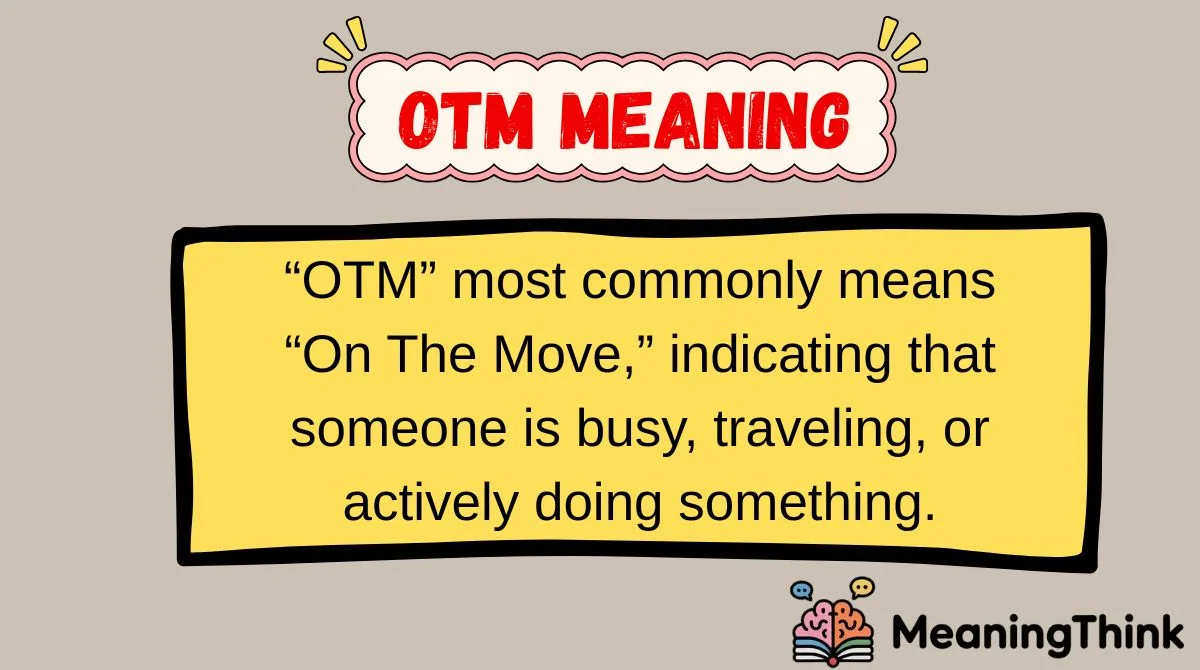
“OTM” most commonly means “On The Move,” indicating that someone is busy, traveling, or actively doing something.
In finance, it also means “Out of The Money,” referring to options that have no intrinsic value. Less commonly, it can imply urgency or responsiveness in texting.
Detailed Meaning Breakdown
Primary Meaning: On The Move
The most widely used meaning of “OTM” in texting is “On The Move.” It tells others that you are currently active, busy, or not stationary.
Example:
- “Can’t talk much, I’m OTM.”
This signals limited availability and often implies the person will respond later.
Secondary Meaning: Out of The Money (Finance)
In financial contexts, “OTM” stands for “Out of The Money.” It is used in options trading.
- A call option is OTM when the market price is below the strike price.
- A put option is OTM when the market price is above the strike price.
This meaning is technical and mostly used by traders or finance professionals.
Rare Meanings
Less common interpretations include:
- “Off The Market” (dating context)
- “On The Mic” (music or streaming context)
- “Over The Moon” (emotional exaggeration, rare shorthand)
These meanings are niche and depend heavily on context.
What “OTM” Means in Different Situations
Everyday Texting
In casual messaging, “OTM” usually means you’re busy or going somewhere.
Example:
- “Heading out now, OTM.”
It communicates quick status without needing a full explanation.
Social Media Platforms
On platforms like Twitter, Instagram, or TikTok, “OTM” can signal action or momentum.
Example:
- “Big things happening, OTM 🚀”
Here, it creates excitement and suggests progress.
Dating & Relationships
In dating contexts, “OTM” may indicate being busy or unavailable.
Example:
- “Sorry, I’ve been OTM all day.”
It can soften delayed responses and avoid sounding uninterested.
Professional Communication
In work-related chats, “OTM” should be used cautiously.
Example:
- “Currently OTM, will respond in 30 mins.”
This is acceptable in informal work chats but not in formal emails.
Cultural or Regional Differences
“OTM” usage is more common in English-speaking digital spaces. In regions where English slang is mixed with local language, it may still be understood but less frequently used.
Younger users tend to recognize it more than older generations.
Psychological & Tone Analysis
Why People Use It
People use “OTM” because it is:
- Fast to type
- Efficient
- Informal
- Clear in the right context
It saves time while conveying status.
What It Signals Socially
Using “OTM” suggests:
- You are active or busy
- You are socially aware of modern slang
- You prefer quick communication
It can also signal importance or productivity.
Emotional Layer Behind It
Tone depends on context:
- Neutral: “I’m OTM” (just busy)
- Slight urgency: “OTM now, talk later”
- Excited: “We’re OTM 🚀”
It can subtly shape how your message is perceived.
15 Real Conversation Examples (Explained)
- “Can’t call right now, I’m OTM.”
- Indicates being busy or traveling.
- “OTM to the gym, catch you later.”
- Shows physical movement and future intent.
- “Sorry for late reply, been OTM all day.”
- Explains delayed response politely.
- “We’re finally OTM with the project!”
- Suggests progress or momentum.
- “OTM 🚗💨”
- Casual, visual way to show movement.
- “I’ll join the meeting, just OTM.”
- Implies slight delay but commitment.
- “He’s OTM again, always busy.”
- Describes someone’s lifestyle.
- “OTM to something big 👀”
- Builds curiosity or excitement.
- “Still OTM, will text later.”
- Reinforces unavailability.
- “OTM but listening.”
- Indicates multitasking.
- “We’re OTM financially this quarter.”
- Suggests positive business progress.
- “That option is OTM right now.”
- Finance usage: no intrinsic value.
- “I’ve been OTM mentally lately.”
- Metaphorical use: busy or overwhelmed.
- “OTM, don’t wait for me.”
- Signals independence or delay.
- “OTM with new goals 💪”
- Motivational tone.
When “OTM” Can Be Misunderstood
Context Confusion
Without context, “OTM” can mean different things. A trader and a teenager may interpret it differently.
Generational Gap
- Younger users: Understand instantly
- Older users: May not recognize it
This can lead to confusion in mixed-age communication.
Platform Differences
- Text messages: Usually “On The Move”
- Finance forums: “Out of The Money”
- Social media: Could be motivational or vague
Always consider where the conversation is happening.
Similar Words, Symbols, or Abbreviations
- BRB – Be Right Back
- AFK – Away From Keyboard
- IMO – In My Opinion
- IDK – I Don’t Know
- TTYL – Talk To You Later
- GM – Good Morning
- ICYMI – In Case You Missed It
- BTW – By The Way
- FOMO – Fear Of Missing Out
- GOAT – Greatest Of All Time
These abbreviations serve similar roles in quick communication.
When Not to Use “OTM”
Professional Risks
Avoid using “OTM” in:
- Formal emails
- Client communication
- Official reports
It may appear unprofessional or unclear.
Cultural Risks
In global communication, not everyone understands slang. Using “OTM” may confuse non-native English speakers.
Tone Risks
“OTM” can sometimes seem dismissive if overused.
Example:
- Repeated short replies may feel uninterested.
Balance is key.
Expert Tips for Using “OTM” Correctly
- Use it only when context is clear
- Avoid it in formal communication
- Pair it with a full sentence for clarity
- Use it sparingly to avoid sounding lazy
- Add emojis if tone needs softening
- Know your audience before using it
- Avoid mixing meanings in one conversation
- Clarify if there’s any chance of confusion
FAQs
What does OTM mean in texting?
It usually means “On The Move,” indicating someone is busy or traveling.
What does OTM mean in finance?
It means “Out of The Money,” describing options with no intrinsic value.
Is OTM rude to use?
No, but it can seem dismissive if used too often without explanation.
Can OTM mean something else?
Yes, in rare cases it can mean “Off The Market” or “On The Mic.”
Is OTM formal or informal?
It is informal and best used in casual communication.
Do people still use OTM in 2026?
Yes, especially in texting, social media, and niche communities like finance.
Should I use OTM in work chats?
Only in informal team chats, not in formal communication.
How do I avoid confusion when using OTM?
Add context or use a full sentence alongside it.
Final Summary & Smart Usage Advice
“OTM” is a flexible abbreviation with two main meanings: “On The Move” in everyday communication and “Out of The Money” in finance. Its meaning depends entirely on context, making it both useful and potentially confusing.
Used correctly, it helps you communicate quickly and efficiently. Used poorly, it can create misunderstandings or seem unprofessional.
The key is simple:
- Know your audience
- Understand the context
- Use it with clarity
When you do that, “OTM” becomes a powerful tool in modern communication.