Communication today relies heavily on emojis. A single emoji can express feelings faster than a full sentence. One emoji that often creates confusion is 🥱.
You may receive it in a text message, see it in a social media comment, or notice it during an online conversation and wonder what the sender actually means.
Does it mean someone is tired? Are they bored? Could they be hinting that a conversation is uninteresting? Or is it simply a casual expression without any negative intent?
The answer depends heavily on context.
The 🥱 emoji has evolved beyond its original meaning. While it started as a symbol of yawning and sleepiness, people now use it to communicate boredom, lack of excitement, emotional exhaustion, and even sarcasm.
Understanding these subtle differences can help you avoid misunderstandings and interpret messages more accurately.
This guide explains everything you need to know about the 🥱 emoji, including its meanings, psychological signals, examples, proper usage, common mistakes, and modern communication trends.
Quick Definition of “🥱 Meaning in Text”
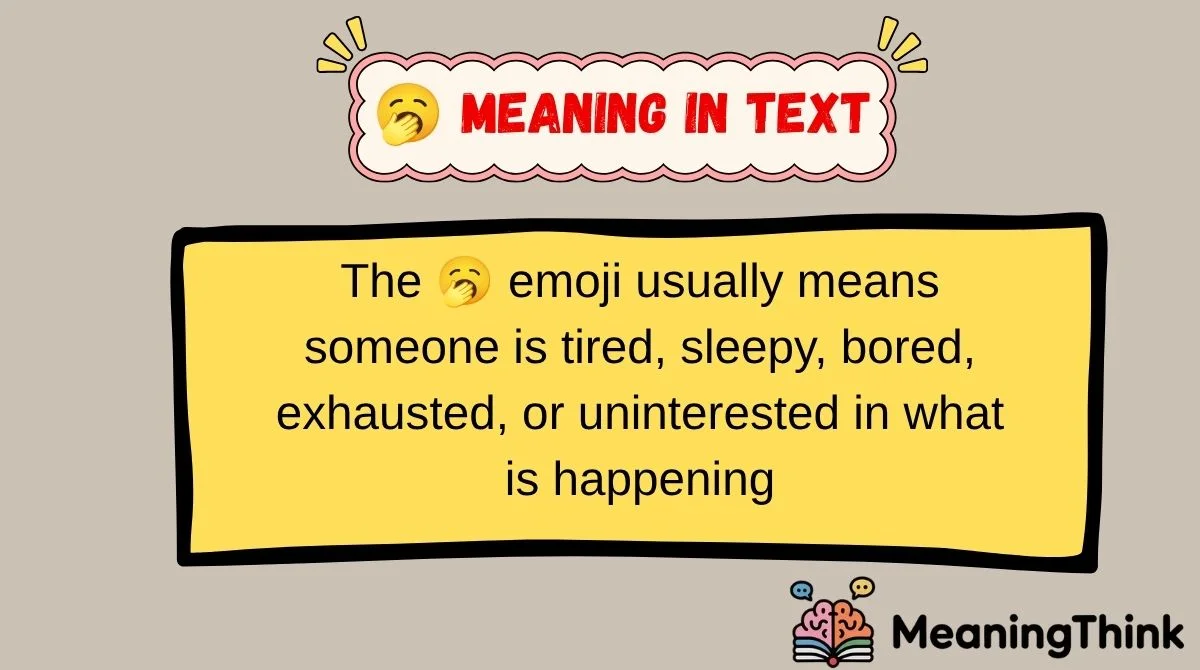
The 🥱 emoji usually means someone is tired, sleepy, bored, exhausted, or uninterested in what is happening. In texting and social media, it can also suggest that something feels repetitive, unexciting, or emotionally draining. The exact meaning depends on the conversation, relationship, and tone being used.
Detailed Meaning Breakdown
Primary Meaning: Tired or Sleepy
The most common meaning of 🥱 is physical tiredness.
People often use it when they are sleepy, have had a long day, or want to indicate they need rest.
Examples:
- “I’ve been working since 7 AM 🥱”
- “Goodnight everyone 🥱”
- “Need coffee ASAP 🥱”
In these situations, the emoji literally represents yawning.
Secondary Meaning: Boredom
A second common meaning is boredom.
When someone finds an activity, conversation, event, or topic uninteresting, they may use 🥱 to express that feeling.
Examples:
- “This meeting is taking forever 🥱”
- “Same drama every week 🥱”
Here, the emoji does not mean sleepiness. Instead, it signals a lack of engagement.
Secondary Meaning: Mental Exhaustion
People also use 🥱 when they feel mentally drained.
Examples include:
- Studying for long hours
- Working under pressure
- Handling emotional stress
Example:
- “Finished my final exams 🥱”
The person may not be sleepy but feels exhausted.
Secondary Meaning: Lack of Excitement
Sometimes 🥱 communicates that something is predictable or unimpressive.
Example:
- “Another remake of the same movie 🥱”
This usage can sound dismissive.
Rare Meaning: Sarcasm
In certain online communities, 🥱 can be used sarcastically.
Example:
- “Wow, what an original idea 🥱”
The sender may actually be criticizing rather than expressing genuine tiredness.
What “🥱” Means in Different Situations
Everyday Texting
In personal conversations, 🥱 most often means:
- Sleepiness
- Fatigue
- Long day
- Need for rest
Example:
“Just got home from work 🥱”
The message usually communicates genuine tiredness.
Social Media Platforms
On social media, meanings become broader.
Users may use 🥱 to indicate:
- Boredom
- Lack of interest
- Repetitive content
- Unimpressive trends
Example:
“Everyone posting the same challenge again 🥱”
The emoji acts as commentary.
Dating & Relationships
In dating conversations, context matters greatly.
Positive meanings:
- Feeling tired after a busy day
- Preparing for sleep
Negative meanings:
- Losing interest
- Feeling emotionally disconnected
- Finding a conversation boring
Example:
Partner: “Tell me about your day.”
Reply: “Work was chaotic🥱”
This likely means tiredness.
However:
Partner: “I love talking to you.”
Reply: “🥱”
This may seem rude or dismissive.
Professional Communication
The 🥱 emoji is generally not suitable for professional settings.
It may appear:
- Disrespectful
- Uninterested
- Unprofessional
Example:
Manager: “Please review the report.”
Reply: “🥱”
This can create a negative impression.
Cultural or Regional Differences
Different cultures interpret emojis differently.
Some people view 🥱 as:
- Honest expression of tiredness
Others may interpret it as:
- Rudeness
- Lack of respect
- Passive criticism
Understanding your audience is important before using it.
Psychological & Tone Analysis
Why People Use It
People use 🥱 because it quickly communicates a state of low energy.
It helps express:
- Physical fatigue
- Emotional fatigue
- Mental exhaustion
- Lack of stimulation
What It Signals Socially
Socially, the emoji often signals:
- Reduced engagement
- Need for rest
- Lower enthusiasm
- Limited excitement
It can influence how others perceive a conversation.
Emotional Layer Behind It
Unlike simple text, emojis add emotional depth.
The 🥱 emoji can suggest:
- “I’m exhausted.”
- “I’m losing focus.”
- “This isn’t exciting.”
- “I need a break.”
This emotional layer is why context matters so much.
15 Real Conversation Examples (Explained)
1.
Person A: “Still awake?”
Person B: “Barely 🥱”
Explanation: Sleepiness.
2.
Person A: “How was work?”
Person B: “Long day 🥱”
Explanation: Physical exhaustion.
3.
Person A: “Another two-hour meeting tomorrow.”
Person B: “🥱”
Explanation: Boredom.
4.
Person A: “Finished studying?”
Person B: “Finally 🥱”
Explanation: Mental fatigue.
5.
Person A: “Ready for bed?”
Person B: “Absolutely 🥱”
Explanation: Sleepiness.
6.
Person A: “The lecture lasted three hours.”
Person B: “🥱”
Explanation: Lack of excitement.
7.
Person A: “The same argument again.”
Person B: “🥱”
Explanation: Frustration and boredom.
8.
Person A: “What are you doing?”
Person B: “Trying not to fall asleep 🥱”
Explanation: Literal tiredness.
9.
Person A: “New season released.”
Person B: “Looks boring 🥱”
Explanation: Disinterest.
10.
Person A: “I worked all weekend.”
Person B: “You deserve rest 🥱”
Explanation: Exhaustion reference.
11.
Person A: “Another update?”
Person B: “🥱”
Explanation: Repetitive situation.
12.
Person A: “Can you stay up later?”
Person B: “No chance 🥱”
Explanation: Sleepiness.
13.
Person A: “How was the flight?”
Person B: “Too long 🥱”
Explanation: Tiredness and boredom.
14.
Person A: “Same trend again.”
Person B: “🥱”
Explanation: Unimpressed reaction.
15.
Person A: “You seem quiet.”
Person B: “Just exhausted today 🥱”
Explanation: Emotional or physical fatigue.
When “🥱” Can Be Misunderstood
Context Confusion
The emoji may mean:
- Sleepiness
- Boredom
- Disinterest
- Exhaustion
Without context, readers may guess incorrectly.
Generational Gap
Younger users often understand emoji nuance.
Older users may interpret 🥱 more literally.
This can create communication issues.
Platform Differences
On some platforms:
- It may be playful.
On others:
- It may appear rude.
Audience expectations influence interpretation.
Relationship Differences
Friends may understand the intended meaning.
Coworkers or strangers may misunderstand it.
Relationship context matters significantly.
Similar Words, Symbols, or Abbreviations
1. 😴
Sleeping emoji indicating deep tiredness.
2. 💤
Represents sleep or boredom.
3. 😪
Suggests sleepiness and fatigue.
4. Ugh
Shows annoyance or frustration.
5. Meh
Indicates indifference.
6. IDC
Means “I don’t care.”
7. Zzz
Represents sleeping or boredom.
8. Tired AF
Internet slang for extreme tiredness.
9. Bored
Direct expression of disinterest.
10. Low Energy
Describes reduced enthusiasm or motivation.
When Not to Use “🥱”
Professional Risks
Avoid using it in:
- Work emails
- Client conversations
- Formal business chats
It may appear disrespectful.
Cultural Risks
Not everyone interprets emojis similarly.
Some people may feel insulted.
Tone Risks
The emoji can accidentally suggest:
- Disinterest
- Disrespect
- Dismissiveness
Especially when used alone.
Relationship Risks
Sending only 🥱 during an emotional conversation may hurt feelings.
Consider adding context.
Public Discussions
Using 🥱 in debates or comments may appear rude and provoke negative reactions.
Expert Tips for Using “🥱” Correctly
1. Always Consider Context
Think about how the receiver may interpret it.
2. Add Words for Clarity
Instead of sending only 🥱, explain your meaning.
Example:
“I’m exhausted today 🥱”
3. Avoid Professional Settings
Keep it for casual communication.
4. Know Your Audience
Close friends may understand your intent better.
5. Use It Sparingly
Overuse can make conversations seem negative.
6. Avoid Sensitive Conversations
The emoji may appear dismissive.
7. Pair It with Friendly Language
This reduces misunderstanding.
8. Consider Alternative Emojis
Sometimes 😴 or 😪 may communicate your message more clearly.
FAQs
What does 🥱 mean in texting?
It usually means the sender is tired, sleepy, bored, or mentally exhausted.
Is 🥱 a rude emoji?
Not necessarily. However, it can appear rude if used to show disinterest in a person or conversation.
What does 🥱 mean from a girl?
The meaning depends on context. It often indicates tiredness, boredom, or emotional exhaustion rather than a hidden message.
What does 🥱 mean from a guy?
Most commonly, it signals fatigue, boredom, or low energy.
Does 🥱 mean someone is not interested?
Sometimes. In certain conversations, it can suggest a lack of excitement or engagement.
Can 🥱 be flirtatious?
Rarely. It is generally associated with tiredness rather than flirting.
Should I use 🥱 at work?
No. Professional communication is usually better without this emoji.
What is the difference between 🥱 and 😴?
🥱 often represents yawning, boredom, or fatigue, while 😴 usually focuses on sleep or being asleep.
Final Summary
The 🥱 emoji is much more than a simple yawn symbol. In modern digital communication, it can represent sleepiness, tiredness, boredom, emotional exhaustion, low enthusiasm, or even sarcasm.
The intended meaning changes depending on the situation, relationship, and platform.
When interpreting 🥱, always consider the surrounding message rather than the emoji alone.
A tired person, a bored social media user, and an exhausted student may all use the same emoji for different reasons.
For best results, use 🥱 thoughtfully, avoid it in professional communication, and provide context whenever possible.
Understanding its nuances will help you communicate more clearly and avoid misunderstandings in today’s emoji-driven conversations.