Have you ever sent someone exciting news and received only 😒 in response? Or maybe a friend replied with that emoji after you made a joke, and you were not sure whether they were annoyed, teasing, or simply unimpressed.
The 😒 emoji is one of the most misunderstood facial expressions in digital communication.
In text messages, social media comments, Snapchat chats, WhatsApp conversations, and online forums, 😒 can carry several meanings depending on context. It often expresses annoyance, disappointment, boredom, skepticism, or mild frustration. However, many people also use it playfully to show sarcasm or mock irritation.
The challenge is that the same emoji can sound completely different based on who sends it, the relationship between the people involved, and the platform where it appears. A teenager might use 😒 jokingly with friends, while a coworker could use it to signal genuine dissatisfaction.
This guide explains exactly what 😒 meaning in text is, how it is used in different situations, what emotional signals it sends, and how to avoid common misunderstandings. By the end, you will be able to interpret and use this emoji with confidence.
Quick Definition of “😒”
Primary meaning
Most common
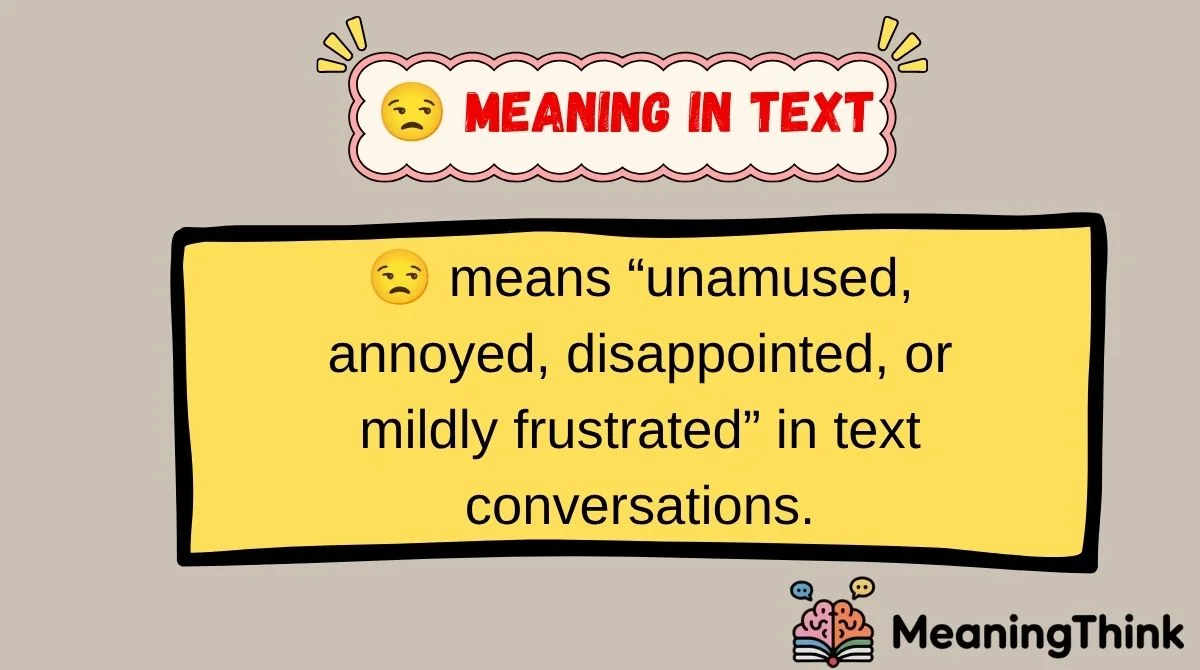
😒 means “unamused, annoyed, disappointed, or mildly frustrated” in text conversations.
It is commonly used when someone finds a situation irritating, boring, unfair, or not worth getting excited about. Secondary meanings include sarcasm, playful teasing, skepticism, and eye-roll energy. In close friendships, it can also indicate mock annoyance rather than real anger.
Detailed Meaning Breakdown
Primary meaning: Unamused or annoyed
The most common interpretation of 😒 is that the sender is not impressed.
Example: “You forgot my birthday again 😒”
Here, the emoji clearly shows disappointment and irritation.
Secondary meaning: Bored or tired of something
People often use 😒 when they are tired of hearing the same thing.
Example: “Another meeting about the same issue 😒”
The tone is more exhausted than angry.
Secondary meaning: Sarcastic eye-roll
In casual chats, 😒 can act like a digital eye-roll.
Example: “Oh sure, because that worked so well last time 😒”
The sender is expressing skepticism or sarcasm.
Rare meaning: Playful mock irritation
Among close friends or romantic partners, the emoji may not indicate real frustration.
Example: “You beat me at the game again 😒”
The person is likely joking rather than genuinely upset.
What “😒” Means in Different Situations
Everyday Texting
In everyday conversations, 😒 usually signals mild annoyance or disappointment.
Message
Likely meaning
“The bus is late again 😒”
Frustration
“I have homework all weekend 😒”
Disappointment
“My phone battery died 😒”
Annoyance
Social Media Platforms
On platforms such as Instagram, TikTok, and X, the emoji often reacts to something ridiculous, disappointing, or unbelievable.
Example comment: “The price went up again 😒”
Users employ it to show collective frustration without writing a long explanation.
Dating & Relationships
In romantic conversations, context becomes very important.
Message
Meaning
“You left me on read 😒”
Genuine irritation
“You’re hanging out without me 😒”
Possibly playful jealousy
“Guess I’m not your favorite anymore 😒”
Teasing with emotion
The emoji can soften a complaint and make it sound less confrontational.
Professional Communication
Using 😒 at work is risky.
Example: “The report was changed again 😒”
A colleague may interpret this as unprofessional or disrespectful. In formal settings, it is usually better to express concerns with clear words instead of emojis.
Cultural or Regional Differences
In many English-speaking online communities, 😒 is strongly associated with eye-rolling or being unimpressed. In some other regions, users may simply see it as a “sad annoyed face” without the sarcastic undertone.
Age also matters:
- Younger users: often use it jokingly.
- Older users: may read it as genuine annoyance.
Psychological & Tone Analysis
Why do people choose 😒 instead of writing “I’m annoyed”?
Because emojis communicate emotion quickly.
What it signals socially
- “I’m not impressed.”
- “I disagree.”
- “This is frustrating.”
- “I’m rolling my eyes.”
- “I’m teasing you a little.”
The emotional layer
The emoji often represents low-intensity negative emotion. It is usually weaker than anger and stronger than simple boredom.
Mild
🙂
Neutral annoyance
😒
Stronger frustration
😠
Full anger
🤬
Many users prefer 😒 because it expresses dissatisfaction without escalating into a serious conflict.
15 Real Conversation Examples (Explained)
1
“You’re late again 😒”
Explanation: Real annoyance.
2
“I spilled coffee on my shirt 😒”
Explanation: Self-directed frustration.
3
“Another update? 😒”
Explanation: Tired of repeated changes.
4
“Wow, what a surprise 😒”
Explanation: Sarcasm.
5
“You ate the last slice 😒”
Explanation: Mild complaint.
6
“Guess I’ll do it myself 😒”
Explanation: Frustration with others.
7
“You beat me again 😒”
Explanation: Playful irritation.
8
“My internet stopped during the game 😒”
Explanation: Disappointment.
9
“You forgot our plans 😒”
Explanation: Hurt feelings mixed with annoyance.
10
“That movie was overhyped 😒”
Explanation: Unimpressed.
11
“Sure, blame me 😒”
Explanation: Defensive sarcasm.
12
“I have to wake up at 5 AM 😒”
Explanation: Dread and frustration.
13
“You really thought that was funny? 😒”
Explanation: Disapproval.
14
“My package got delayed again 😒”
Explanation: Ongoing annoyance.
15
“Fine, you win 😒”
Explanation: Reluctant acceptance, often playful.
When “😒” Can Be Misunderstood
Context confusion
Message: “You’re impossible 😒”
This could mean:
- Real frustration
- Flirty teasing
- Friendly joking
Generational gap
| Age group | Common interpretation |
|---|---|
| Teens | Joking eye-roll |
| 20s–30s | Annoyed or sarcastic |
| 40+ | Genuinely displeased |
Platform differences
| Platform | Typical meaning |
|---|---|
| Snapchat | Playful |
| TikTok | Reaction / eye-roll |
| Personal frustration | |
| Slack | Potentially unprofessional |
Similar Words, Symbols, or Abbreviations
| Term | Meaning |
|---|---|
| 🙄 | Eye-roll, stronger sarcasm |
| 😑 | Speechless or unimpressed |
| 😕 | Confused or disappointed |
| 😤 | Frustrated or determined |
| 😠 | Clearly angry |
| 🤨 | Suspicious or skeptical |
| “ugh” | Verbal annoyance |
| “smh” | Shaking my head |
| “bruh” | Disbelief or frustration |
| “seriously?” | Questioning something annoying |
When Not to Use “😒”
Professional risks
Avoid it in:
- Job applications
- Client emails
- Formal business chats
- Academic communication
Cultural risks
Some people interpret 😒 as rude or disrespectful, especially if they are not familiar with emoji-based humor.
Tone risks
Do not use it when:
- Giving serious condolences
- Discussing sensitive personal issues
- Trying to appear supportive
- Resolving a conflict
In these situations, the emoji can make you seem dismissive.
Expert Tips for Using “😒” Correctly
Use it for mild annoyance
not intense anger
Add context if the meaning is unclear
“I’m joking 😒😂”
Know your audience
friends vs coworkers
Pair it with humor
to soften criticism
Avoid overusing it
every message can sound negative
Choose stronger emojis if truly angry
😠 or 🤬
Choose neutral wording in professional settings
instead of emojis
Watch the conversation history
the same emoji can shift meaning
FAQs
What does 😒 mean from a girl?
Usually annoyance, disappointment, teasing, or playful eye-rolling. The exact meaning depends on your relationship and the conversation.
What does 😒 mean from a guy?
It often signals frustration, boredom, skepticism, or sarcastic humor. Many men use it as a lighter alternative to sounding openly angry.
Is 😒 a flirting emoji?
Not primarily, but it can be used in playful flirting when someone is mock-annoyed, such as “You’re making fun of me again 😒”.
What does 😒 mean on Snapchat?
On Snapchat, it is frequently used jokingly among friends to show eye-roll energy or playful irritation.
Is 😒 the same as 🙄?
No. 🙄 is usually a stronger eye-roll, while 😒 is more about being unimpressed, annoyed, or mildly frustrated.
Can 😒 mean jealousy?
Yes, especially in relationships. A message like “You went without me 😒” may express mild jealousy in a teasing way.
Is 😒 rude?
It can be. In casual chats it is often harmless, but in professional or unfamiliar relationships it may come across as disrespectful.
How should I respond to 😒?
Look at the context. If the person seems genuinely annoyed, acknowledge their concern. If they appear playful, respond with humor or a lighthearted explanation.
Final Summary
The 😒 emoji is one of the internet’s most common symbols for being unimpressed, annoyed, disappointed, skeptical, or playfully irritated. In most text conversations, it represents mild frustration rather than serious anger.
The key to understanding 😒 meaning in text is context:
- With friends, it is often teasing.
- In relationships, it can show playful jealousy or mild annoyance.
- On social media, it frequently acts as a digital eye-roll.
- In professional settings, it may be interpreted as unprofessional.
If you are unsure, pay attention to the surrounding words and your relationship with the sender. Used thoughtfully, 😒 can add emotional nuance, humor, and personality to a conversation without escalating conflict.
Understanding this emoji helps you read messages more accurately and communicate your own feelings more clearly in modern digital conversations.